
While I have been doing my “This Week in History” post (and I do enjoy researching those events), I thought I would do something different this time, especially since I needed to do some new posts. I subscribe myself to several historical social media pages and I was catching up on them over the past few days, and so I decided to pick one of those to focus on here.
Growing up our parents read to us many stories, many of which are fairytales which have been passed down over many generations. Fairtales like “Beauty and The Beast”, “Jack and The Beanstalk” and “Rumpelstiltskin” are believed to be thousands of years old. These stories are believed to have their roots in Eastern and Western Indo-European languages that split around 4,000 years ago. “Stories from the 1001 Nights”, more commonly known as “Arabian Nights”, was published about 900 AD. More well-known to most of us are the Grimm Brother’s Fairytales which were published in 1815. The stories themselves, however, are much older. Hans Christian Anderson’s tales were published in 1835 and are still quite popular today because of the adaptations by Walt Disney.
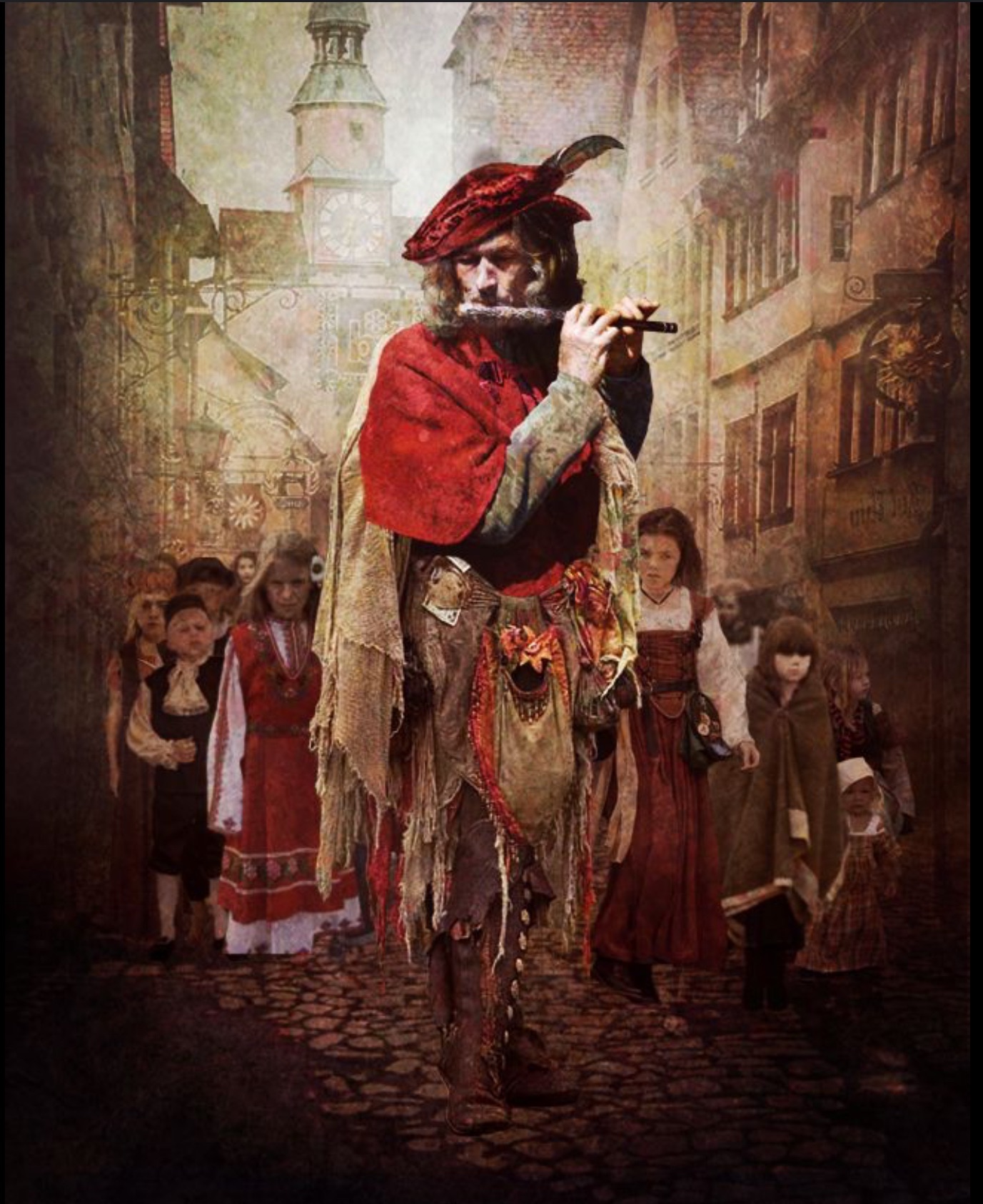
One fascinating fairytale familiar to most children is that of the Pied Piper. Like most of the Grimm Brother’s tales, this story also comes from Germany during the Middle Ages. A stranger arrives in a quaint German village. The gentleman scares away a plague of rats and then lures away the children while whistling a tune on his pipe. The story may actually has some basis in fact.
The story takes place in 1284 in the village of Hamelin in Lower Saxony in Northwest Germany. This area of Germany was undergoing a rapid change both socially and economically. It was becoming a center of Christianity, with pagan settlements disappearing from its borders. It was booming economically having become the home of the Hanseatic League, an alliance of trading partners in the Northern European cities. Hamelin was becoming the place to be, to thrive and to survive in Germany. However, the city had a rat problem and piper was the man hired to deal with the issue. For his services he was to be paid 1,000 guilders. He played his pipe and lured the rats out of Hamelin and drowned them in the River Weser, but something unexpected happened. The mayor reneged on his promise to pay.
Instead of the 1,000 guilders, the mayor offered the piper only 50. The piper was obviously angry. In retaliation, the piper was said to have determined to steal away the town’s children as revenge. As the story is told, this was said to have happened on June 26, 1284. The piper changed from his brightly, multicolored clothing into an all green suit and lured away 130 children using his pipe music to a local cave and they were never seen again. Another story says that the children were led to a hill where they entranced into jumping off.
Research into the story of the Pied Piper of Hamelin in the 20th and 21st Century has produced several plausible theories for how this story may have actually happened in the town of Hamelin, Germany in the late 13th Century. One such theory suggests that the children may have suffered from some form of mass psychogenic illness which created a dancing like mania among them. Another suggests that the Pied Piper is a symbolic character used as a symbol for the outbreak of the bubonic plague in the town that killed the children and that the story was created to help explain the excessive grief the people could not verbalize.
One last theory relates the Pied Piper as being a recruiter for young people to go to Eastern Europe to help spread Christianity. Researchers have studied surnames that appear within and around the town of Hamelin in the 13th Century and found the same surnames in the Baltic Sea region and further east around the same time. They hypothesize that this suggests significant emigration from Hamelin to Eastern Europe and the Baltic region at same time in the late 13th Century and late Medieval period. Thus, they believe the story is allegorical rather than factual.
What do you think?

Discover more from Author. Political Analyst. Family Historian
Subscribe to get the latest posts sent to your email.
 Author. Political Analyst. Family Historian
You must be logged in to post a comment.