Blog

Immigration: A Historical Analysis Part 2

I want to now look more closely at each time period. We will look at a comparison of the nations who sent colonists first—France, Spain, and England. We will consider the various settlements and we will consider what the owners of the companies who sent settlers knew about the “New” World. This is particularly interesting because I think many have simply believed that people got on a boat and had no idea what they were heading into. That isn’t quite right. I will explain.

These were not blind expeditions into an entirely unknown wilderness. Prior to the foundations of the permanent colonies, European nations had accumulated much information about the Atlantic and Pacific coastlines. Here are the dates of the explorations:

1513 — Ponce de León → Florida
1528 — Narváez → Florida/Gulf Coast
1539 — De Soto → Southeast
1540 — Coronado → Southwest/Great Plains
1559 — Tristán de Luna → Pensacola
1562 — Ribault → Florida/South Carolina
1564 — Laudonnière → Fort Caroline
1565 — Menéndez → St. Augustine
1584–1587 — Roanoke
1607 — Jamestown
1620 — Plymouth

And there’s an especially interesting distinction here: exploration and colonization weren’t the same thing. Ponce de León, De Soto, Narváez and Coronado were primarily conducting expeditions—some for exploration, some for conquest, wealth, territorial claims, or finding settlements. St. Augustine, Roanoke, Jamestown and Plymouth represent the next step: attempting to establish communities that would remain. In fact, St. Augustine was founded in 1565—42 years before Jamestown and 55 years before Plymouth.

I think this makes for a fascinating transition: the people who eventually would become “settlers” weren’t arriving in an unexplored land. European explorers had been mapping, describing, claiming, fighting over, and attempting to colonize portions of North America for more than half a century before Jamestown.

Another important fact to remember is that often the information passed on to the monarchies involved was either flawed, wrong, or was slanted to encourage more investment from the corporations behind the settlements and/or expeditions.

Exploration Period: 1514-1620 Who Were They & Where Did They Explore

The term “immigrant” isn’t truly appropriate for this time period because the people who would ultimately arrive in North America were chosen by a monarch, colonial governor/proprietor, religious organization, etc. No one showed up at the castle and asked to be sent and there was no application process.

These monarchies or corporate leaders had a specific objective for the settlement.

  • establish a military foothold
  • claim territory for the crown
  • compete with another European power
  • establish a trading post
  • find valuable resources
  • establish an agricultural colony
  • spread Christianity
  • Create a permanent settlement
  • Provide an outlet for particular religious communities

Let’s consider the major explorations during this time period and what discoveries those produced. I don’t think most of us would remember, nor would have been able to place these on a timeline. I don’t recall being taught the explorers in a timeline, but rather by who they were and what they explored.

The earliest exploration has been highly disputed despite the fact that we named the North American Continent after him. Amerigo Vespucci’s explorations of Central and South America are more documented and, thus, considered more accurate than this travels to North America. For this reason, we won’t look at those.

The first firmly documented exploration happened in 1513 by Juan Ponce de Leon. He landed in Florida and explored the Panhandle. Eight years he returned with a colonizing expedition, but that failed because of conflict with the native population. In 1528, Pánfilo de Narváez, also from Spain landed near Tampa Bay, but the mission fell apart. Then in 1536, Álvar Núñez Cabeza de Vaca would set out again for Florida. There were three additional explorers from Spain who would follow Cabeza de Vaca and they would all spend about eight years exploring the Southern U.S. before reaching New Spain.

New Spain was the enormous Spanish colonial territory that included Mexico, California; much of the present-day southwestern United States; Florida; and other territories at various times. California was incorporated into the Spanish colonial world much later than the initial conquest of Mexico. Let’s take a look at the dates of the explorations that led to New Spain:

1521 — Spain conquers the Aztec Empire and establishes the core of New Spain in Mexico.

1530s–1540s — Spanish exploration moves north. Those include expeditions by explorers Nuño de Guzmán, Hernán Cortés, Francisco de Ulloa, and Juan Rodríguez Cabrillo who explored the Pacific coast and Gulf of California.

1542 — Juan Rodríguez Cabrillo explores the Pacific coast of present-day California for Spain.

1579 — Sir Francis Drake, an English expedition, reached the Pacific coast, probably somewhere in present-day California or Oregon, though the exact landing site remains debated.

At about the same time (1539-1543) Hernando de Soto was exploring the U.S. Southeast, including Florida, Georgia, the Carolinas, Alabama, Mississippi, Arkansas, Louisiana, and possibly Texas. It was one of the most extensive explorations into the southeastern interior. De Soto’s exploration reached the Mississippi River in 1541.

From 1540 to 1542, Francisco Vasquez de Coronado explored the Southwest and Great Plains while searching for the legendary Seven Cities of Cibola and other rumors of great fortunes. Garcia López de Cárdenas explored Arizona and discovered the Grand Canyon. Between 1540 and 1565, there were four more explorations of the Southeastern U.S. Spanish exploration essentially ended in 1565 with the establishment of a permanent settlement of St. Augustine. Founded by Pedro Menédez de Avilés in 1565, St. Augustine was the first permanent settlement.

France began exploration in 1562 with the explorer Jean Ribault. He scouted out the Atlantic Coast of Florida, Georgia, and South Carolina, establishing Charlesfort in South Carolina. Of course, this would later become Charlestown and finally Charleston. In 1564, René de Laudonnière also explored Florida and established the a settlement known as Fort Caroline in what is now Jacksonville.

It’s important to know that there was a war between Fort Caroline and St. Augustine in 1565 which began prior to the establishment of St. Augustine. Obviously, the French did not want a Spanish settlement so close to them. Fort Caroline was associated with French Huguenots (Protestants), although not everyone there was necessarily Protestant. France wanted a foothold in North America for strategic and commercial reasons, while the Huguenots also saw Florida as a place where they could establish a community outside Catholic France.

Spain already regarded Florida as part of its claimed territory. More importantly, Florida’s Atlantic coast was strategically important because Spanish ships carrying wealth from the Caribbean and Mexico passed through the Florida Straits and along the coast on their way back to Spain. A French fort nearby could potentially threaten that traffic.

The two expeditionists would face off in May 1565. Menéndez arrived in Florida in August with roughly 800 people. When the Spanish encountered the French near the St. Johns River, neither side immediately fought a decisive battle. Menéndez eventually sailed south and established St. Augustine on September 8, 1565, approximately 35–40 miles south of Fort Caroline, but this was not an end to the war.

Ribault decided that the French needed to eliminate the Spanish settlement before it could become established. On September 10, he took approximately 600 men aboard his ships and sailed south toward St. Augustine. He left a much smaller force behind to defend Fort Caroline.

Then nature changed everything. A powerful hurricane struck the Florida coast. Ribault’s fleet was scattered and many of the ships were wrecked far south of St. Augustine. The French soldiers who survived were stranded along the coast. Menéndez became aware that Fort Caroline was poorly defended. They easily captured Fort Caroline.

On September 20, 1565, Menéndez marched approximately 400–500 Spanish troops overland from the St. Augustine area toward Fort Caroline. They attacked the fort while most of its able-bodied defenders were absent with Ribault. Fort Caroline fell. Most of the French defenders were killed; some inhabitants escaped, including René de Laudonnière.

The next important explorations involved the coast of North Carolina. Three English explorers would do reconnaissance on the North Carolina coast. Philip Amadas and Arthur Barlowe began their expedition in 1584 on behalf of Sir Walter Raleigh. They reported back to Raleigh about the Outer Banks, the region, and its inhabitants. Trading with the Native Americans began right away. Amadas and Barlow would take 2 Natives back to England with them. They were Manteo and Wanchese. They would have the men speak to the Raleigh and others about the prospect of a permanent settlement. Unfortunately, they were overly optimistic which created false expectations. Amadas and Barlowe were followed by Ralph Lane who would establish a settlement called Roanoke. This settlement was to be an exploratory and military colony, but problems persisted with resources that only England could provide. The first settlement failed.

In 1587, a second attempt was made by John White. This time the settlement included families. The group that arrived on Roanoke was larger than the first. Raleigh sent seven ships with 600 people. It was still considered a military/expeditionary colony. The goals of the settlement included occupying the territory, seeking precious metals and stones, and establishing a base from which English Privateers (and pirates) could attack Spanish shipping. This is a story most of us know…The Lost Colony. There has been much investigation of Roanoke in the past few years. You can find some wonderful videos on YouTube about what they have discovered about what happened the settlers after White left for England to obtain more provisions.

Another attempt by England was not made until 1607. The Virginia Company would arrive on the James River. The Jamestown settlement was established. It was comprised of 104 men and boys. There were 40 soldiers, 35 gentlemen, artisans, and laborers. The settlement did not yet allow women because they believed it would be better to have a solidly established settlement prior to bringing women. It was also because they wanted this group of men to explore further to locate a safe harbor, find a navigable river, choose defensible ground, find fertile land, investigate resources, establish/maintain relationship with natives, and even to continue looking for a route to the Pacific Ocean. Obviously, they thought the area was much smaller than it is.

Another misconception concerns the Natives. Most, I think, probably thought that the English showed up to be surprised by the Natives, but that is not the case. They already knew that they were there. The Virginia Company had explicit instructions about the Indigenous peoples. The Roanoke Colony, as we know, had a relationship with Algonquian-speaking communities. The Jamestown colonists immediately encountered the Powhatans. What these settlers did not fully understand was the size of these groups and their political systems; their territorial boundaries; alliances between tribes; seasonal movements; agricultural methods; as well as their war fighting abilities.

After almost a large number of colonists died in the first winter, a second group was sent. This group included women. This made the Jamestown Settlement successful. HINT: men stink on their own! LOL

The last group of explorers searched out the Northeastern U.S. and parts of Canada. From 1609-1610 Samuel de Champlain, a Frenchman, explored the northeastern interior and strengthened French claims and knowledge of the area. This was followed by Dutch explorers beginning in 1614 who scouted the Hudson River and New Amsterdam (New York City). The area of settlement became known as New Netherland. Trading was a primary goal of this settlement.

In 1620 the English sent the Mayflower to the area of Massachusetts where they would establish the Plymouth Colony. This followed extensive reconnaissance of the coastline prior to the Mayflower’s departure from England. Unlike the Jamestown settlers, the Plymouth colonists did not land knowing about the area in which they would live. This was because they landed in the area of Cape Cod. The National Park Service says that there were three separate expeditions of the surrounding area prior to establishing a settlement. They knew that they needed to secure an area that had fresh water, food, a suitable settlement location that would provide security.

The families who came on the Mayflower were unlike those in St. Augustine, Roanoke, and Jamestown. These colonists were comprised of what they termed “Saints”— members of a Separatist congregation from Leiden (you know them as Pilgrims)— and “Strangers”— individuals seeking economic opportunity, English families, and people brought along because of their skills as artisans, craftsmen, and other skills needed in the colony. The total passengers were 102.

The earliest European “immigrants” were not just people moving from one place to another. They were carefully assembled populations of soldiers, farmers, craftsmen, religious groups, merchants, and adventurers chosen by governments and companies for specific purposes. These men, and later the colony’s leadership, would continue to decide who would come as they populated colonies rather than single settlements. You will see how this changes in the next post.

I realize this has been a long post, but I think it is important to consider these various periods of immigration. You will notice that I did not yet discuss the North Atlantic Slave Trade which began in 1620. I plan to address that in a separate post so that I can handle it alone from the rest of the time periods because it affects the coming time periods.

I hope that you have learned something you did not know or did not realize about the very earliest days of the U.S.A. I hope that you will subscribe to my site so that you can receive notification when the next post is posted, and that you will share it your friends.

Enjoy the rest of your week and your weekend.

God Bless!

US Immigration: A Historical Analysis Part One

I spent some time thinking about what my next series would be about. I wanted a series that would be interesting, educational, and, perhaps, thought provoking. When I taught political science at our local university, I taught on this very subject. I had my students pick countries that they would research immigration law and write a paper and do a presentation on each country. It was always a thought provoking class because we don’t normally talk about the immigration policies of other nations in comparison to our own. Most don’t truly understand what our policy is. We’ve heard about various VISA types but we don’t understand them. We’ve heard of GREEN CARDS but don’t understand the requirements for obtaining and keeping one. Most of us don’t know what is required to become a US Citizen.

My plan is to start with the history of immigration in the United States and then move on to other issues like those mentioned above and discuss thoroughly the issues of immigration. I think readers will find this truly interesting. That, of course, is my goal.

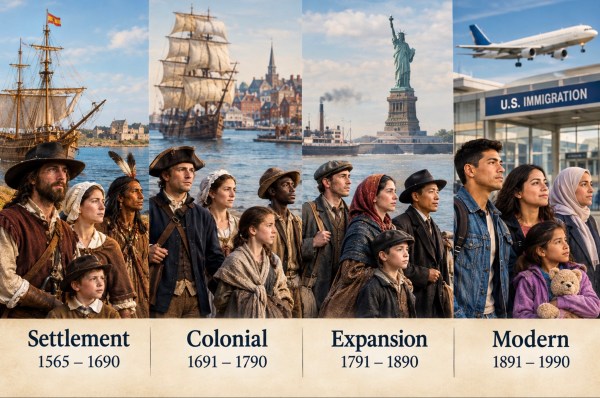
First, I will cover the history of immigration utilizing 4 time periods: Settlement (1565-1690); Colonial (1691-1790); Expansion (1791-1890); Modern (1891-1991). These time periods cover the changing dynamic of immigration from the very earliest human arrival in the “New World”. Keep in mind, I know people were already here. I am part Muskogee Creek, so I am well aware that this world was not new and that those already living here lost any control they had over their land when people began to arrive. For them, we are all illegal. But even they weren’t here always. They came across the Bering Strait from Siberia and other parts of Asia, though that was thousands of years ago, but they were new comers at one time. Immigration has always been a part of human life. The question is with a population of the US being 342.9 million people when do we have enough? Is there a time when we should cut off all immigration into our country? We are already dealing with homelessness, hunger, and other issues of over population and poverty. When do stop taking people in and start encouraging other nations to keep their people and change their systems so that they don’t want to leave?

Immigration in the United States: Four Eras That Tell a Very Different Story

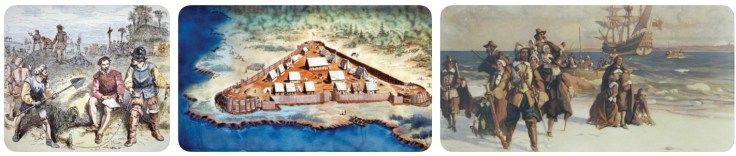
Illustration of early settlers in a historical landscape with agriculture and animals.

When Americans talk about immigration, it is easy to imagine that the United States has always had something resembling today’s immigration system—visas, legal categories, border inspections, deportation, and a distinction between legal and illegal entry. It hasn’t. For most of American history, there was little or no federal immigration policy at all. The meaning of “immigrant,” who was welcome, who was excluded, and what constituted illegal entry changed dramatically over four centuries.

A useful way to see that evolution is to divide American immigration history into four periods:

  1. Settlement: 1565–1690
  2. Colonial: 1691–1790
  3. Expansion: 1791–1890
  4. Modern: 1891–1990

These periods also reveal an important point: the people coming to America were not all the same type of immigrant. Some were wealthy merchants and entrepreneurs. Others were farmers, artisans, religious refugees, indentured servants, enslaved people, or desperately poor laborers. And the government did not treat all of them alike.

I. Settlement: 1565–1690 Before There Was a United States Immigration Policy

The first period is perhaps the most difficult to call “immigration” in the modern sense. There was no United States government, no federal border, no American citizenship and no national immigration law. Instead, European powers were establishing colonies on land already inhabited by Indigenous peoples.

The newcomers came primarily from:

  • Spain
  • England
  • France
  • the Netherlands
  • smaller numbers from other European countries

They came for very different reasons. Some were:

  • soldiers and administrators
  • explorers
  • missionaries
  • farmers
  • tradesmen and craftsmen
  • merchants
  • investors
  • religious settlers
  • indentured servants

And some arrived as enslaved Africans, whose movement to the Americas was forced rather than voluntary immigration.

The Spanish established St. Augustine in Florida in 1565. English settlement followed at places such as Jamestown and Plymouth. Dutch colonists established New Netherland, while French settlements developed along the St. Lawrence and eventually throughout the Mississippi Valley.

There was no immigration policy, not in the modern sense. The controlling authority was generally the European crown or colonial proprietor, rather than an American federal government. England, Spain, France and the Netherlands determined who could establish settlements in their respective colonies. Colonial governments could also impose their own requirements.

In other words, the question wasn’t generally: “Does this person have a legal right to immigrate to the United States?” There was no United States to immigrate to. The question was more likely: “Does this person have permission from the colonial authority to settle here?”

There was considerable economic diversity. Some settlers had substantial resources and were investors or merchants. Others came with almost nothing.

One particularly important group was indentured servants. A person could agree to work for a specified period—often several years—in exchange for transportation to America, food and shelter, and eventually freedom and, in some cases, land or wages. Thus, the early colonies weren’t populated exclusively by wealthy Europeans seeking opportunity. A significant portion of the European population consisted of people seeking a new life because economic opportunities were poor at home.

What about “illegal immigration”?

This is where modern terminology becomes misleading. There was no federal concept of “illegal immigration.” A person could certainly violate colonial rules by entering or settling without permission, but there wasn’t a nationwide immigration enforcement system comparable to the modern one. Enforcement was primarily local and colonial. A person who violated colonial law might be:

  • denied permission to settle,
  • expelled,
  • arrested under another law,
  • returned to a ship,
  • or simply remain undetected.

There was no U.S. Border Patrol, federal immigration court or federal deportation system.

II. Colonial America: 1691–1790 Immigration Becomes a Major Part of Colonial Society

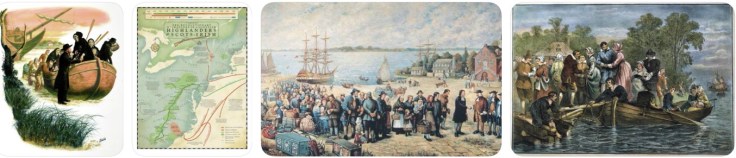
Illustration of a group of individuals arriving by boat to shore, surrounded by tall grass.
Screenshot

By the eighteenth century, immigration had become an essential component of population growth. The colonies increasingly attracted people from throughout Europe. Among the important immigrant populations were:

  • English
  • Scots
  • Scots-Irish
  • Germans
  • Dutch
  • French Huguenots
  • Swiss
  • Welsh
  • smaller groups from other European countries

Pennsylvania provides an interesting example. Pennsylvania actively attracted immigrants. William Penn envisioned Pennsylvania as a place where people of different European backgrounds could settle. Germans, Scots-Irish, Quakers, Mennonites and other religious groups arrived in substantial numbers. Philadelphia became one of the most cosmopolitan cities in colonial North America.

Who were these immigrants? Again, there was no single “immigrant type.” There were Farmers and agricultural families; Germans and Scots-Irish came looking for land; Craftsmen; Carpenters, blacksmiths, weavers, shoemakers and other skilled workers were valuable to developing communities; Merchants and entrepreneurs. Port cities attracted people with capital and commercial connections. There were also religious refugees because of persecution or restrictions throughout Europe.

Indentured servants continued to come under contract to wealthy to pay for their transportation. Most of these people were poor Europeans. The slave trade continued. Of the 12.5 million Africans sold to slave traders about 10.7 million survived the passage. Of those approximately 400,000 were brought to the US.

These categories matter because it is inaccurate to describe colonial immigration simply as either “rich people” or “poor people.” Both were present.

Did the colonies restrict immigration? Yes—but restrictions were generally colonial rather than federal. Colonies could impose rules concerning:

  • settlement
  • religion
  • political loyalty
  • poverty
  • public assistance
  • indentured servants
  • enslaved people
  • disease and quarantine

One important issue was whether a colony would have to support poor immigrants who arrived without sufficient resources. That concern would remain part of American immigration policy for centuries.

What constituted illegal immigration at this time? There still wasn’t a comprehensive national concept of illegal immigration. A person could violate colonial law or arrive without the permission required by a particular colony, but the enforcement mechanisms were fundamentally different from today’s. There was no national immigration database and no federal border enforcement system. Colonial governments relied on:

  • local officials
  • sheriffs
  • courts
  • port authorities
  • poor laws
  • ship regulations

III. Expansion: 1791–1890 The Era of Open Immigration—and the Beginning of Federal Restrictions

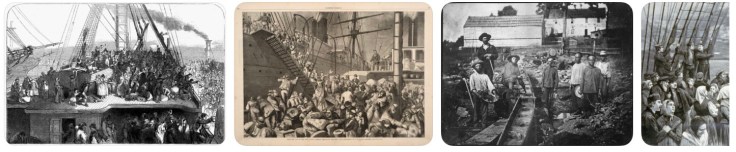
Historic engraving of a large group of people aboard a ship, depicting maritime life.

This period produced one of the biggest transformations in American immigration history. The United States went from having very little federal immigration regulation to developing the beginnings of a national immigration system.

It also experienced enormous immigration. Between 1820 and 1890, millions of immigrants arrived, with federal records beginning systematic reporting of immigrant arrivals in 1820. In the early republic, immigration was essentially open. The Constitution gave the federal government authority over naturalization, but that wasn’t the same thing as establishing a comprehensive immigration system. The Naturalization Act of 1790 established the first federal naturalization rules and restricted naturalization to “free white persons” of good moral character who had lived in the United States for a specified period. That distinction is important: Naturalization law was not the same thing as immigration law. A person could enter the country without facing the modern visa system and still be unable—or initially ineligible—to become a citizen.

The Alien and Sedition Acts

In 1798, the federal government temporarily became much more restrictive. The Alien Act authorized the president to remove an alien considered dangerous to the United States, while the Naturalization Act increased the residency requirement for citizenship from five to fourteen years. These measures were controversial and the Alien Act was not renewed. For much of the nineteenth century, therefore, the United States had an enormous amount of immigration without a comprehensive federal system controlling who could enter.

Immigrants who came during this time period were varied and where they came from changed during the course of the century. We will consider them during specific time periods.

Early and middle nineteenth century

Large numbers came from:

  • Ireland
  • Germany
  • Britain
  • Scandinavia
  • other parts of northern and western Europe

The Irish famine of the 1840s produced a particularly dramatic migration. Many immigrants were poor, but again, “poor” didn’t mean “unskilled.” Immigrants included:

  • farmers
  • laborers
  • craftsmen
  • engineers
  • merchants
  • professionals
  • entrepreneurs
  • domestic workers
  • skilled industrial workers

America’s expanding cities, canals, railroads, mines, factories and farms created enormous demand for labor.

The Chinese migration

Chinese immigration became particularly important in the West. Chinese immigrants worked in:

  • mining
  • agriculture
  • restaurants and laundries
  • small businesses
  • railroad construction

The Library of Congress notes that Chinese laborers played important roles in mining and construction of the Central Pacific Railroad. 

The late nineteenth century

By the 1870s–1890s, immigration increasingly included people from southern and eastern Europe. Between 1870 and 1900, nearly 12 million immigrants arrived, driven by economic hardship, famine, land shortages, political persecution and the attraction of American economic opportunity.

“Illegal immigration” in the sense we know of it really became a national issue in the late nineteenth century. This is one of the most important distinctions in American immigration history. Before federal restrictions existed, entering without a federal immigration visa wasn’t “illegal immigration” because there was no such federal requirement. The concept changed as Congress began creating categories of people who were prohibited from entering.

1875: the beginning of federal exclusions

The Page Act of 1875 was the first federal immigration law to exclude particular categories of people. It targeted, among others, Chinese laborers arriving under certain circumstances and Chinese women suspected of prostitution. 

1882: More Significant Change

The Immigration Act of 1882 excluded categories including:

  • certain convicts
  • people considered likely to become public charges
  • people with certain mental or physical conditions

And the Chinese Exclusion Act of 1882 suspended immigration of Chinese laborers. The Library of Congress describes Chinese exclusion as the first federal legislation specifically excluding a racial/ethnic immigrant group on such a broad basis.

1885: contract labor

Congress also prohibited the immigration of many contract laborers. Thus, by the end of the Expansion period, America was moving away from the nineteenth-century model of: “Come to America and find work” toward: “Certain categories may enter; others may not.” That distinction created something recognizable as illegal entry.

Initially, enforcement was relatively primitive. There was no modern Border Patrol. Federal officials increasingly inspected immigrants at ports, and people found inadmissible could be denied entry or returned. But enforcement away from ports was extremely limited. A Congressional historical account notes that until the late nineteenth century there was little federal legislation restricting immigration; by the early twentieth century, border enforcement consisted of only a very small number of mounted inspectors. Consequently, someone who successfully entered the country and disappeared into the population could be extremely difficult for the government to locate. This would become a major issue in the next period.

IV. Modern Immigration: 1891–1990 From Open Immigration to a Complex Federal System

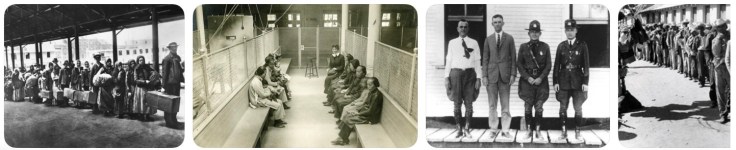
Historical photograph of a group of people waiting in line inside a building.

The year 1891 is an excellent dividing line because immigration administration became substantially more centralized at the federal level. The United States now had a national immigration bureaucracy. This period eventually produced:

  • immigration inspection
  • exclusion categories
  • deportation
  • quotas
  • visas
  • border enforcement
  • immigration detention
  • refugee programs
  • employment restrictions
  • legalization programs

In other words, the basic architecture of modern immigration policy emerged during this period.

1891–1920: Mass immigration meets increasing restriction

The great wave of immigration continued. Millions arrived from:

  • Italy
  • Russia
  • Poland
  • Austria-Hungary
  • Greece
  • the Balkans
  • Germany
  • Ireland
  • Britain

Between 1880 and 1920, approximately 4 million Italians came to the United States alone. Many were poor agricultural workers or laborers. But they also included:

  • craftsmen
  • shopkeepers
  • businessmen
  • professionals
  • political refugees
  • religious minorities
  • entrepreneurs

When we think of immigration during this time period, most will think of Ellis Island which became the famous symbol of this era. Immigration wasn’t simply “welcomed”. This period saw increasingly extensive federal screening. Immigrants could be rejected for reasons including:

  • disease
  • criminal history
  • certain political beliefs
  • prostitution
  • likelihood of becoming a public charge
  • other statutory grounds

The government was increasingly asking: “Who should be allowed to become part of American society?”

1921–1965: The quota era

After World War I, American immigration policy changed dramatically. The Emergency Quota Act of 1921 established numerical restrictions, followed by the Immigration Act of 1924, which created the national-origins quota system. The system strongly favored immigration from northern and western Europe and sharply reduced immigration from other regions. Asian immigration was also severely restricted. This was a profound departure from nineteenth-century immigration.

Instead of merely asking: “Is this person admissible?” the government increasingly asked: “How many people from this particular country or national origin should be admitted?”

But there was an important exception. Mexico Mexican immigration followed a different trajectory. American agriculture and industry repeatedly needed Mexican workers. During World War II, the United States created the Bracero Program, allowing Mexican workers to enter temporarily under employment contracts. The program ultimately brought nearly 4.5 million Mexican workers into the United States over its duration.

There was also contradiction. American employers wanted the labor. Immigration restrictions limited the supply of legal workers. The result was an increase in unauthorized Mexican migration. The Library of Congress describes growers actively seeking undocumented workers when legal immigrant labor was insufficient.

Finally, illegal immigration becomes a major enforcement issue. This is where the modern meaning of illegal immigration becomes much more recognizable. The government now had:

  • immigration inspectors
  • immigration records
  • deportation authority
  • border patrols
  • exclusion laws
  • numerical quotas

And therefore it could identify people who had entered or remained in violation of federal immigration law.

Operation Wetback

In 1954, the federal government launched Operation Wetback, a major enforcement campaign aimed primarily at unauthorized Mexican immigrants. The Library of Congress reports that approximately one million people were deported or returned during the operation, although historical estimates and the circumstances of many of those returns have been debated. This illustrates another major development: Illegal immigration was no longer primarily a question of being turned away at the port. It increasingly involved locating people after they had entered and settled in the United States.

1965: Another Immigration Revolution

The Immigration and Nationality Act of 1965 fundamentally changed the system. It abolished the national-origins quota system and replaced it with a preference structure emphasizing:

  • family reunification
  • skilled workers
  • other employment and humanitarian categories

The change had major demographic consequences. The Library of Congress notes that immigration after 1965 increasingly came from Asia, the Mediterranean, Eastern Europe, Latin America and Africa.

US Citizenship & Immigration Services likewise notes that the 1965 amendments replaced the national-origins system with a preference system emphasizing family reunification and skilled immigrants. This is one of the most important transitions in the entire history of American immigration.

1980–1990: Refugees, legalization and enforcement

The final decade of our period produced another important combination: more humanitarian admissions + stronger enforcement + legalization. The Refugee Act of 1980 established a general framework for refugee admissions and the Immigration Reform and Control Act of 1986, commonly called IRCA, attempted to address unauthorized immigration from several directions simultaneously. The IRCA:

  • legalized many undocumented immigrants who had been living in the country since before 1982
  • created a legalization program for certain agricultural workers
  • imposed sanctions on employers who knowingly hired unauthorized workers
  • increased immigration enforcement

This is significant because Congress was acknowledging a recurring problem: Unauthorized immigration had become deeply embedded in the American labor market and communities. In response, the government combined enforcement with legalization.

The Immigration Act of 1990 further increased overall immigration levels, revised exclusion and deportation rules, created new nonimmigrant categories and established Temporary Protected Status. The Act moved away from simply increasing the number of VISAs and created a system of who would be allowed to obtain one. There were three major categories:

  • Family sponsored immigrants
  • Employment based immigrants
  • Diversity immigrants

Employment based immigration was expanded significantly. The ACT created a much more elaborate system of admitting people based upon their occupations. Eight different types of immigrants were created:

  • People with extraordinary skills and abilities
  • Outstanding professors and researchers
  • Multinational executives and managers
  • Professionals with advanced degrees
  • Skilled workers
  • Professionals
  • Certain religious workers
  • Immigrant investors

As you can see, the ACT explicitly recognized workers with skills, education, professional expertise, and those who could invest in our country. The EB-5 program was established an immigrant investors program. This was created for those who bring foreign investment and/or create jobs. The goal was to not simply bring in workers, but to create pathways for highly skilled workers, professionals, and investors.

The Diversity Immigrant Visa program was also created in the 1990s. It is often referred to as the Diversity Visa Lottery. The purpose was to provide opportunities to people from countries that historically had low levels of immigration to the United States. The difference was that this program did not require a family or employer to sponsor them. Instead they would be selected by a lottery.

However, the family sponsorship system was also expanded. Specifically, Congress increased Visa availability for spouses and minor children of lawful, permanent residents. This continued the basic principle established by the Immigration & Nationality Act of 1965.

Additionally, the ACT created a Temporary Protected Status which allows nationals of designated countries experiencing certain conditions like armed conflict or environmental disaster to remain temporarily in the United States rather than being returned to a country where conditions were unsafe. This was a major expansion of the humanitarian side of immigration law.

Exclusion and deportation were also revised by the ACT. Congress updated the grounds for excluding people from entry and for deporting people already in the country. The requirements for becoming a citizen were changed also. The naturalization decision-making was transferred to the Immigration & Naturalization Service. It established an administrative naturalization process and ended judicial naturalization.

Finally, the ACT addressed illegal immigration. These changes were important in light of what the IRCA of 1986 had done. The 1986 law specifically attacked unauthorized immigration by employer sanctions, increased enforcement, and legalization (amnesty). The ACT of 1990 did not repeat the legalization program. Instead, it restructured legal immigration while revising the exclusion and deportation provisions.

CONCLUSION

By 1990, the US had gone from essentially no national immigration system to a highly structured system in which the federal government distinguished among immigrants based upon family relationships, education, occupation, extraordinary ability, investment, nationality, humanitarian circumstances (including refugee and asylum protections), and others.

Today, our system is one of the most complex immigration systems in the world. Legal permanent immigration is still largely based on family relationships and employment, with the Diversity Visa program providing a smaller additional pathway. Additionally, the federal government maintains extensive systems for border control, visa screening, detention, removal and enforcement against illegal immigrants. The system we have today is a highly regulated federal process in which the government determines not only who may enter, but why they may enter, how long they may stay, whether they may work, and what circumstances may eventually allow them to become a permanent resident or citizen.

We must remember that these rules and regulations are LAW codified within the Federal Code. Doing anything that is adverse to those LAWS is, by definition, ILLEGAL. Breaking the law of the United States by coming across our border without a VISA or other lawful immigration status makes that person an illegal immigrant and a criminal. That is why when these people are caught and detained they must appear before a judge who determines what will happen. Law abiding citizens who believe in the enforceability of our immigration laws should not be vilified. Sanctuary cities and those who do not support our immigration laws should be. We as a nation should consider immigration as a privilege, not a right. We absolutely cannot take everyone. We cannot take into our country the 7.65 billion people living in the rest of the world, not that all of those want to come, but if a third wanted to come that is still 2.6 billion people…BILLION, not million. We have to use common sense when setting the numbers allowed to come and who we will allow to come. That is not unreasonable. Instead, perhaps, we ought to work with those citizens in those nations were problems exist to change them so that those people don’t want to leave rather than bringing them here.

Tell me what you think.

May God continue to bless our nation. We need it.

Stylized signature of the name 'Deborah' with a small bee illustration.

Rethinking ‘The Road Not Taken’ and the Choices That Shape Us

In 1915 Robert Frost wrote this poem while he was living in England. It was published in the Atlantic Monthly in August 1915 and later included in one of his collections titled Mountain Interval. Most of us have heard this poem, learning it in our secondary education; however, it is often misinterpreted as a celebration of taking the unconventional path in life. While that is a legitimate interpretation, in my opinion, there is a different consideration of its meaning.

As the poem begins, the narrator is reflecting back on a time when he was taking a walk in the woods and encountered diverging paths. He’s sad that he has to make a choice. He examines both paths ultimately choosing the more aesthetically pleasing and with less obvious use. It is interesting that the poet says, “…looked down one as far as I could to where it bent in the undergrowth; then took the other, as just as fair” meaning he did not immediately observe the path he chose. He took the path that he hadn’t looked at first. Only after walking down that path did he see that it was beautiful and untrodden. Can you think of a time when you had a choice and you decided to take the choice you hadn’t fully investigated? It’s impulsive and could lead to a result unintended.

Looking back a Robert Frost’s life at the time this poem was written, we learn that this poem came out of a friendship Frost had begun with English poet Edward Thomas. The two often took walks in the woods together. It was Thomas’ habit of agonizing over the route they should take that lead to Frost writing this poem. Thomas often regretted the path they chose, wishing they had taken the other which he felt might have been more interesting. Frost wrote the poem as a gentle joke, though he later remarked that he “wasn’t quite sure whether [Thomas knew] I was kidding or not”.

The poem actually says that the two paths are really not that different. It is only as he looks back later in life that he imagines that he took the one less traveled by and that it was okay. What we can see here is that we often remember things differently than they actually were. In the beginning he describes the paths:

”Though as for that the passing there had worn them really about the same…” And then,

”And both that morning equally lay in leaves no step had trodden black.”

Frost says that he might go back and take the other path, but then, maybe he won’t because life takes us away from that need or even our availability to go back. In that way, the road we took was probably okay in the end. If we consider the meaning of the poem, we can see several messages:

  1. Life requires choices.
  2. We cannot know what difference the alternative choice would have produced.
  3. We construct a story about our choices in hindsight.

The title of poem is often mistitled, too. Many call it, “The Road Less Traveled”, when it is in fact titled, “The Road Not Taken”. You cannot dismiss the importance of the difference. It isn’t about the road the traveler chooses; it is about the one he did not choose. It is about all the possibilities we lose when we make the choice.

  • The career we did not pursue.
  • The relationship we did not enter.
  • The place we did not visit.

As you enter into a new week, what choices will you have to make? Will you choose to go to church, or to stay home? Will you call that long lost friend to reconnect, or let it go? Will you join that club you’ve been thinking about, or given in to your shyness? Everything we do in a week is comprised to choices. Whatever choices you make, commit to not looking back with regret and resolution as our poet did. You can never know what the outcome of making the other choice would be, and perhaps, there might be a good reason behind not making that choice. Just own it. The choices may come back around so that you can make a different decision in the future, but you cannot bank on that.

I hope that your decisions will be the right ones for you. I hope you will choose to follow Jesus because He will never let you down. Faith in knowing that He has your best interest at heart and that He loves you and will always love you is so fulfilling. I have seen His hand in my life, and I am convinced that there is no better way to live than under the divine protection and will of an almighty God. If you’d like to know more, DM me.

Have a great week & God bless!

You Know My Name, But Do You Really Know Me?

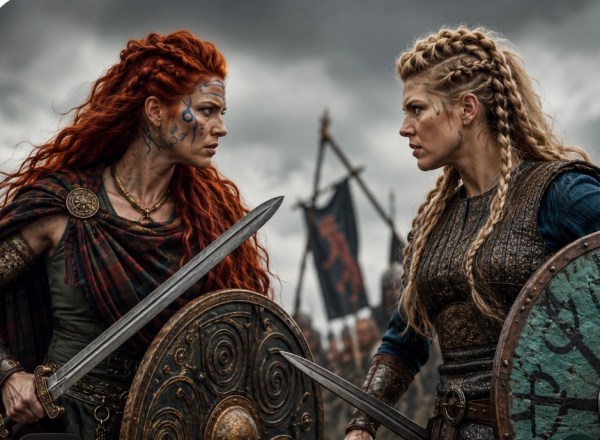
For my last post in this series, I decided to cover two heroines who you may have heard of; you may even think you know about them. But do you? One of these women is a historically documented warrior, while the other’s existence has not been established. While it would be far more interesting if these ladies had encountered each other in battle, one lived in the first century while the other lived in the 12-13th century. So, who are these ladies? Boudica and Lagertha, of course. You may have guessed that from the AI image.

So which one actually existed and which one are we unsure of? Boudica has been historically documented while Lagertha’s existence has never been confirmed via archeology or other historical record. We know about Boudica by virtue of the written record from two Roman historians—Tacitus, who wrote in the late first century/early second century, and Cassius Dio who wrote in the third century. On the other hand, the stories of Viking Shield Maiden Lagertha (also known as Lathgertha, Ladgerda or Lathgertha) come from the Saxo Grammaticus’ Gesta Danorum (Deeds of the Danes) which was written between the 12-13th century. Scholars, according to World History Encyclopedia, consider the early Saxon histories to be fictionalized. The History Channel’s series Vikings made Lagertha a household name in spite of her questionable authenticity. Nevertheless, it is likely that a shield maiden like Lagertha existed and makes a comparison to Boudica interesting.

Boudica, as I have stated above, lived during the first century CE in eastern Britannia in the area of Norfolk. She was the queen of the Iceni tribe. The Iceni were a British Celtic-speaking people who were not necessarily a single, extended family group, but rather a large tribal community made up of numerous local groups and settlements. A terrific series called Britannia on Prime Video presents this period of time and similar Celtic tribes. Roman historians spoke of them as the Icenci and the Eceni. They were known to be prosperous having good soil for agriculture and access to the North Sea for trade with Europe. They were not considered primitive for the time period. They were known for sophisticated metalworking and long-distance trade routes. One of the most significant pieces of evidence of the Iceni was the Snettisham Hoard which was discovered in Norfolk. These treasures included gold and silver torcs, jewelry, coins, ingots and other decorated metalworks. In spite of this, however, their economy was primarily agricultural. They raised wheat, barley, cattle, sheep, pigs, and horses.

The Icenci had an organized political structure prior to the Roman occupation of Britain. They also coined their own money. Boudica came to power after the death of her husband King Prasutagus. He is described as more of a “client” king—a local ruler who governed his people while recognizing Roman supremacy; however, that relationship broke down. One of the fascinating characteristics of the Iceni people was that women were allowed to possess significant wealth and status which is reflected in the graves discovered in the area of Norfolk. While not being a matriarchal community, women were allowed to own property and political power, like Boudica. Unfortunately, the Roman invasion of 43 CE under the leadership of Claudius would change the Iceni.

As we have noted, the Iceni initially cooperated with Rome, but that relationship broke down following the death of Prasutagus. At the time of his death, he provided for the transfer of his wealth to be divided between his two daughters and Rome. However, Rome was not happy with that arrangement. According to Tacitus, Roman leaders seized the wealth and property of the Iceni, publically beat Boudica, and assaulted her daughters. The Iceni, lead by Boudica, revolted. They were joined by other tribes like the Trinovantes which was based in the area of modern day Essex and Colchester. Boudica and her forces destroyed the Camulodunum, Londinium, and the Verulamium through fighting and fire. Evidence of these battles has been found around Colchester, London, and St. Albans. Destruction was so severe that archaeologists have termed the rebellion the “Boudican Destruction Horizon”.

Despite their initial success against Roman forces, the Iceni people were ultimately defeated by Suetonius Paulinus. Boudica would die soon after this. According to Tacitus, Boudica committed suicide by poisoning; Dio, on the other hand, claims that she died due to illness. The region once controlled by the Iceni was brought firmly into the Roman provincial system. Eventually their identity disappeared being assimilated into Anglo-Saxon Britain. Boudica was more than a warrior woman who took on the enemy; she was a symbol of the people she represented; a group of people who were more developed technically, wealthy, and politically sophisticated than many tribes of the day. However, Boudica was not an outlier in her community; the community produced other women like her. We know about her because she was a queen who faced Rome head on.

How does Lagertha compare to Boudica? According to legend, Lagertha would have lived in nineth century Norway. Like Britain, Norway was not yet a unified country. Additionally, women were not “subordinate housewives”. They could possess wealth and political power within a traditional, patriarchal society. Men and women in Norway had different social roles, but historical evidence reflects wealthy and powerful people of both sexes. Marriage was a family and economic alliance. The woman’s family negotiated the marriage and it typically joined together two kin groups, though women were not distanced from their own families. Women often brought substantial wealth and property into marriages. In many cases, she could retain ownership of the property she brought into the marriage. This is quite different from European marital traditions. Moreover, women could divorce their husbands under certain circumstances like abuse, neglect, or insults towards her or her family.

In Norwegian culture, the center of power was within the household, and the farm was the key economic unit. They did not look at this circumstance as women doing women’s work and men doing men’s work. Women managed the critical economic operation. While the men were out raiding and trading, women were producing textiles, tending to livestock, managing household resources, producing and preserving food, caring for their children, and much more. Archaeologists have discovered large numbers of graves of Viking women that contained keys, a symbol of household authority.

A prime example of how Norwegian wealthy women could possess great power is contained in the Oseberg burial site which dates to around 834 CE. In this burial site, archaeologists discovered two women buried in an enormous ship along with a wagon, sledges, beds, chests, textiles, household equipment, elaborate carvings, animals, as well as the ship itself. While we do not know who these women were, it is evident that they were of high status. There is also archaeological evidence of women being buried with weapons like swords, axes, spears, and arrowheads. This is not to say that Norwegian culture was to be admired; the culture possessed dark aspects which negatively affected women. Specifically, women could be captured in battle, enslaved, sexually abused, sold, or killed in circumstances we would find reprehensible.

So what does this tell us about our character Lagertha? Saxo had similar women upon which to create Lagertha. She embodied the independent, wealthy, politically influential and, sometimes, physically imposing Viking woman and then he pushes it to the extreme. Lagertha does it all and then some. She doesn’t just have influence inside her home; she becomes a ruler and commands warriors; ultimately killing the man who stood between her and political independence.

Boudica and Lagertha could not have existed if not for the liberal, cultural ideals and practices of their communities. Boudica and the Iceni could have set the course for the women of Scandinavia having ten to eleven centuries between them. The comparison is quite compelling and inspiring. While other societies treated women as property to be controlled and of lower intellectual abilities, both of these societies provided, if not encouraged, women to participate in similar activities as men.

I hope you have enjoyed these posts about influential women of antiquity. I have greatly enjoyed writing about them. I am now considering what my next series will be about. If you have any ideas, please comment!

God Bless!

Teuta and Zenobia: Revolutionary Queens Who Challenged Rome

You may wonder why I chose to write about “bad girls”. I think most of us understand that we each have a dichotomous nature and that, often times, we are guided by one side more than the other. Some of us can balance the two; but, others have more difficulty. I have experienced that difficulty myself. I can sometimes be more headstrong and independent than I should be. I have learned over the years when those traits are more positive than negative. Other times it has been my greatest failure. It is my intention to relate women who are little known to us, but who made an impact on our world, whether good or bad. I will leave that interpretation and judgment to the reader.

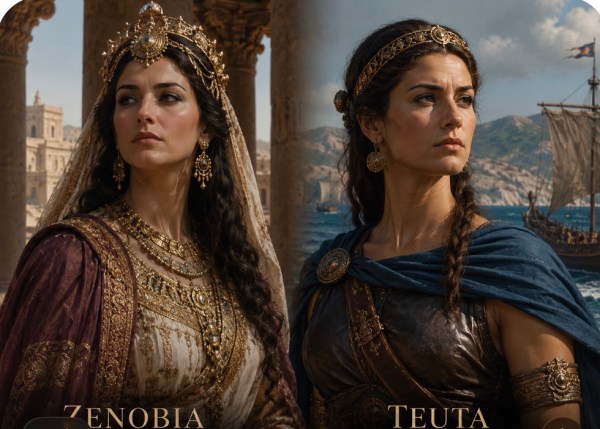
The first woman is Teuta who lived in 3rd Century BC in the Eastern Roman Empire. Teuta was the queen regent of the Ardiaei tribe in Illyra, which includes parts of the Western Balkans including Albania, Montenegro, and the southeastern coast of the Adriatic Sea. She ruled the tribe from 231 to approximately 228-227 BCE.

Teuta assumed control of the monarchy on behalf of her young step-son, Pinnes, after the death of her husband King Agron. She is best known for her defiance against Rome which demanded she stop attacking Roman shipping and the murder of a Roman envoy. Teuta was a pirate known for intercepting Roman ships and stealing their wares for the support of her people. Her tribe along with other Illyrian tribes were known as warriors and pirates. Their economy, which struggled, was based on agriculture, mining, and commerce, primarily with Greek colonies.

Teuta utilized their navy to control the Adriatic trade routes and to capture coastal cities like Phoenice. Teuta’s fierce advocacy for her people led to conflict with the greater Roman Empire eventually leading to the First Illyrian-Roman war in 229-228 BCE. Teuta lost the war and was forced to surrender and cede territory. She is an enduring heroine in Albanian culture because they consider her a protector of their traditional ways of life.

Another such bad girl was Zenobia, a warrior during the 3rd Century AD in Syria. Like Teuta, Zenobia obtained power by becoming the regent to her oldest son, Vaballathus. She ruled from 267 to 272 AD. In 270 AD Zenobia launched an invasion of the Roman Empire that increased her kingdom. By the mid part of 271, her realm from Ancyra, central Anatolia, to Upper Egypt. She declared her son emperor and she claimed the title of empress which essentially declared the independence of Palmyra (modern day Syria).

Both of these women placed the security and well-being of their kingdoms above allegiance to the Roman Empire. They were willing to fight personally for their people when they could have passed the problems on to others. Moreover, both women had the benefit of ruling on behalf of their sons. Neither would be known had they not been widowed young and been placed in the position of needing a regent for their young children. Their personalities and characters were just what their kingdoms needed at the time they needed it. They were independent, courageous, physically and mentally strong, and faithful; though their adversaries considered them as criminal, treasonous harlots.

The historical significance of these two women should not be ignored. For the time periods in which they reigned women were considered property in most situations. Women were never consulted on their opinions much less their ideas on how to secure and improve the lives of their people. Women during antiquity were usually nothing more than objects to be admired, wives to secure the positions of their husbands, and property to be controlled. They lived among other leaders like Hannibal, Spartacus, and Julius Caesar. The courageousness of these women should be shared with our daughters so that they understand how women have been influential in their world, especially in antiquity which their history books will never include.

Have a great week!

For more information on Teuta and Zenobia:

https://www.ancient-origins.net/history-famous-people/fierce-queen-illyrians-teuta-untameable-003126

Of course there’s always Wikipedia and YouTube!

Bad Girls: A Look At the Female Rebel Throughout History

We took a look at women through history who sacrificed their comfortable lifestyles to participate in war. The British would say these women were “Doing Their Bit”. But, as we saw, these women did their service in disguise. It was incredibly dangerous for men in battle much less women. Men saw women differently in history. Women were seen as people to do be protected and honored as wives and mothers. We don’t care about this position today. At one time, the military would not take men who were their mother’s only child or they would let them go if they had siblings killed in battle making him the last child. We valued family then and the government knew that no parent should have to lose all their children to war.

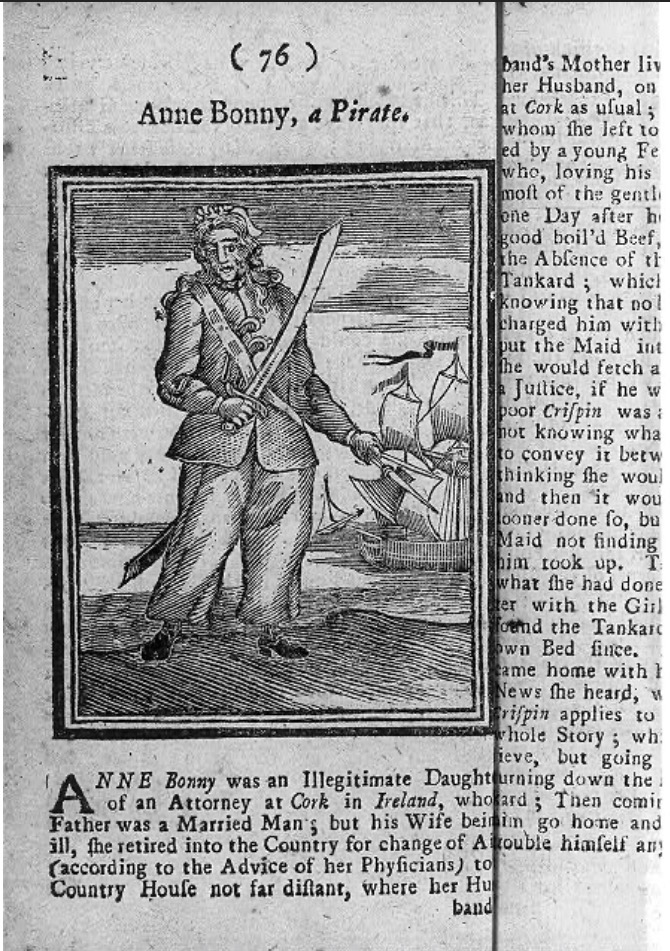
Now we are going to look at female rebels over time. These women are different from the previous ladies we looked at. While these women have similar courage, they didn’t just rebel against the stereotype of women being the weaker sex, but they rebelled against the nation’s government in any way they could. The first rebel we’re going to look at is Anne Bonny.

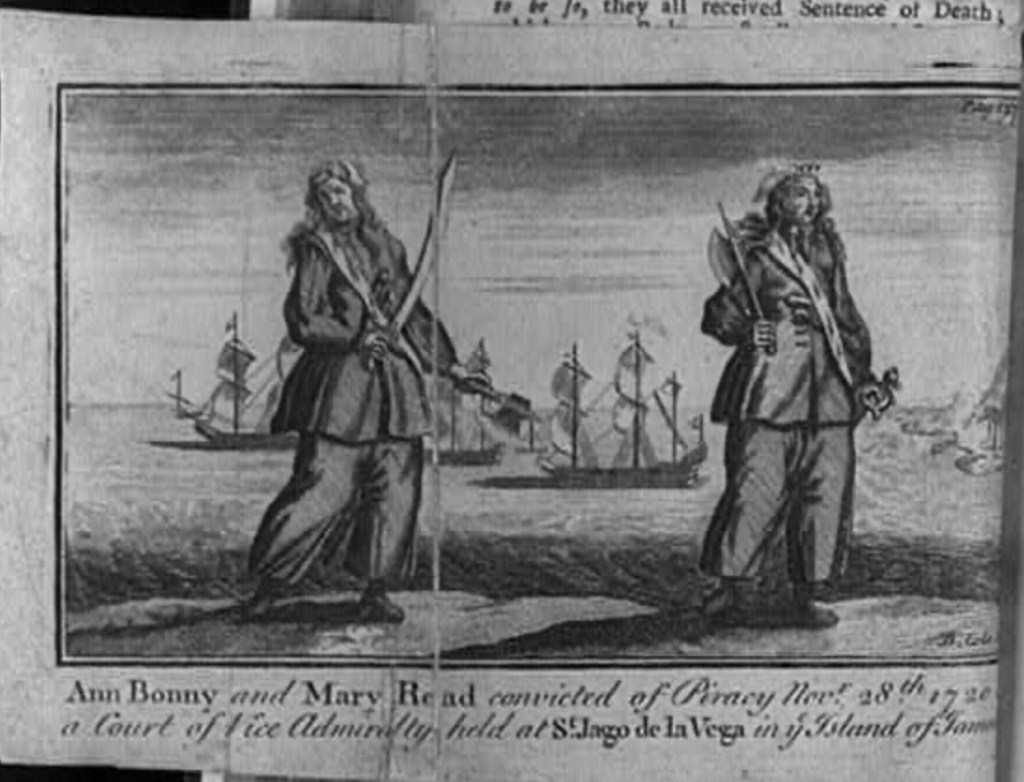
Anne is an interesting example of the rebel female. She was born about 1698 in Kinsdale, Ireland. Anne is one of the most famous pirates in history, mainly due to her gender, although she was only a pirate for about two years. Anne was a pirate in the Caribbean during the end of the Golden Age of Piracy. Women during this time had few rights, but those on pirate ships were able to gain some level of freedom and equality. Many pirate ships had democratic leadership. Everyone had a vote on key issues. They would vote for their leaders, meaning the captain, first mate, and quartermaster could all be voted out of their positions if the majority of pirates voted to do so. They would have a written document that laid out what the rules were for their ship.

Screenshot

Anne’s family went through a difficult period when she was young and her father was discovered to have impregnated a servant while she was working in his family’s home. Anne’s father, who was a lawyer, was damaged by the scandal. He disguised Anne as a boy and brought her to live in his home; however, when the duplicity was discovered William decided to move the family to Charles Town (now Charleston), South Carolina. Around 1718 Anne met James Bonny. They married quickly thereafter. Disapproving of his daughter’s choice, he disowned Anne. Anne and James decided to go to New Providence Island in the Bahamas. James Bonny was a confidential informant on pirate activity for Governor Woodes Rogers. It was here that Anne met the pirate known as Calico Jack (real name John Rackham). She quickly fell in love with him and decided to abandon James Bonny.

Screenshot

Whether Bonny ever killed anyone is unknown, though there is a story about her that relates a situation wherein Bonny beat a rapist so badly that he was hospitalized. It is believed that this altercation happened in her late teens. She was a pirate for 69 days, not much time to earn the reputation that she has. This notoriety is most likely attributed to her being a woman. Recently Bonny and Reid have been described as lesbians. This is a modern interpretation. I believe they are grasping at any straws they can get to prove that homosexuality is more common than we have been led to believe in attempt to mainstream the alternate lifestyle.

There were statuescommissioned for Bonny and Reid in 2020 and was unveiled at the Execution Docking in Wapping, London. The statues did not remain on display due to complaints from various groups suggesting that, by celebrating these women, they are promoting piracy. The statues were taken possession of by a local resident.

Bonny and Reid have been characters in numerous movies and plays. Here are just a few.

Hope you have a great week! Stay tuned for more bad girls in the coming weeks!!

”Therefore put on the full armor of God, so that when the day of evil comes, you may be able to stand your ground, and after you have done everything, to stand.” Ephesians 6:13 NIV

Uncovering the Real Mulan: Historical Warrior Women of China

If you enjoyed the movie Mulan as much as I did, I bet you wondered if the story had any basis in fact. I wasn’t educated on the early military history of China, or Asia for that matter, in any depth. In researching female warriors for this series, I decided to research “Mulan” and find out if there were any epic warrior women. I greatly enjoyed the process. Here is what I discovered.

While Mulan is based upon the Chinese “Ballad of Mulan” which dates to the 5th or 6th Century, the character may be based upon three such warriors in Chinese history. Historians tend to agree that Mulan is a literary character, but they point to the following three women who parallel her legend as potential models for the ballad.

First is Fu Hao who was both a high priestess as a military general. She was one of the many wives of Wu Ding, king during the Shang Dynasty (cir. 13th Century). The entirety of Fu Hal’s life comes from the contents of her tomb, which was unearthed in 1976, rather than from written records. Archeologist Zheng Zhenxiang discovered more than 500 bone objects known as oracle bones. These bones are engraved with the story of the queen’s life. It might be interesting to note that King Wu Ding promoted cooperation with the neighboring tribes. To do so, he married a woman from each tribe. He had 64 wives! Although Chinese kings and emperors were strong, able men, at this time China had a semi-matriarchal society and profited from the slave trade. Fu Hao used both to her advantage.

Fu Hao owned her own land which contributed to her wealth. Oracle bones indicated that she offered the king valuable tributes during her life. The King often called upon Fu Hao to conduct rituals and to offer sacrifices to the ancestors. During this period of Chinese history two activities were of the utmost importance—religious rituals and battles. Fu Hao was engaged significantly in both.

Discovered in her tomb were many weapons and inscriptions on the oracle bones reflect Fu Hao’s role in military battles during the Shang Dynasty. In fact, Fu Hao was responsible for the defeat of the Tufang, a neighboring tribe that had been the enemy of the Shang for generations. Fu Hao defeated the Tufang in a single, decisive battle. The defeat of neighboring Yi, Qiang and Ba tribes would follow. She is described as having been responsible for conducting the largest ambush in Chinese history. She had command of over 13,000 soldiers. Generals Zhi and Hou Gao served under her. She was not the only female to serve in the military; the oracle bones revealed the records of over 600 who participated in the military during this time. The temple Mu Xin was dedicated to her posthumously.

Second is Princess Pingyang of the late 6th- early 7th Century CE. She was the only daughter of Emperor Gaozu of the Tang Dynasty and his wife Empress Taimu. The princess was instrumental in her father becoming emperor. During the fall of the Sui Dynasty while her husband and father were away fighting, Pingyang used her position and wealth to feeding the peasantry and to recruit rebel leaders. At the age of 28, she was successful in raising an army of almost 70,000 men which became known as the “Army of the Lady”. She used her army to capture key cities, to include the Sui Capital of Chang’an, in the Guanzhong region. Because of the contributions, the emperor gave her a military funeral complete with military band and named a strategic pass after her—the Niangzi Pass today was once the Lady’s Pass.

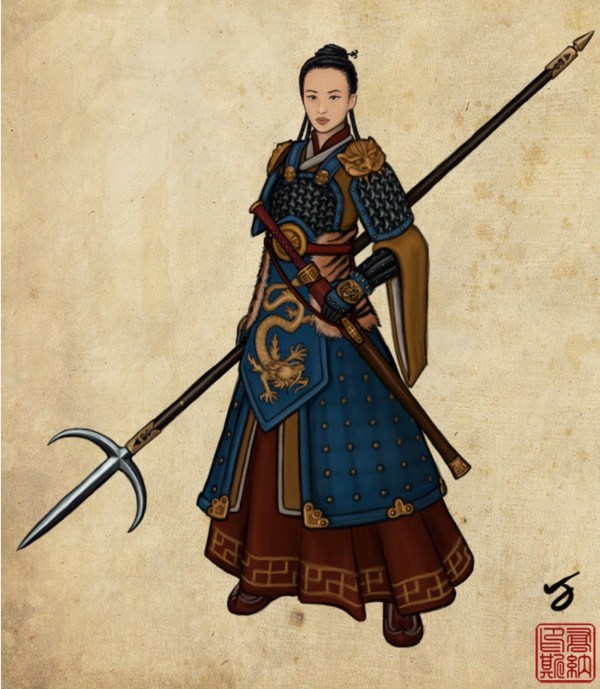
Last we have Qin Liangyu who lived from 1574 to 1648. Qin Liangyu is historically significant because she is the only woman to be officially recorded as a military commander in China’s Twenty-Four Histories. She was well educated in the classics as well as in military arts like archery and horseback riding. After the untimely death of her husband Ma Qiancheng, she took command of the elite White Cavalry. Utilizing warfare that prioritized ambushes and offensive stands in the narrow mountainous passes, she led her troops to victory over the invading forces of Manchu. She made use of her great knowledge of the rugged terrain to out maneuver the larger invading Manchu armies. Moreover, her soldiers incorporated long pikes, poisoned arrow volleys, and lightweight defensive gear to maintain speed and endurance. She also succeeded in putting out rebellions in the southwest and defending the capital of Beijing. For her achievements, Qin Liangyu earned the title “Marquis Zhongzhen”, a title given to her posthumously by the Southern Ming Dynasty. It is interesting to add that Qin Liangyu was quite tall for even women today. Her height has been estimated based upon preserved clothing to be approximately 6 foot 1 one inch. Additionally, she lived and fought into her 60s.

In closing up this series, there are other epic warrior women like Boudicca in 1st Century Britain, Joan of Arc in 15th Century France, and even a more modern Russian woman named Lyudmila Pavlichenko who fought during World War II. I wanted to focus on the lesser known of those ancient of warrior women. What I discovered during this research process was that women have always involved themselves in conflicts throughout history. While their numbers are far less dramatic than the millions of men who have fought over the centuries, these women are no less honorable, courageous, and skilled than those male counterparts, much like the women who serve in our military today. We must never diminish their contributions to our world and to history.

I am now contemplating what my next series will be. Stay tuned!

Epic Warrior Women: Artemisia I, Kicking A— In Ancient Greece

Unlike our previous warrior women, we’ll now go to the ancient world. In the annals of ancient history, few figures stand out quite like Artemisia I of Caria. A Greek queen ruling a Persian vassal state in the 5th century BCE, she personally led ships into battle against her fellow Greeks during the Second Persian Invasion of Greece. Herodotus, known as the “Father of History” and a fellow Halicarnassian, couldn’t help but marvel at her: a woman who joined Xerxes’ massive expedition not out of necessity, but driven by “high-hearted valour” and “manly courage.”

When most of us think of Ancient Greece and Rome, we would not think of a woman going into battle in our first thoughts. We know of strong ancient women like Cleopatra, but one who both ruled a region and fought isn’t what we normally think of. Most history classes aren’t going to focus on these women, choosing instead to focus on the majority…men. In fact, Alexander the Great’s sister, Cynane (358-323 BCE) was also a warrior, having fought along side her famous brother and she even masterminded an attack that would place her daughter on a throne by force.

Artemisia ruled Halicarnassus (modern-day Bodrum, Turkey) and the nearby islands of Cos, Nisyros, and Calydna. With a Halicarnassian father, Lygdamis, and Cretan mother, she was a blend of Greek and regional heritage. After her husband’s death, she assumed the tyranny (rule) herself, even though her son Pisindelis was of military age. She wasn’t forced to participate in Xerxes’ campaign—she chose to, contributing five ships to the Persian fleet. Those vessels were said to be the best in the entire navy after the elite Sidonian contingent, and her counsel to the king was considered the wisest among all his allies. 

Artemisia’s reputation as a naval commander was forged in the crucible of the Greco-Persian Wars. She took part in the Battle of Artemisium in 480 BCE, a series of naval clashes off the coast of Euboea that coincided with the famous stand at Thermopylae.

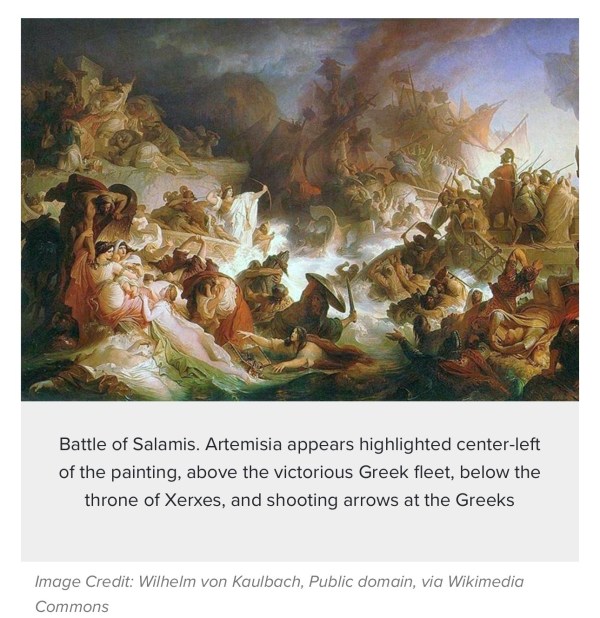
Her defining moment came later that year at the Battle of Salamis. Xerxes had captured Athens, but the Greek fleet, primarily Athenian and Spartan-led, had withdrawn to the narrow straits between the island of Salamis and the mainland. The Persian commanders overwhelmingly urged an immediate naval assault to finish the Greeks. Artemisia alone advised caution.

She urged Xerxes, via his advisors, to spare his ships and avoid battle at sea. Her reasoning was shrewd and prophetic: the Greeks were superior seafarers—“as men are to women” at sea, in her words. Xerxes had achieved his main objective by burning Athens; thus, the rest of Greece would likely submit without further risk. Fighting at this point could endanger the entire fleet. “If he succeeds [with land forces under Mardonius], the honor will be yours,” she added. “If he fails, it would be no great matter as you would be safe.” 

Xerxes respected her but chose not to give weight to her opinion. The result was a decisive Greek victory that crippled the Persian navy and shifted the momentum of the war.

Even in defeat, Artemisia shone. According to Herodotus, when her ship was pursued by an Athenian vessel during the chaotic retreat, she rammed and sank a friendly Calyndian ship—either by accident or clever calculation. The Athenian pursuer, seeing her attack what he assumed was an enemy vessel (or mistaking her for a Greek defector), broke off the chase. Xerxes, according to witnesses, remarked that his men had become women and his women men, praising Artemisia’s gallantry while lamenting the performance of his other commanders. Some accounts suggest he even inquired whether she had sunk an enemy ship. 

Artemisia wasn’t just a fighter; she was a voice of reason in Xerxes’ war council. After Salamis, she again counseled the king wisely on his next steps, reinforcing her image as one of his most reliable allies. Herodotus portrays her with genuine admiration, repeatedly highlighting her intelligence, bravery, and independence in a world dominated by male rulers and warriors.

This stands in stark contrast to typical ancient attitudes toward women in power. While many Greek sources viewed female rulers with suspicion or as aberrations, Herodotus treated Artemisia as a exemplification of courage. She was the only woman among Xerxes’ naval commanders, yet she earned his esteem through deeds rather than birthright alone.

Artemisia I’s story survived primarily through Herodotus’ Histories, with mentions in later writers like Plutarch, Pausanias, and Polyaenus. She became a symbol of female agency and martial prowess in a male-dominated era.

In an age when most women in power are remembered for intrigue or tragedy, Artemisia stands out for her competence on the deck of a trireme and in the war council. Herodotus marveled at her; Xerxes respected her; and history has preserved her as one of antiquity’s most remarkable warrior queens.

•  Modern accounts in Barry Strauss’ The Battle of Salamis or general histories of the Greco-Persian Wars.

Artemisia’s ships may have been outnumbered and ultimately defeated at Salamis, but her reputation sailed on, undefeated.

If you have any warrior queen bee that you’d like me to research and write about, please leave a comment. I’d be happy to consider her.

God bless!

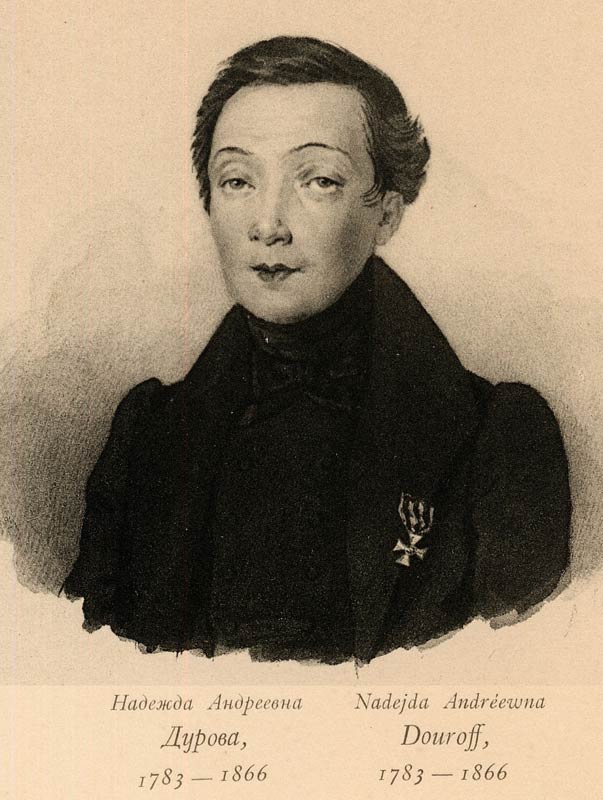
The Unmasking: Nadezhda Durova, Russia’s Calvary Maiden

Our next female warrior is probably someone you have never heard of. I know I had never heard of her until my 19th Century Russian History course at Florida State University when I was a graduate student. My primary focus in graduate school was Russian/US relations. It was a phenomenal time to be studying this field because our relationship was in transition. The Cold War had ended, Reagan was out of office, and Boris Yeltsin was in power in Russia. It seemed like a good time to me to get a handle on where the former USSR had come from. I only had a cursory knowledge of Russian history, so this course seemed ideal.

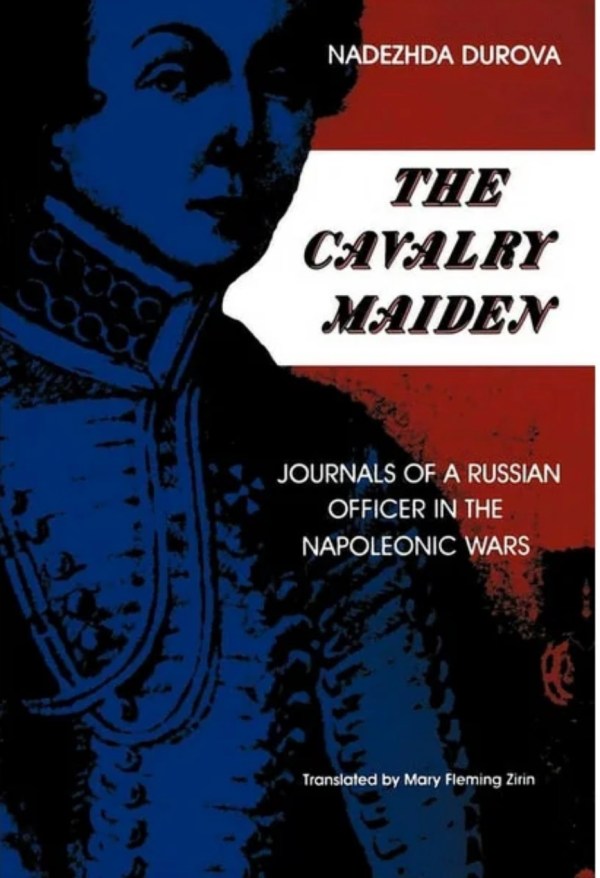
One of the novels assigned to us to read that semester was The Calvary Maiden, the story of Nadezhda Durova. Nadezhda, like Francis Elizabeth Quinn, was a young woman who disguised herself as a man in order to fight in the Russian Army. The Calvary Maiden is her autobiography which she published under the pen name Aleksandr Aleksandrov. Unlike Francis Quinn, Durova lived her adult life as a man. She admitted to liking women’s clothes on others, but that she never felt comfortable in them. However, she did marry and have affairs with men.

So who was Nadezhda Durova? Nadezhda Adreevna Durova was born on September 17, 1783, in the Kama-Volga region of Russia. She was born into a military family and she was taught martial arts as a child. Her mother Aleksandra Aleksandrova came from a wealthy, landowning family in Ukraine. Her father was a Hussar soldier and was known to be handsome and charming. Hussars were elite, mostly European light calvary soldiers famous for their speed, daring tactics, and ornate uniforms. Renowned for scouting, raids, and shock charges, they evolved into a dashing 18th-century European staple, while Polish “Winged Hussars” functioned as elite heavy shock cavalry. (Wikipedia) Against her father’s wishes, Aleksandra and Andrei Durova eloped.

Aleksandra was excited when she discovered she was pregnant. She dreamed of a bouncing, robust baby boy; however, she gave birth to a little girl with tufts of dark brown hair. Aleksandra did not take to her daughter. She often became incensed by her crying. On one occasion, her mother would throw her out of a moving, carriage window because she would not stop crying. Andrei was horrified by his wife’s actions. He rescued his daughter and took her on horse back for the rest of their travels. After that, Andrei would not allow his wife to have any input into Nadezhda’s parenting and discipline. He called her Nadya (or Nadia) for short. So, it isn’t surprising that Nadia would find more acceptance in her father and his soldier friends than in her mother. In our country we would simply call her a tomboy. Two more daughters and, finally, a son would be born to the Durova family.

As Nadya grew up she became more and more fiercely independent. The more this happened, the more her mother attempted to break her. She was forced to spend significant hours sewing and crocheting. Nadya had little talent or interest in either. She preferred to ride her horse Alchides through the countryside. Nadya had matured into a young woman who deeply resented women like her mother and one who wasn’t especially attractive. Her face had been scarred by a harsh case of chicken pox and was overly tanned from long hours in the sun. Because of time spent in the presence of her father’s men, her manners were anything but girly. However, she was NOT without male suitors.

Because she was desperate to flee her mother’s home, she accepted a marriage proposal from a junior court clerk named Chernov. In 1803 she gave birth to a son named Ivan. However, Nadya would leave her family not long after her son’s birth and would return to her family. According to her memoirs, she was deeply unhappy. In 1806 she would again escape her family by running away and never returning. She cited a “family disappointment” as the cause for her departure. She also talks about how, at age 16, she left home and, for the first time, dressed as a man in order to join a regiment of Cossack soldiers. She writes that she fell in love with a Cossack soldier and left with him when she was 18, formally separating herself from her husband and son.

At another time when she was disguised as a man, she fought in the Polish Lancers. It was during this time that she first saw real battle. This was during the Napoleonic Wars. On May 22, 1807, she participated in direct action. The Lancers did not fight as a regiment, but instead they fought in squadrons. Because of her inexperience, Nadya did not understand this and when it was her turn, she joined in every squadron’s assault until an officer noticed what she was doing and admonished her.

It was also at this time that she noticed several French Dragoons surrounding a Russian Dragoon officer and knock him off his horse with a single pistol shot. Nadya lowered her lance and charged. Surprised by her actions, the French Dragoons fled. She gave her horse to that Russian officer to get him to the nearest field hospital for treatment.

She also fought in the Battle of Heilsberg on June 10, 1807, a bomb exploded directly under Alchides, but, miraculously neither was injured. On June 14th, her regiment would participate in the Battle of Friedland. She described the casualties to her side as being over half. All of this time, she was known as Trooper Sokolov. As the war was nearing the end in July 1807, Tsar Aleksander heard rumors about a girl in his cavalry. When asked about Trooper Sokolov, her fellow soldiers only had the best things to say. The Tsar summoned Nadya to St. Petersburg. According to her memoirs, the Tsar was impressed by her and gave her permission to stay in the cavalry. She was awarded the Cross of St. George for saving the life of the Russian officer and commissioned her as a Second Lieutenant. He gave her the privilege of choosing which regiment she wanted to join. The Tsar further provided her with money to purchase new uniforms, equipment, and a direct stipend. Nadya chose the Mariupol Hussars, which was known for the large amount of Russian aristocrats in its ranks. Interestingly, although he knew her to be a woman, Nadya would continue to dress as a man. The Tsar gave her the last name “Aleksandrov”.

Only a few senior officers knew Nadya’s true identity. Rumors continued to circulate about the alleged female cavalrywoman. She was almost discovered during a riding accident. Her horse was thrown head over end and Nadya was knocked unconscious. She awoke just in time. Another soldier was just about to unbutton her blouse so that she could breathe.

Nadya would return to battle during Napoleon’s invasion of Russia in 1812. She was injured during the Battle of Borodino when she received a concussion and her knee was hit by a spent cannonball. Rather than lying in a hospital bed, Nadya offered her services as an orderly. She would also fight to topple Napoleon in 1813 and 1814 and she would receive additional accommodations for her service.

Early on Nadya wrote to her father and admitted to him what she was doing. She told him where she was and what had happened. Her father wanted to bring her home, but Nadya was not interested. In 1816 as the Napoleonic Wars were ending, her father wrote to her and urged her to come home and to help him run the family estate. Nadya decided to retire and to go home. She was a captain.

Bored with farm life, Nadya decided to start writing. Her brother Vasily introduced to her to famous Russian writers like Pushkin. It was Pushkin who gave her the nickname “Cavalry Maiden” in 1863. He had become an admirer of her and of her writing. While The Cavalry Maiden is her most famous work, she also wrote four novels and numerous short stories between 1836 and 1840. Nadya lived the remainder of her life in Yelabuga, a town in the Republic of Tartarstan along the right side of the Kama River in Russia. She died in March 1866 at the age of 83. A statue of her on her horse sits in Yelabuga today as a tribute to their famous citizen. She was buried in her full uniform and with military honors. In the 1940s playwright Aleksandr Gladkov wrote a play called A Long Time Ago dedicated to her. Eldar Ryazanov, a Soviet and Russian film director, screenwriter, poet, actor and pedagogue whose popular comedies, satirizing the daily life of the Soviet Union and Russia, directed the movie The Hussar Ballad which was adapted from Gladkov’s play.

I hope you have enjoyed this story of Nadya Durova. Let me know of any female soldiers/warriors you’d like me to write about!

God Bless!

Frances Elizabeth Quinn: The Irish Girl Who Became a Union Soldier—Five Times


We all know the stories of many of the brave men who fought in the Civil War. We may even be familiar with stories of brave women who served during the war as nurses, but most of us, I would bet, aren’t familiar with a story of the story of the women who also fought. Few stories were as bold, persistent, or downright cinematic as that of Frances Elizabeth Quinn, an Irish immigrant who disguised herself as a man and enlisted in the Union Army at least five separate times. Her determination, grief, and grit made her one of the most compelling female soldiers of the era.

🇮🇪 From Ireland to Illinois: A Childhood Marked by Loss

Frances was born in Ireland and brought to the United States as a small child. Her family settled in La Moille, Illinois. Tragedy struck early—both of her parents died soon after arriving, she and her brother Thomas were separated and raised by different families, a painful fracture that shaped her future (https://en.wikipedia.org/wiki/Frances_Elizabeth_Quinn).

When Thomas ran away at fourteen to join the 52nd Illinois Infantry, Frances—only sixteen—refused to be left behind again.

🪖 A Soldier in Disguise

Frances cut her hair, donned men’s clothing, and enlisted under the name B. Frank Miller. This would be the first of many aliases.

Her enlistments included:

  • Indiana three‑month infantry unit (as B. Frank Miller)
  • 2nd Tennessee Volunteer Cavalry
  • 90th Illinois Infantry (“Irish Legion”)—twice
  • A cavalry division as a teamster
  • Later service under the name Frank Martin as an orderly to General Jeremiah Boyle(Wikipedia)(https://www.researchonline.net/ilcw/unit111.htm)

Each time she was discovered to be a woman, she was discharged—only to enlist again.

⚔️ Battlefield Service and Injury

Frances is said to have been injured twice during her service having fought in both the infantry and the calvary. She was wounded during the Battle of Stones River on December 31, 1862. There she was shot in the shoulder, and her sex was discovered yet again. Later she was wounded in the leg during an attempt to escape. (Wikipedia)

Her resilience was astonishing. Even after injury, humiliation, and repeated dismissals, she kept returning to the fight.

💔 A Sister’s Grief Becomes a Soldier’s Resolve

In April 1863, Frances learned that her beloved brother Thomas had been killed at Shiloh.
This loss devastated her—but it also fueled her determination to rejoin the Union cause.

Under the name Frank Martin, she became an orderly and scout, impressing officers with her courage and effectiveness. She even helped bring Confederate prisoners into Union lines (Wikipedia).

🎭 A Life of Aliases and Reinvention

Frances used multiple identities throughout the war:

Her ability to reinvent herself was both a survival strategy and a testament to her fierce independence.

🌟 Why Her Story Matters

Frances Elizabeth Quinn represents:

  • Women who defied gender norms long before they had legal rights to do so
  • Irish immigrant contributions to the Union cause
  • The emotional power of family bonds in wartime
  • The hidden history of female soldiers, many of whom remain unnamed

Her story is a reminder that the Civil War was not fought only by the men whose names fill the textbooks—but also by determined, courageous women who refused to stay on the sidelines.

This is the first of several posts I plan to write about females in battle.

Have a great week!


Website Built with WordPress.com.

Up ↑

Author. Political Analyst. Family Historian

Stay informed with curated content and the latest headlines, all delivered straight to your inbox. Subscribe now to stay ahead and never miss a beat!

Skip to content ↓