
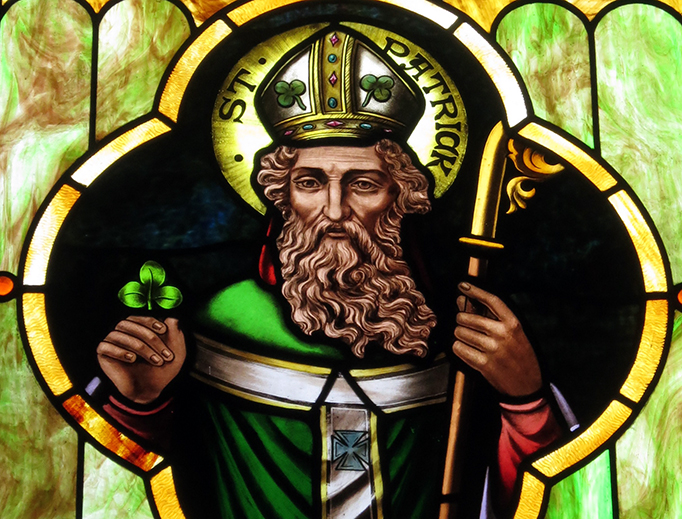
I have always been a huge fan of St. Patrick’s Day mostly because of my Irish roots, but until a few years ago, I knew almost nothing about St. Patrick. I am not Catholic so I had no reason to know anything about him. Of course, I knew the legend about his running snakes out of Ireland, but that was essentially it. Then, my loving mother-out-law (don’t you love that!) went to Ireland and Scotland on a trip to visit the Thin Places and brought back a wealth of information to me about, not only the Thin Places, but also St. Patrick. I was amazed by Patrick’s story, and to be quite frank, I felt shorted by not having known all the information about him before. For myself looking back over my life, I would have found encouragement in his story. In those times when I thought things to be insurmountable, St. Patrick’s story would be one to turn to as a reminder that things never stay bad forever.
So, who was St. Patrick? Patrick, born about 385 A.D. and died March 17, 461 A.D., came from a good family and lived in Roman Britain. His father, Calpurnius, was a deacon in the church. Patrick was not interested in God or the church as a young man. At the age of 16, he was doing what many boys of his age were doing; he was hanging out along the water when an Irish raiding party came along and kidnapped him. They took him to Ireland where he was held captive as a slave. While in Ireland, he was a sheepherder. While tending to the sheep, he began to pray and to seek out God. He chose not to be bitter about his predicament. It was at this time, after six years of captivity, that Patrick said God spoke to him. He ran away, running over 200 miles. He took a boat back to Britain and was captured, spending time in captivity once again. Once released he was reunited with his family and spent a few years with them.
Then one night he had a vision of the people of Ireland calling to him saying, “We beg you, holy boy, to come and walk again among us.”(https://www.usatoday.com/story/news/2025/02/19/who-was-st-patrick-heres-what-to-know-about-the-man-behind-the-holiday-march-17/79194446007/). He knew that he had to go back, but he did not return for 20 years. Between the time of his vision and the time he returned to Ireland, he received training and education in the Christian faith. When Patrick arrived in Ireland, the various pagan religions saw him as a threat to their way of life.
Many scholars believe that the reason the Irish turned to the Christian faith was because Patrick possessed the ability to heal, to raise the dead, as well as other signs and wonders. Without these abilities, it may not have happened in such a large fashion as it did. Historians allege that he consecrated 1000 priests, 200-300 bishops, and converted 40 out of the 150 tribes to Christianity. He is often described as being a humble person, but also generous. He is noted for bringing gifts to chieftains, but also for refusing gifts for himself. Britannica indicates that “he was a humble-minded man, pouring forth a continuous paean of thanks to his Maker for having chosen him as the instrument whereby multitudes who had worshipped ‘idols and unclean things’ had become ‘the people of God.’”(https://www.britannica.com/biography/Saint-Patrick)
There are, of course, legends about St. Patrick. The snakes are just one, but it is probably the most glaringly untrue. It’s unlikely that there were ever snakes in Ireland for Patrick to run out because of the previous ice age which made Ireland too cold. The most popular is the shamrock which St. Patrick used to explain the trinity–three leaves with one stalk=three person in one God. The shamrock is the national flower of Ireland.
Now, you might ask, what is that reference you made to the Thin Places? That’s a great question. I had never heard of the Thin Places until my mother-out-law went on her trip to Scotland and Ireland. I became interested after hearing about it from her, so I went to the YouTube video she told me about. I am going to link two videos on the subject here for you. The first one by Rebecca Friedlander has a full length movie associated with it that is available for a fee. Basically, the Thin Places are places where you can get very close to the heavens or other realms as Ms. Friedlander calls them…so close that it gets thin. Like being on the top of a mountain. Like Mt. Ararat, I would believe because that is where Noah’s Ark came to rest and it is sacred. It is in these thin places where we can go and we can pray and fast to be closer to God. Here is the link to the video. https://youtu.be/j2AftRs-QRc?si=4bvMXH9Egd_Nr0VH And here is another one called “Braving the Thin Places” by a different person. https://youtu.be/-n_IooHy6S0?si=txGcFjPSyMM8OmtM. Both of these ladies speak of the Thin Places in terms of Ireland and Scotland, though I believe that there are Thin Places around the world and not simply limited to Ireland and Scotland. You will notice that when Ms. Friedlander describes the Thin Places, she uses the word “fairies”. This is odd to me for someone who professes to be Christian and who is attempting to put this idea within a Christian context; the two don’t really go together. When I think of what they are talking about, I think of Thin Places as those places where we feel closest to God. I am a mountain girl. I love to stand a top a mountain and gaze out at the vastness of God’s creation. I feel close to Him there and I usually feel a strong urge to talk with God in those moments. Someone else might get that same feeling out on the sea. When I listen to what Rebecca describes, I get the feeling that Thin Places can be a physical place or they can be an emotional place. I also thought about how quantum physicists speak of multiple realities and portals to those realities when I listen to her describe these Thin Places. I would love to hear what you think about these descriptions of Thin Places.
I hope you’ve enjoyed the information about St. Patrick. He is so much more than a singular day of debauchery and deserves our respect and honor for what he brought to our faith. Happy St. Patrick’s Day.
God Bless You All!

Discover more from Author. Political Analyst. Family Historian
Subscribe to get the latest posts sent to your email.
 Author. Political Analyst. Family Historian
You must be logged in to post a comment.