
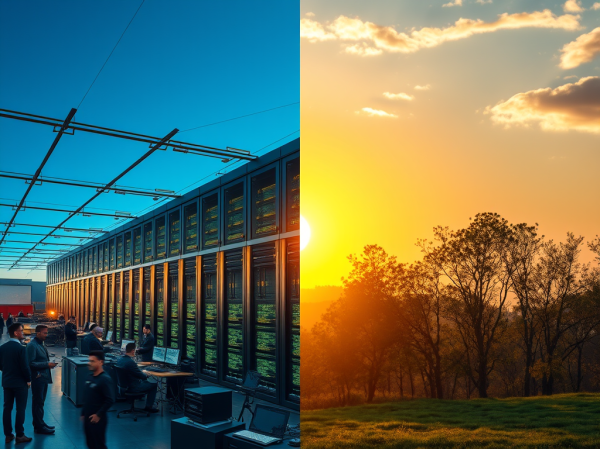
Where I live was recently selected as a potential site of a data center. A local town meeting was held to discuss the matter and people showed up in droves to protest. I immediately got angry because everytime, it seems, that our county has an opportunity for significant growth and revenue generation, the people drive it out. The county was the original site for Disney World, but the “powers that be” ran them off. We now have an amusement park anyway. The county has run off Buck-ee’s, an NHRA track, a car manufacturing plant, and a biofuel plant amongst others. The county, which sits on the Florida border in south, central Georgia, offers many benefits to industry–90% of residents have a high school diploma or college degree, the median age is 34-years old, and has a population over 100,000; however, the median income is only $58,000.00 and 18% of the population live below the poverty line with an unemployment rate of 3.7% in December 2025 (U.S. Bureau of Statistics). Each of these rejected industries or businesses would have brought higher than usual salaries and jobs, but that did not seem to matter.
From my experience much of the rejection of these wasn’t for any good reason. Those “powers that be” seem hell bent on keeping the county small and dependent on a few small corporations to fund our economy. While the county has welcomed a Wal-Mart milk distribution center, Martin’s Bakery, Bimbo’s distribution, and an Amazon satellite distribution center, the county needs more industry to replace those that have either closed or moved. Hard dollars are necessary to generate growth, but the economy is overwhelmingly service driven, which may become unsustainable without a solid hard dollar base.
If residents know this (and they do), why do they consistently reject the very industries which would provide those hard dollars and jobs? First, I believe is a lack of full understanding of the pros and cons of those industries. When the biofuel plant wanted to come, the singular dispute against it was the potential for pollution despite the fact that the county is home to a PCA paper plant. Consider a comparison of a biomass plant and a paper plant:
- Raw Material Sourcing: Paper plants often rely on deforestation, while biofuel plants use agricultural waste or dedicated crops. This particular plant was going to use garbage to generate the biofuel.
- Production Emissions: Paper production typically emits more greenhouse gases compared to biofuel production.
- Water Usage: Paper plants generally consume more water and can lead to water pollution through effluents.
- Waste Generation: Biofuel plants can produce less solid waste, especially if using waste feedstocks.
- Air Quality Impact: Paper plants may release more volatile organic compounds (VOCs) and particulates than biofuel plants.
- Lifecycle Analysis: A full lifecycle assessment often shows biofuels as having a lower overall environmental impact compared to paper.
If we consider the pros and cons of biomass plants, residents should have known that:
Pros:
- Reduces greenhouse gas emissions compared to fossil fuels.
- Can utilize waste materials, promoting recycling and waste management.
- Supports energy independence by diversifying energy sources.
- Creates jobs in agriculture and renewable energy sectors.
- Can enhance rural economies through crop production.
Cons:
- Can lead to deforestation and habitat loss for crop production. This one was not going to be based on trees or crops, but instead on garbage.
- May compete with food production, raising food prices.
- Requires significant water and land resources for cultivation. The plant itself was not going to be huge, but would have provided an alternative source of energy. The county has taken up farm land to install solar panels, which residents have not complained about.
- Production processes can be energy-intensive and polluting, but is less polluting than the paper mill.
- Limited availability of certain feedstocks can hinder scalability.
First, what is a data center exactly. A data center is a building used to house networked computer systems or servers and associated systems such as telecom systems and networking components (switches, routers). Data centers are used by companies to organize, process and store the large amounts of data. “The United States’ position as a leading AI innovator is rooted in its rapidly evolving digital infrastructure. Data centers are the backbone of this expanding digital ecosystem, processing and storing the vast volumes of data required to power AI, the cloud, and other energy intensive technologies.” (https://www.statista.com/topics/10667/data-centers-in-the-us/#topicOverview) The promotion of data centers is advocated by those who want to drive monetary policy to a solely digital system. The blockchain system used by cryptocurrencies requires significant computational power which leads to high energy consumption. To power the mining system, therefore, uses energy which most often comes from non-renewable sources, raising concerns about carbon footprints. Newer systems are attempting to reduce this, but are not yet widely used. Studies have shown that Bitcoin’s energy use is comparable to that of some small countries.
Where do data centers get their power? The primary source of power is electricity generated by oil. To understand why data centers are oil dependent at the current time, we need to consider what components of the center use.
- IT Equipment: Represents the largest portion of energy use, including servers, storage, and networking devices.
- Cooling Systems: Essential for maintaining optimal temperatures consume significant energy.
- Power Distribution: Energy used in transforming and distributing power to IT equipment.
- Lighting: Often overlooked, but contributes to overall energy consumption.
- Uninterruptible Power Supplies (UPS): Provides backup power and can add to significant energy use.
- Infrastructure Management: Energy used for monitoring and managing data center operations.
Some centers use hybrid power systems, utilizing both renewable and non-renewable sources of power, but there is increasing pressure to rely more on renewable energy, but determining just how much energy comes from renewables is difficult to find. One of the reasons for this is because people define the terms differently. In practice, operators usually rely on one of three approaches:
- Renewable energy credits (RECs). Companies can purchase credits representing a set amount of renewable power generation. For example, a business with a 10 MW data center might purchase 10 megawatts’ worth of RECs and claim the facility is “covered” by renewable energy. In reality, this doesn’t mean the electricity entering the facility comes directly from renewables. It only means the company has financially supported renewable generation somewhere else. This is the most common strategy. The fact is that this is a lie. You cannot claim to use renewable energy when all you’re doing is purchasing something that does not exist so that you can make a claim that is not real.
- Adding renewable power to the grid. Some operators, such as Google, fund or build renewable power plants that feed electricity into the grid. The approach increases the overall share of renewable energy available, but the power itself isn’t reserved for the company’s data centers. It’s distributed to any connected home or business. This is the hybrid system.
- Direct renewable sourcing. In some cases, data center operators build renewable power plants and connect them directly to their data centers. Known as “behind-the-meter” sourcing, this approach provides the most tangible link between renewable generation and data center consumption. (https://www.datacenterknowledge.com/sustainability/the-truth-about-renewable-energy-in-data-centers)
Moreover, the situation is complicated by grid itself. In those hybrid systems, it’s impossible to guarantee that the energy flowing into a particular data center is renewable. Even data center operators with behind-the-meter plants face challenges. Many renewable energy sources, like wind and solar, are unreliable due to weather conditions. Only geothermal, oil, and nuclear will provide a steady supply of energy. As a result, many data centers with “behind-the-meter” energy still draw on “dirty” power sources when renewable output dips.
Let’s make another comparison that many can relate to–energy required to charge EVs at charging stations. EVs are often touted as zero-emission vehicles, but that’s not exactly true. The real environmental impact depends on where the electricity comes from, so if your power grid relies heavily on coal, then charging your EV isn’t exactly saving the planet. It’s essentially shifting the emissions from the tailpipe to the power plant. Like the data center, use of renewable energy sources like solar and wind are not the most preferable due to weather issues. When talking about EVs, citizens must keep in mind the overall impact of these charging stations, as well as the cars themselves, to the environment. The mining process for the metals and the production of the batteries for these cars has a significant impact on the environment. Not-to-mention, the difficulty with which they pose at the end of the life of the battery for disposal.
Then, you must consider the increased cost at your home to install and power the personal charging station. All of which really does not provide a significant savings to the consumer when talking about charging. “How much does it really cost to keep your EV juiced up each month? Well, it depends. A lot. But let’s break it down. The big factors are how much you drive, the efficiency of your EV (miles per kWh), and, of course, the cost of electricity in your area. If you drive about 37 miles a day, which is around 13,500 miles a year – about average for an American driver–and your EV gets around 0.35 kWh per mile, you’re looking at roughly 13 kWh per day. Now, electricity prices vary wildly. The national average is around $0.17 per kWh, but you might pay way more or less depending on where you live….” (https://anfuenergy.com/ev-charging-stations-how-much-wattage-used/) If you live in California, you’re probably paying double that. While charging an EV can be economical compared to gas, it can become a burden while traveling through rural areas where charging stations are still rare. This projected cost also does not take into consideration any increase in home electricity cost.
Taking into account the pros and cons of biomass facilities and EV charging stations (home and public), why are people so opposed to data centers. Some of the reasons given include:
- Environmental Concerns: Data centers consume large amounts of energy, contributing to carbon emissions. Data center share of total U.S. electricity consumption 4.4%.
- Water Usage: They require significant water for cooling, which can strain local water resources. In our county we sit on top of the Florida aquifer, so water is not as much of an issue as it would be if we did not.
- Noise Pollution: The cooling systems and generators can create disruptive noise in surrounding areas. Many data centers are located away from residential neighborhoods where noise would not be an issue.
- Traffic and Infrastructure: Construction and operation can increase traffic and strain local infrastructure. At the same time, construction and operation provide jobs and an increased tax base to the county.
- Aesthetic Impact: Large facilities may be seen as unsightly and disrupt the visual landscape.
- Security Issues: Concerns about data privacy and security can lead to public distrust. People are more willing to submit their personal information via social media where it is sold to third parties for the financial gain of the platform and to risk that information being used for negative purposes, so these concerns seem a bit hypocritical.
The concerns of my county regarding all of these industries is overstated and emotional when compared to what we already have. I did not mention that we have a plant that builds batteries for the rocket industry, which also presents pollution, safety, and security issues which rarely gets brought up. It is my opinion that the economic needs of the community far outweigh these concerns. If you simply consider the income generated by a data center and the increased tax base that it brings with it, you must stop to consider how these increased dollars can benefit a small South Georgia county.
- The global data center market is projected to generate over $200 billion annually. If you look at worldwide revenue, from 2017 to 2029, the global data center market revenue is projected to rise from around 272.86 billion dollars in 2024 to an estimated 480.07 billion dollars by 2029. The U.S. leads in revenue, with China, India, and other countries showing significant growth. (https://www.statista.com/serp?q=Revenue+in+the+data+center+market+worldwide+from+2017+to+2029%2C+by+selected+country)
- Major players like Amazon, Microsoft, and Google significantly contribute to this revenue.
- Revenue varies widely based on location, size, and services offered.
- Colocation data centers typically earn between $100 million to $1 billion per year.
- Hyperscale data centers can generate billions in revenue due to their scale and efficiency.
- The growth of cloud computing continues to drive increased revenue for data centers.
I believe it is time for my community, as well as others who stand in opposition to every new technology, to step back from their reservations and allow our communities to thrive. These new industries mean increased incomes and tax revenue which would offset some of the risk to home values and environmental concerns.
Let me know what you think!

 Author. Political Analyst. Family Historian
You must be logged in to post a comment.