
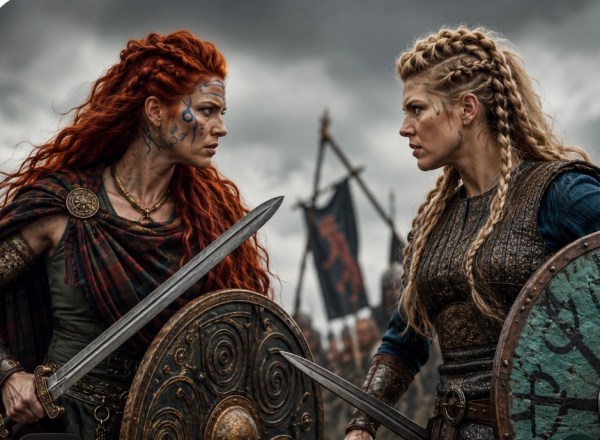
For my last post in this series, I decided to cover two heroines who you may have heard of; you may even think you know about them. But do you? One of these women is a historically documented warrior, while the other’s existence has not been established. While it would be far more interesting if these ladies had encountered each other in battle, one lived in the first century while the other lived in the 12-13th century. So, who are these ladies? Boudica and Lagertha, of course. You may have guessed that from the AI image.
So which one actually existed and which one are we unsure of? Boudica has been historically documented while Lagertha’s existence has never been confirmed via archeology or other historical record. We know about Boudica by virtue of the written record from two Roman historians—Tacitus, who wrote in the late first century/early second century, and Cassius Dio who wrote in the third century. On the other hand, the stories of Viking Shield Maiden Lagertha (also known as Lathgertha, Ladgerda or Lathgertha) come from the Saxo Grammaticus’ Gesta Danorum (Deeds of the Danes) which was written between the 12-13th century. Scholars, according to World History Encyclopedia, consider the early Saxon histories to be fictionalized. The History Channel’s series Vikings made Lagertha a household name in spite of her questionable authenticity. Nevertheless, it is likely that a shield maiden like Lagertha existed and makes a comparison to Boudica interesting.
Boudica, as I have stated above, lived during the first century CE in eastern Britannia in the area of Norfolk. She was the queen of the Iceni tribe. The Iceni were a British Celtic-speaking people who were not necessarily a single, extended family group, but rather a large tribal community made up of numerous local groups and settlements. A terrific series called Britannia on Prime Video presents this period of time and similar Celtic tribes. Roman historians spoke of them as the Icenci and the Eceni. They were known to be prosperous having good soil for agriculture and access to the North Sea for trade with Europe. They were not considered primitive for the time period. They were known for sophisticated metalworking and long-distance trade routes. One of the most significant pieces of evidence of the Iceni was the Snettisham Hoard which was discovered in Norfolk. These treasures included gold and silver torcs, jewelry, coins, ingots and other decorated metalworks. In spite of this, however, their economy was primarily agricultural. They raised wheat, barley, cattle, sheep, pigs, and horses.
The Icenci had an organized political structure prior to the Roman occupation of Britain. They also coined their own money. Boudica came to power after the death of her husband King Prasutagus. He is described as more of a “client” king—a local ruler who governed his people while recognizing Roman supremacy; however, that relationship broke down. One of the fascinating characteristics of the Iceni people was that women were allowed to possess significant wealth and status which is reflected in the graves discovered in the area of Norfolk. While not being a matriarchal community, women were allowed to own property and political power, like Boudica. Unfortunately, the Roman invasion of 43 CE under the leadership of Claudius would change the Iceni.
As we have noted, the Iceni initially cooperated with Rome, but that relationship broke down following the death of Prasutagus. At the time of his death, he provided for the transfer of his wealth to be divided between his two daughters and Rome. However, Rome was not happy with that arrangement. According to Tacitus, Roman leaders seized the wealth and property of the Iceni, publically beat Boudica, and assaulted her daughters. The Iceni, lead by Boudica, revolted. They were joined by other tribes like the Trinovantes which was based in the area of modern day Essex and Colchester. Boudica and her forces destroyed the Camulodunum, Londinium, and the Verulamium through fighting and fire. Evidence of these battles has been found around Colchester, London, and St. Albans. Destruction was so severe that archaeologists have termed the rebellion the “Boudican Destruction Horizon”.
Despite their initial success against Roman forces, the Iceni people were ultimately defeated by Suetonius Paulinus. Boudica would die soon after this. According to Tacitus, Boudica committed suicide by poisoning; Dio, on the other hand, claims that she died due to illness. The region once controlled by the Iceni was brought firmly into the Roman provincial system. Eventually their identity disappeared being assimilated into Anglo-Saxon Britain. Boudica was more than a warrior woman who took on the enemy; she was a symbol of the people she represented; a group of people who were more developed technically, wealthy, and politically sophisticated than many tribes of the day. However, Boudica was not an outlier in her community; the community produced other women like her. We know about her because she was a queen who faced Rome head on.
How does Lagertha compare to Boudica? According to legend, Lagertha would have lived in nineth century Norway. Like Britain, Norway was not yet a unified country. Additionally, women were not “subordinate housewives”. They could possess wealth and political power within a traditional, patriarchal society. Men and women in Norway had different social roles, but historical evidence reflects wealthy and powerful people of both sexes. Marriage was a family and economic alliance. The woman’s family negotiated the marriage and it typically joined together two kin groups, though women were not distanced from their own families. Women often brought substantial wealth and property into marriages. In many cases, she could retain ownership of the property she brought into the marriage. This is quite different from European marital traditions. Moreover, women could divorce their husbands under certain circumstances like abuse, neglect, or insults towards her or her family.
In Norwegian culture, the center of power was within the household, and the farm was the key economic unit. They did not look at this circumstance as women doing women’s work and men doing men’s work. Women managed the critical economic operation. While the men were out raiding and trading, women were producing textiles, tending to livestock, managing household resources, producing and preserving food, caring for their children, and much more. Archaeologists have discovered large numbers of graves of Viking women that contained keys, a symbol of household authority.
A prime example of how Norwegian wealthy women could possess great power is contained in the Oseberg burial site which dates to around 834 CE. In this burial site, archaeologists discovered two women buried in an enormous ship along with a wagon, sledges, beds, chests, textiles, household equipment, elaborate carvings, animals, as well as the ship itself. While we do not know who these women were, it is evident that they were of high status. There is also archaeological evidence of women being buried with weapons like swords, axes, spears, and arrowheads. This is not to say that Norwegian culture was to be admired; the culture possessed dark aspects which negatively affected women. Specifically, women could be captured in battle, enslaved, sexually abused, sold, or killed in circumstances we would find reprehensible.
So what does this tell us about our character Lagertha? Saxo had similar women upon which to create Lagertha. She embodied the independent, wealthy, politically influential and, sometimes, physically imposing Viking woman and then he pushes it to the extreme. Lagertha does it all and then some. She doesn’t just have influence inside her home; she becomes a ruler and commands warriors; ultimately killing the man who stood between her and political independence.
Boudica and Lagertha could not have existed if not for the liberal, cultural ideals and practices of their communities. Boudica and the Iceni could have set the course for the women of Scandinavia having ten to eleven centuries between them. The comparison is quite compelling and inspiring. While other societies treated women as property to be controlled and of lower intellectual abilities, both of these societies provided, if not encouraged, women to participate in similar activities as men.
I hope you have enjoyed these posts about influential women of antiquity. I have greatly enjoyed writing about them. I am now considering what my next series will be about. If you have any ideas, please comment!
God Bless!









 Author. Political Analyst. Family Historian
You must be logged in to post a comment.