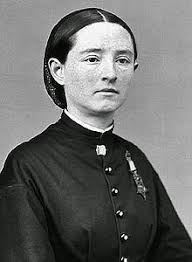
We all know the stories of many of the brave men who fought in the Civil War. We may even be familiar with stories of brave women who served during the war as nurses, but most of us, I would bet, aren’t familiar with a story of the story of the women who also fought. Few stories were as bold, persistent, or downright cinematic as that of Frances Elizabeth Quinn, an Irish immigrant who disguised herself as a man and enlisted in the Union Army at least five separate times. Her determination, grief, and grit made her one of the most compelling female soldiers of the era.
🇮🇪 From Ireland to Illinois: A Childhood Marked by Loss
Frances was born in Ireland and brought to the United States as a small child. Her family settled in La Moille, Illinois. Tragedy struck early—both of her parents died soon after arriving, she and her brother Thomas were separated and raised by different families, a painful fracture that shaped her future (https://en.wikipedia.org/wiki/Frances_Elizabeth_Quinn).
When Thomas ran away at fourteen to join the 52nd Illinois Infantry, Frances—only sixteen—refused to be left behind again.
🪖 A Soldier in Disguise
Frances cut her hair, donned men’s clothing, and enlisted under the name B. Frank Miller. This would be the first of many aliases.
Her enlistments included:
Indiana three‑month infantry unit (as B. Frank Miller)
Each time she was discovered to be a woman, she was discharged—only to enlist again.
⚔️ Battlefield Service and Injury
Frances is said to have been injured twice during her service having fought in both the infantry and the calvary. She was wounded during the Battle of Stones River on December 31, 1862. There she was shot in the shoulder, and her sex was discovered yet again. Later she was wounded in the leg during an attempt to escape. (Wikipedia)
Her resilience was astonishing. Even after injury, humiliation, and repeated dismissals, she kept returning to the fight.
💔 A Sister’s Grief Becomes a Soldier’s Resolve
In April 1863, Frances learned that her beloved brother Thomas had been killed at Shiloh. This loss devastated her—but it also fueled her determination to rejoin the Union cause.
Under the name Frank Martin, she became an orderly and scout, impressing officers with her courage and effectiveness. She even helped bring Confederate prisoners into Union lines (Wikipedia).
🎭 A Life of Aliases and Reinvention
Frances used multiple identities throughout the war:
B. Frank Miller
Eliza Miller
Ellie Reno (claiming to be a niece of General Jesse Reno)
Her ability to reinvent herself was both a survival strategy and a testament to her fierce independence.
🌟 Why Her Story Matters
Frances Elizabeth Quinn represents:
Women who defied gender norms long before they had legal rights to do so
Irish immigrant contributions to the Union cause
The emotional power of family bonds in wartime
The hidden history of female soldiers, many of whom remain unnamed
Her story is a reminder that the Civil War was not fought only by the men whose names fill the textbooks—but also by determined, courageous women who refused to stay on the sidelines.
This is the first of several posts I plan to write about females in battle.
Where I live was recently selected as a potential site of a data center. A local town meeting was held to discuss the matter and people showed up in droves to protest. I immediately got angry because everytime, it seems, that our county has an opportunity for significant growth and revenue generation, the people drive it out. The county was the original site for Disney World, but the “powers that be” ran them off. We now have an amusement park anyway. The county has run off Buck-ee’s, an NHRA track, a car manufacturing plant, and a biofuel plant amongst others. The county, which sits on the Florida border in south, central Georgia, offers many benefits to industry–90% of residents have a high school diploma or college degree, the median age is 34-years old, and has a population over 100,000; however, the median income is only $58,000.00 and 18% of the population live below the poverty line with an unemployment rate of 3.7% in December 2025 (U.S. Bureau of Statistics). Each of these rejected industries or businesses would have brought higher than usual salaries and jobs, but that did not seem to matter.
From my experience much of the rejection of these wasn’t for any good reason. Those “powers that be” seem hell bent on keeping the county small and dependent on a few small corporations to fund our economy. While the county has welcomed a Wal-Mart milk distribution center, Martin’s Bakery, Bimbo’s distribution, and an Amazon satellite distribution center, the county needs more industry to replace those that have either closed or moved. Hard dollars are necessary to generate growth, but the economy is overwhelmingly service driven, which may become unsustainable without a solid hard dollar base.
If residents know this (and they do), why do they consistently reject the very industries which would provide those hard dollars and jobs? First, I believe is a lack of full understanding of the pros and cons of those industries. When the biofuel plant wanted to come, the singular dispute against it was the potential for pollution despite the fact that the county is home to a PCA paper plant. Consider a comparison of a biomass plant and a paper plant:
Raw Material Sourcing: Paper plants often rely on deforestation, while biofuel plants use agricultural waste or dedicated crops. This particular plant was going to use garbage to generate the biofuel.
Production Emissions: Paper production typically emits more greenhouse gases compared to biofuel production.
Water Usage: Paper plants generally consume more water and can lead to water pollution through effluents.
Waste Generation: Biofuel plants can produce less solid waste, especially if using waste feedstocks.
Air Quality Impact: Paper plants may release more volatile organic compounds (VOCs) and particulates than biofuel plants.
Lifecycle Analysis: A full lifecycle assessment often shows biofuels as having a lower overall environmental impact compared to paper.
If we consider the pros and cons of biomass plants, residents should have known that:
Pros:
Reduces greenhouse gas emissions compared to fossil fuels.
Can utilize waste materials, promoting recycling and waste management.
Supports energy independence by diversifying energy sources.
Creates jobs in agriculture and renewable energy sectors.
Can enhance rural economies through crop production.
Cons:
Can lead to deforestation and habitat loss for crop production. This one was not going to be based on trees or crops, but instead on garbage.
May compete with food production, raising food prices.
Requires significant water and land resources for cultivation. The plant itself was not going to be huge, but would have provided an alternative source of energy. The county has taken up farm land to install solar panels, which residents have not complained about.
Production processes can be energy-intensive and polluting, but is less polluting than the paper mill.
Limited availability of certain feedstocks can hinder scalability.
First, what is a data center exactly. A data center is a building used to house networked computer systems or servers and associated systems such as telecom systems and networking components (switches, routers). Data centers are used by companies to organize, process and store the large amounts of data. “The United States’ position as a leading AI innovator is rooted in its rapidly evolving digital infrastructure. Data centers are the backbone of this expanding digital ecosystem, processing and storing the vast volumes of data required to power AI, the cloud, and other energy intensive technologies.” (https://www.statista.com/topics/10667/data-centers-in-the-us/#topicOverview) The promotion of data centers is advocated by those who want to drive monetary policy to a solely digital system. The blockchain system used by cryptocurrencies requires significant computational power which leads to high energy consumption. To power the mining system, therefore, uses energy which most often comes from non-renewable sources, raising concerns about carbon footprints. Newer systems are attempting to reduce this, but are not yet widely used. Studies have shown that Bitcoin’s energy use is comparable to that of some small countries.
Where do data centers get their power? The primary source of power is electricity generated by oil. To understand why data centers are oil dependent at the current time, we need to consider what components of the center use.
IT Equipment: Represents the largest portion of energy use, including servers, storage, and networking devices.
Cooling Systems: Essential for maintaining optimal temperatures consume significant energy.
Power Distribution: Energy used in transforming and distributing power to IT equipment.
Lighting: Often overlooked, but contributes to overall energy consumption.
Uninterruptible Power Supplies (UPS): Provides backup power and can add to significant energy use.
Infrastructure Management: Energy used for monitoring and managing data center operations.
Some centers use hybrid power systems, utilizing both renewable and non-renewable sources of power, but there is increasing pressure to rely more on renewable energy, but determining just how much energy comes from renewables is difficult to find. One of the reasons for this is because people define the terms differently. In practice, operators usually rely on one of three approaches:
Renewable energy credits (RECs). Companies can purchase credits representing a set amount of renewable power generation. For example, a business with a 10 MW data center might purchase 10 megawatts’ worth of RECs and claim the facility is “covered” by renewable energy. In reality, this doesn’t mean the electricity entering the facility comes directly from renewables. It only means the company has financially supported renewable generation somewhere else. This is the most common strategy. The fact is that this is a lie. You cannot claim to use renewable energy when all you’re doing is purchasing something that does not exist so that you can make a claim that is not real.
Adding renewable power to the grid. Some operators, such as Google, fund or build renewable power plants that feed electricity into the grid. The approach increases the overall share of renewable energy available, but the power itself isn’t reserved for the company’s data centers. It’s distributed to any connected home or business. This is the hybrid system.
Moreover, the situation is complicated by grid itself. In those hybrid systems, it’s impossible to guarantee that the energy flowing into a particular data center is renewable. Even data center operators with behind-the-meter plants face challenges. Many renewable energy sources, like wind and solar, are unreliable due to weather conditions. Only geothermal, oil, and nuclear will provide a steady supply of energy. As a result, many data centers with “behind-the-meter” energy still draw on “dirty” power sources when renewable output dips.
Let’s make another comparison that many can relate to–energy required to charge EVs at charging stations. EVs are often touted as zero-emission vehicles, but that’s not exactly true. The real environmental impact depends on where the electricity comes from, so if your power grid relies heavily on coal, then charging your EV isn’t exactly saving the planet. It’s essentially shifting the emissions from the tailpipe to the power plant. Like the data center, use of renewable energy sources like solar and wind are not the most preferable due to weather issues. When talking about EVs, citizens must keep in mind the overall impact of these charging stations, as well as the cars themselves, to the environment. The mining process for the metals and the production of the batteries for these cars has a significant impact on the environment. Not-to-mention, the difficulty with which they pose at the end of the life of the battery for disposal.
Then, you must consider the increased cost at your home to install and power the personal charging station. All of which really does not provide a significant savings to the consumer when talking about charging. “How much does it really cost to keep your EV juiced up each month? Well, it depends. A lot. But let’s break it down. The big factors are how much you drive, the efficiency of your EV (miles per kWh), and, of course, the cost of electricity in your area. If you drive about 37 miles a day, which is around 13,500 miles a year – about average for an American driver–and your EV gets around 0.35 kWh per mile, you’re looking at roughly 13 kWh per day. Now, electricity prices vary wildly. The national average is around $0.17 per kWh, but you might pay way more or less depending on where you live….” (https://anfuenergy.com/ev-charging-stations-how-much-wattage-used/) If you live in California, you’re probably paying double that. While charging an EV can be economical compared to gas, it can become a burden while traveling through rural areas where charging stations are still rare. This projected cost also does not take into consideration any increase in home electricity cost.
Taking into account the pros and cons of biomass facilities and EV charging stations (home and public), why are people so opposed to data centers. Some of the reasons given include:
Environmental Concerns: Data centers consume large amounts of energy, contributing to carbon emissions. Data center share of total U.S. electricity consumption 4.4%.
Water Usage: They require significant water for cooling, which can strain local water resources. In our county we sit on top of the Florida aquifer, so water is not as much of an issue as it would be if we did not.
Noise Pollution: The cooling systems and generators can create disruptive noise in surrounding areas. Many data centers are located away from residential neighborhoods where noise would not be an issue.
Traffic and Infrastructure: Construction and operation can increase traffic and strain local infrastructure. At the same time, construction and operation provide jobs and an increased tax base to the county.
Aesthetic Impact: Large facilities may be seen as unsightly and disrupt the visual landscape.
Security Issues: Concerns about data privacy and security can lead to public distrust. People are more willing to submit their personal information via social media where it is sold to third parties for the financial gain of the platform and to risk that information being used for negative purposes, so these concerns seem a bit hypocritical.
The concerns of my county regarding all of these industries is overstated and emotional when compared to what we already have. I did not mention that we have a plant that builds batteries for the rocket industry, which also presents pollution, safety, and security issues which rarely gets brought up. It is my opinion that the economic needs of the community far outweigh these concerns. If you simply consider the income generated by a data center and the increased tax base that it brings with it, you must stop to consider how these increased dollars can benefit a small South Georgia county.
The global data center market is projected to generate over $200 billion annually. If you look at worldwide revenue, from 2017 to 2029, the global data center market revenue is projected to rise from around 272.86 billion dollars in 2024 to an estimated 480.07 billion dollars by 2029. The U.S. leads in revenue, with China, India, and other countries showing significant growth. (https://www.statista.com/serp?q=Revenue+in+the+data+center+market+worldwide+from+2017+to+2029%2C+by+selected+country)
Major players like Amazon, Microsoft, and Google significantly contribute to this revenue.
Revenue varies widely based on location, size, and services offered.
Colocation data centers typically earn between $100 million to $1 billion per year.
Hyperscale data centers can generate billions in revenue due to their scale and efficiency.
The growth of cloud computing continues to drive increased revenue for data centers.
I believe it is time for my community, as well as others who stand in opposition to every new technology, to step back from their reservations and allow our communities to thrive. These new industries mean increased incomes and tax revenue which would offset some of the risk to home values and environmental concerns.
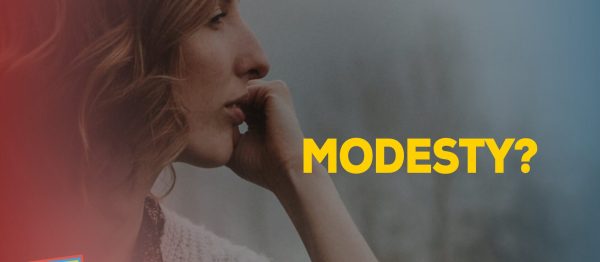
Modesty dressing has become an increasingly visible conversation in fashion, culture, and personal identity. What once might have been seen purely through the lens of religious or traditional expectations has grown into a broader movement rooted in autonomy, creativity, and self‑expression.
At its core, modesty dressing is not about hiding—it’s about choosing.
1. Modesty as an Expression of Personal Values For many people, modest clothing is a way to align outward appearance with inner beliefs. These can be cultural, spiritual, aesthetic, or simply personal comfort preferences. The key shift today is that modesty is often self‑directed rather than externally imposed. People choose silhouettes and styles that feel authentic to who they are.
For millions of people, modest dress is deeply connected to faith and heritage. In religions such as Islam, Judaism, and Christianity, modesty holds spiritual significance. Clothing communicates. When someone chooses to dress modestly, they are often signaling that they value personal boundaries and expect others to respect them.
While modesty does not control how others behave, it can reinforce a sense of personal agency. Dressing with intention fosters awareness of how you present yourself and what message you want to send. For example:
Muslim women may wear the Hijab as an expression of faith and devotion.
Some Jewish women wear wigs (sheitels) or head coverings after marriage, guided by traditional interpretations of modesty laws.
Certain Christian communities emphasize conservative dress as a reflection of humility and reverence.
In these contexts, modest dressing becomes an outward expression of inward belief—a visible commitment to spiritual principles.
2. The Rise of Modest Fashion in Mainstream Style From runway collections featuring high necklines and flowing fabrics to global brands embracing inclusive options, modest fashion has moved far beyond niche markets. Designers have recognized the demand for clothing that is stylish, contemporary, and less revealing—without sacrificing individuality. It’s no longer an “alternative” style; it’s a vibrant fashion category of its own.
Additionally, fast fashion cycles move quickly, often encouraging constant comparison and consumption. Modest dressing tends to emphasize timeless silhouettes, higher necklines, longer hemlines, and looser fits—styles that outlast fleeting trends.
This approach can:
Save money
Reduce decision fatigue
Promote sustainable wardrobe choices
Encourage thoughtful purchasing habits
Rather than chasing every new style, modest fashion often focuses on versatility and longevity.
3. Creativity Within Constraints Contrary to the idea that modest dressing limits style, many find that it sparks creativity. Playing with layering, textures, structure, oversized cuts, monochromatic palettes, or bold accessories can transform simple pieces into striking ensembles. Modesty is not the absence of style—it’s a different kind of canvas. The global growth of modest fashion industries—including designers, influencers, and brands dedicated to covered yet stylish clothing—demonstrates that elegance and modesty are far from mutually exclusive.
4. Comfort and Confidence Some people embrace modest dressing simply because it feels good. Loose, breathable clothing supports movement, comfort, and a sense of ease. For many, modesty is less about covering up and more about showing up confidently without worrying about constant adjustments or unwanted attention. For many people, modest clothing provides a sense of comfort and security. When you’re not preoccupied with adjusting hemlines or worrying about exposure, you’re freer to focus on your work, conversations, and goals.
Confidence doesn’t have to come from showing more—it can also come from feeling appropriately covered, comfortable, and aligned with your values.
5. A Space for Many Interpretations Modesty looks different across cultures and individuals. What one person considers modest might not match another’s definition—and that’s the beauty of modern fashion. The goal isn’t to enforce a standard but to create space for everyone to express themselves in ways that feel respectful, stylish, and true to who they are. Dressing modestly is most meaningful when it is chosen—not imposed. When it stems from conviction rather than pressure, it becomes a powerful form of self-expression rather than restriction. In a world that often equates visibility with value, modest dressing quietly challenges that narrative. It suggests that worth isn’t measured by exposure—but by substance.
We know that each person’s life is a book which has meaning and relevance to the story of mankind, even if we feel insignificant. When someone dies that story ends and the book is closed. The same can be said of our families. Every family carries a story — a tapestry woven from the lives, choices, triumphs, and hardships of those who came before us. Yet in the busyness of everyday life, it’s easy to move forward without looking back. Taking the time to explore your family’s history is more than a nostalgic hobby. It’s a meaningful act of grounding, understanding, and connection.
1. It Helps You Understand Who You Are Your identity is shaped not just by your own experiences, but by the generations before you. Learning about the paths your ancestors walked — whether they crossed oceans, built new communities, or persevered through personal challenges — can give you a deeper sense of place in the world. Family narratives, like those preserved in historical memoirs and genealogical research collections such as Family History & Stories, remind us that we’re part of a much bigger story. [Family His…& Stories | PDF]
2. It Preserves Stories Before They Fade Every family has stories that risk being lost with time — memories held by grandparents, handwritten letters tucked away in drawers, or names on old family‑tree charts like those found in historyfiles. Documenting these stories ensures they remain accessible for future generations. Without our effort to safeguard them, rich histories may disappear. [onedrive.live.com]
3. It Strengthens Family Bonds Researching family history often becomes a shared journey. Interviews, photos, and documents open the door to conversations with relatives you may not know well. Even old family anecdotes — like the multigenerational stories captured in files such as history reference — help bridge gaps between ages and bring families closer together. [history reference | HTML]
4. It Provides Perspective and Resilience Learning about hardships or resilience in your family line can offer strength during your own challenges. When you discover what earlier generations endured or accomplished, your own struggles can feel more manageable. Their perseverance becomes a quiet encouragement: you come from strength.
5. It Preserves Cultural and Regional Roots Family histories often hold clues about cultural heritage, migration, and traditions. Whether your roots trace through states like Georgia or North Carolina — as seen in historical accounts preserved in materials such as history reference — understanding where your lineage comes from can deepen your appreciation for the customs and values passed down to you. [history reference | HTML]
6. It Creates a Legacy for the Future By learning and recording your family’s past, you’re creating a gift for future generations. One day, someone in your family may rely on the notes, photos, and stories you preserved — just as you may rely on the work of earlier relatives who safeguarded records like those represented in Family History & Stories. [Family His…& Stories | PDF]
I write stories like Finding Faith and Send Me A Song because of my belief in discovering one’s family history and of the importance of sharing our family stories. These help us to feel more grounded and to help us understand where it is we come from and why we are the way we are. I believe that our hearts and souls long to know that history. This why adoptees like myself don’t feel whole until we can discover our birth families. I believe we have a right we have to know and understand where we came from. So often, not knowing can be damaging and can lead people to strike out under the frustration of not understanding who we truly are.
Studies have shown that adoptees and foster children are twice as likely as suffer from depression, anxiety, and other mental heal health issues as blood related children are. Key findings regarding mental health in adopted and foster children include:
Contextual Factors: Risk varies based on adoption type, with children placed in foster care or adopted later in life facing higher risks than those adopted at birth. (National Institutes of Health (NIH) )
Higher Prevalence: Adopted children are nearly twice as likely to suffer from mood disorders like anxiety and depression.
Foster Care Risk: Former foster children are significantly more likely (over 2x) to develop clinical depression, and are also prone to PTSD, attachment issues, and behavioral problems.
Common Issues: Common diagnoses include Reactive Attachment Disorder (RAD), Oppositional Defiant Disorder (ODD), and PTSD, often stemming from early life trauma.
Core Issues: Many adoptees struggle with issues related to loss, rejection, identity, and grief, which can increase the likelihood of internalizing or externalizing emotional stress.
Knowing your family’s history is more than collecting dates and names. It’s about honoring the lives that shaped yours, preserving wisdom that might otherwise be lost, and fostering deeper ties between generations. Your story didn’t begin with you — and exploring the roots of your family tree can be one of the most meaningful journeys you take.
Remember, too, that it cannot stop with YOU! You must take your family’s history forward for those who will come after you. Start a journal or scrapbook or make a video and fill it full of all the important information about your family so that your grandchildren, great-grandchildren and on will know who you were, what was important to you, and the about world you live in and keep it safe. Make sure that your children understand and respect the importance of keeping this information and adding to it as they grow up and become parents themselves. They will be glad that you instilled this in them when they are themselves parents and grandparents.
Nicholas was born on March 15, 270, in Patara, Turkey. We know from records that Nicholas lost both of his parents, (Epiphanius and Johanna in some accounts), as a young boy and that he used his inheritance to assist the poor. He devoted his life to his faith and became a monk. We don’t know what business his father was in to have such wealth to leave his son well off and well raised. Catholic.org indicates that he was raised by an uncle. Apparently, however, the family was devoted to their Christian faith because Nicholas knew enough to know that he needed Christ and to devote his life to Christ and to caring to those less privileged than he. He traveled to Egypt and to Israel. He was believed to have been arrested and imprisoned by Diocletian. He was also believed to have been present at the Council of Nicea where some have said that he struck the heretic Arius in the face.
Biography.com relates a story of three young girls who were extremely poor. Their father had no money for their dowries. At this time in history dowries were very important to make good marriages for young women. The family was concerned for their daughters. “Three times, Saint Nicholas secretly went to their house at night and put a bag of money inside. The man used the money so that one of his daughters could marry. On the third visit, the man saw Saint Nicholas and thanked him for his kindness.” There was another time when Nicholas saved three men from being falsely imprisoned and sentenced to death. He is also said to have done many miracles.
The story of Nicholas circulated throughout Europe after his death, which was believed to have happened about December 343. His remains were stolen and taken to Bari, Italy, where his remains have been enshrined in the Basilica of San Nicola.
It was the Dutch who seemed to have loved the story the most and who would take the story and make it famous. The Dutch began to celebrate the feast of Saint Nicholas on December 6th, and the children began putting out wooden shoes the night before. The next morning, they would wake up to small treats in their shoes. It was those Dutch immigrants who would bring these traditions to the New World. They called him Sinterklaas.
Over the decades, Sinterklaas became Santa Claus and the celebration changed from December 6th to be included with the Christmas celebrations on December 25th. He would be transformed from a thin, tall man, to a shorter, rounder man with chubby, rosy cheeks and fluffy white hair after a poem by Clement Clark Moore called “The Night Before Christmas” was written. Then the Coca-Cola Company picked that image up and ran with it and created the image we know today.
Interestingly, the modern city of Demre, Turkey is built near the ruins of the saint’s hometown of ancient Myra and attracts many Russian tourists as St. Nicholas is a very popular Orthodox saint. Restoration of Saint Nicholas’ original church is currently underway, with the Ministry of Culture and Tourism in 2007 permitting Divine Liturgy to be celebrated at the site and contributing 40,000 Turkish lira to the project.
Would Nicholas appreciate what his reputation has become over the past 1755 years? Probably not. He probably would not appreciate that his kind gift giving to impoverished child has upstaged in many ways the truth of the Christ’s birth. Whether Christians were celebrating Christ’s birth in December during his lifetime remains to be seen. The church was still very young and how the church’s calendar of celebrations would be scheduled may not been determined yet. However, one can be certain that there would be on that calendar a time to celebrate the Savior’s birth and no doubt that Nicholas, as a devoted servant, would never have wanted to do anything to upstage that celebration. However, that is exactly what we have allowed to happen. No longer to do we focus solely on the gift of a Savior born of a brave young woman supported by her husband and the long trek made to a far away city under duress, or to the visitors who came to see the baby that night, BUT we cut that off to give his devotee more time and energy than we give to him. Saint Nicholas would be appalled and angry. He might even wish to strike out at us. Who could blame him? As adults it is our job to reel it in. If we call ourselves Christians, then we must put Jesus first and Nicholas second. Put it in perspective. Limit the craziness for HIS sake and yours.
In the United States today, there are approximately 400,000 children in the foster care system. The average age of a foster child is eight years old. More than half are under the age of ten, and 27% are teens. The system which relies heavily on volunteer families is often misunderstood and suffers from a bad reputation. As of 2023, there were fewer than 200,000 licensed foster homes in the US, a decline from over 220,000 in 2019, with the number continuing to drop each year. As someone who has firsthand knowledge of the system, having lived in foster care for the first 5 years and four months of my life, I can attest to the pros and cons of the system. I can also attest to my experience with some of the children who aged out of the system when I was teaching at my local university. It was the first time I had encountered anyone in that situation, and I made it my goal to mentor these young ladies.
The system, obviously, was quite different when I was in foster care. I was in the system in the late 60s and early 70s. That system was secretive and was not geared for the benefit of the child. At no time did I ever feel loved, acknowledged in my feelings, or did I understand my situation. I was treated more as a commodity than a child. In those five years and four months, I was in four homes. The last home was my longest and the one that I still somewhat recall. I cannot see faces anymore, but I can recall certain situations. Some I wish I didn’t.
There were two foster children in this home. My younger foster brother, Wesley, had some issues with his legs and wore braces. I recall going with him when his braces had to be adjusted, or he had to get new shoes. I believe he was born with curved legs and that they were being straightened out. Believe me, the braces did not slow him down any and it did not keep him from doing the things he wanted to do. Then there were three natural children—a son and two daughters. I will tell you that Wesley and I did not understand that we were not their children or that he and I were not brother and sister. DFACS did a terrible job of explaining these situations to us, if they ever tried. I don’t recall ever being told that we were not actual siblings.
Our clothes and toys (although we only had 1 or 2) came from Goodwill. We never had anything new. We had never been taken out of the home to a store to go shopping for toys or food. We were always at home, except to go to the doctor or once to go on a trip. When our adoption came, the day before we were made to pack up our things. When we asked to take a book, we were told that we could not because those things did not belong to us. We both went to our new families with the clothes on our backs and nothing else. Today, foster children are fortunate enough to have suitcases to take their belongings with them and to have foster parents who don’t confiscate their belongings at the door.
We also ate differently than the rest of the family. We were always fed at different times from everyone else. I suppose that, perhaps, they had food stamps for us and only those foods were fed to us. I recall a breakfast one morning. We had oatmeal and a small cup of Kool-Aid. Mine was cherry. Wesley accidentally knocked my Kool-Aid over into my oatmeal. I was forced to eat it anyway. There were no treats except for birthdays. We did get our favorite cake, but we had no friends and there were no parties. There was no Christmas for us. No presents. No Santa Claus.I knew nothing of these until I was adopted. You wouldn’t have known any of this if you listened to DFACs, though. According to them and their “Non-identifying Information Sheet of Lies”, I had lots of toys, and I loved to go grocery shopping. If I did, why did I weigh 31 pounds as a 5-year old?
Today, I doubt foster families would get away with this. A 5-year-old would be in kindergarten and, if the child weighed 31 pounds, someone would be answering a ton of questions as to why. However, an issue that continues from my time until now is that trauma, no matter when and how experienced, separation from birth parents, inadequacies of health care often lead to behavioral, mental, and physical health issues. In the late 1960s, some states began to pay subsidies for hard-to-place children who had these types of issues. Today, parents of children adopted or fostered with ADHD, OCD, GAD, and other mental health disorders receive monthly stipends to offset the costs of treating these disorders.
It is estimated that anywhere from 30 to 80% of foster youth have at least one chronic medical condition, and roughly 25% have three or more chronic illnesses. Obviously, these children deserve foster parents who are able and willing to provide, not only the time needed to obtain the treatment these children require, but the emotional support and the true care and concern as well. Caring for a child with a terminal illness requires an even more special type of foster situation. For these children, their chronic conditions are not only more likely to be pervasive than among their peers but also more likely to cause serious health consequences. According to ChildrensRights.com, 77% of foster children experience more eating disorders than their peers. Bulimia occurs seven times more often among foster children than it does among the general population, and it tends to require intervention more often. (https://www.childrensrights.org/news-voices/for-children-in-foster-care-chronic-illness-takes-a-heavy-toll)
My experience when I was in care was that we were only taken to the doctor for our shots once a year. I only recall going to the doctor one other time and that was for a horrific headache, which I did not realize at the time was a migraine. I was not a particularly healthy child so it is surprising that I would not have needed to go to the doctor more often, but I know that I only went once a year. Wesley went to change his braces and to get new shoes and to get his shots. They had to do those things because he was growing. DFACS would know if the braces or shoes were too small, and they would get into trouble. They did as little for us as they could get away with. Interestingly, in Alabama where I lived, foster parents were paid $30 per month for standard foster care in 1973 (the year we were adopted). So that means that our foster parents made $60.00 for us. Today, they are paid $543; thus, they would make $1086 today for two children of similar age. That is a 27.6% increase which is quite small for the time period. That’s 52 years. You’d think they would’ve given a bigger increase given inflation over that length of time.
When we talk about mental health and trauma, we must talk about trauma that comes from anywhere. It could come from the home with the biological family that caused the separation and placement into the system, it could be abuse in the foster home, it could be simply the separation itself. Even a child placed at birth and who grows up in foster care like me will experience the trauma of separation. Ignoring this or belittling this fact only hurts the child more. Every adoptee experiences trauma, even those who are adopted at birth. No matter when a person realizes that their biological parent is not the parent who has raised them, it is going to create an identity crisis, and this crisis is traumatic. Working through the trauma takes time and therapy for everyone. How each goes about it will be different, but each will have to do it. Failing to seek healing through therapy or blocking the trauma can have dramatic results, if not deadly. “McCauley Evans describes three reasons for the disproportionately high percentage of adoptee suicides: 1) Adoption—or more precisely the separation from one’s mother—is a trauma. 2) Adoptees lack a complete, accurate, and up-to-date medical history, which may include depression or even suicide. 3) Adoptees don’t want to upset their adoptive parents with concerns about depression or anything that could be seen as ingratitude, including normal, healthy curiosity about their roots” (Riben, M. (2015). Toward Preventing Adoption-Related Suicide. Huffington Post).
When it comes to foster children, NIH found in a study of 515 foster children, that 26.4% of preadolescent children who had experienced abuse and who had entered foster care in the previous year had a history of attempting suicide and 4.1% were at imminent risk of attempting suicide. In this study, NIH further found that “children at higher risk of suicidality tended to be younger, non-Hispanic, abused, and to have experienced multiple types of maltreatment, more referrals to child welfare, more household transitions, and a longer length of time in foster care and that physical abuse and chronicity of maltreatment were the most robust predictors of suicidality.” https://pmc.ncbi.nlm.nih.gov/articles/PMC4319651/
Here's my point, if we wish for adoption and the foster care system to be our substitution for abortion, then we have to overhaul both. We have to stop treating children like a commodity. Children should never be sold! Foster and adoptive parents should be the most highly scrutinized people on the planet. There are too many pedophiles beating the system and they do it by circumventing the system and going outside the normal legal avenues. One way of doing this is rehoming. Adoptive parents who decide their adoption did not work out how they wanted; so, they go to the personal ads and list the child for sale. They find someone willing to take the child…just pay me for our expenses; they go to an attorney; and it’s all done outside of the normal channels with no vetting of the new parents. This process should be illegal, but it isn’t.
There also needs to be more regulation of private adoption agencies for these same reasons. We have to make sure that adoptive parents are being vetted properly and thoroughly, and the same for foster parents. We cannot allow ourselves to become so desperate that we take anyone. When we do this, our children get abused.
And then we need superior healthcare for our foster children, especially mental healthcare. We need to encourage them to seek counseling, group therapy, and mentors from former fosters and adoptees who have been successful. We need to turn this system around so that women can feel good about placing their children into the system and not worry that their children are going to be hurt or left. We need to encourage people to adopt. There is nothing wrong with our foster children. Bless their hearts they don’t deserve the reputation foster care gets. They are beautiful, God made children who deserve to be loved and cared for. God has a purpose for their lives, and He may just very well bless you and your family for bringing a foster child into your home. Remember Moses? He was the first foster child. God had a pretty amazing purpose for him, didn’t He?
In closing out this blog post, I would ask that you pray for our foster children. Pray for them to have safety in their homes, to have love that's true, to find good friends who they can depend on, and for permanent families. Pray that dangers like these below be taken away and that they be protected. Our children should not have to fear their homes.
1. Alarming Prevalence of Abuse – Children in foster care are significantly more likely to experience abuse, with up to 40% facing some form of maltreatment. 2. Common Types of Abuse – Neglect is the most frequent form (53%), followed by physical abuse (16%) and sexual abuse (4.4%), with residential facilities reporting higher abuse rates. 3. Declining Foster Care Population – The number of children in foster care has decreased by 6% in recent years due to preventive measures and family preservation efforts. 4. High Vulnerability Factors – Parental substance abuse, young age, and severe mental health challenges contribute to the heightened risks faced by foster children. (https://powertosoar.org/abuse-in-foster-care-statistics/)
Children are our hope for tomorrow. We cannot be selective. We must cherish them all; support them all; love them all. "The Lord watches over the foreigner and sustains the fatherless and the widow, but he frustrates the ways of the wicked." Psalms 146:9 NIV
I remember hating my name when I was growing up. It was so often mispronounced and I got tired of having to correct people. I didn’t know until I was an adult that it actually wasn’t being mispronounced. My biological mother named me Deborah Dean, but the hospital misspelled it Deanne, so it became Dee Ann rather than Dean. Boy, I was so upset because I would’ve loved to have been called Deborah Dean. What a quintessential Southern name for a girl of the sixties. I loved it. But, my adoptive parents dropped the Deborah and kept the Deanne and added Celia. When I located my biological family and found out about the Deborah, I went to court and added the Deborah back to my name, but kept the Celia because it was my adoptive grandmother and great-grandmother’s names. I wasn’t going to insult them. I am honored to be named for them.
The names we give to our children should not be random. These names have much to do with their personalities and the people that they become. One of the reasons that I love the name Deborah is because of Deborah in the Bible. My great-great-grandfather on my biological mother’s side was a German Jew named Joseph Schmaller. This helps me to identify more with Deborah in the Bible. At one time I wanted to be an attorney and judge, but I chose not to be because I realized that attorneys often must compromise their own morals and values to represent people who they know are guilty. I didn’t want to do that. I realized that everyone is entitled to a defense whether guilty or not. That is the American way, but I would not have felt good about myself if I had gotten someone off who I known was guilty. Moreover, I would’ve felt horrible if I had been responsible for someone being convicted who I had known was innocent, especially if it had been a capital case. So, I declined to go into that business as the attorney. I did work for a time as a paralegal. I think that the name Deborah fits who I am as a person because I am a thoughtful and discerning person. I have also served in the military. I relate to Deborah’s strength of judgment and deep faith in God. I wear a bee ring on my finger to remind me to think, to use good (sweet) words, and to put my faith in God not in myself.
I wonder, however, if parents today put much thought into the names that they choose for their children. In the centuries prior, there were naming rules for children. The first born son was named after the paternal grandfather. The second son would be named for the mother’s father. The third son would be named for the father. The first daughter would be named for the mother’s mother. The second daughter would be named for the father’s mother. The third daughter would be named for the mother. We follow none of these anymore.
Each century has had its trends where names are concerned. In the 18th and 19th centuries, the trend was Biblical names. The most popular boy names were John, Thomas, James, Joseph, and the most popular girl names were Sarah, Mary, Faith, Hope, and Charity.
The 20th century saw a diverson from tradition and the beginning of the use of unconventional names as a way of reflecting parents’ creativity, individuality, and nonconformity. “the rise of unconventional names represents a shift in societal attitudes towards naming and an increasing recognition of the importance of individuality and self-expression” ( https://logowski.com/blog/evolution-and-significance-of-naming-across-the-ages), but can this go too far? When does creativity and self-expression become ridiculous or foolish? What may seem cute when a child is three, may at 15 be a reason for teasing and bullying.
I recall when I found out at 40 that I was pregnant with our daughter that I started making lists of names that I liked. Some were just single names others were combinations of first and middle names. I made three and four pages and gave the pages to my husband to choose a name from. He kept not responding to me until two weeks before our daughter decided to make her appearance. I asked him why he was taking so long. He said, “Because I don’t want to make a mistake and choose some name that will embarrass her when she walks across the stage to get her high school diploma.” I thought it was sort of silly at the time, but now I understand after some of these awful names have become infamous.
Many people idolize Kim Kardashian, but there are people like me who believe she is an idiotic, narcissist. Why would anyone in their right mind name their child North West? It’s a child, not a compass. Then you have people like Gwyneth Palthrow who named her daughter Apple. Really, Gwyneth? Apple? That isn’t even cute when 2. It’s just weird. And what about when you’re 80 and a grandma. Your grandchildren go to introduce you to their friends…”This is my Grandma Apple”…nope, that’s just weird! George Foreman named all of his children George. Talk about a narcissist, right? What did he call them at the dinner table…1,2,3,4 or a,b,c,d? Why would you do this to your children? Remember Michael Jackson’s son Blanket or Frank Zappa’s daughter Moon Unit?
One thing I can say about these is at least they are all spelled in the traditional way. The other trend we see with names is that we get cutesy spellings of names. You take a traditional name like Bailey and today it might be spelled Baylee or Bayleigh or Baelee or Baeleigh or Beighlee. Curiously, I often encounter names that are spelled one way but pronounced in a way that does not go with how they are spelled. For example, a friend has a daughter whose name is spelled Elle, but they pronounce it as Ellie. Obviously, it isn’t spelled to be pronounced Ellie; it’s spelled to be pronounced as “L”. So now people are forced to comply with illiteracy.
Then you have people like Elon Musk who just make it all up—the language, the name, and the pronunciation. Elon has thirteen children by three mothers. The more oddly named children are the children of Elon and the singer Grimes. Their first child born in May 2020 is named X Æ A-Xii and goes simply by X. In December 2021, they welcomed a daughter named Exa Dark Sideræl Musk. She goes by the nickname “Y” since her brother is “X”. Their third child together is a son named Techno Mechanicus (a.k.a. Tau).
No doubt Elon’s children are being raised in an alternate reality and will be accustomed to a different lifestyle, but what happens when this isn’t the case? What happens when your family is just the odd family on the block? Trying too hard to be cute can get you into a pickle. Consider names that people have actually given to their children. From Familyminded.com, some of the worst names included “ABCDE”, “Arson”, “Bacardi”, which reminded me of the 80s television show “Blossom” and Blossom’s best friend Six. In the first episode Blossom asks Six how she got her name. Six tells her, “That’s how many beers my dad said it took to get me.” Perhaps that explains the “Bacardi”? But, no kid should ever know that or be named for that! (https://familyminded.com/s/worst-baby-names-3ccbdcefe32c4222) Another list from WRAT 95.9 radio, includes names like “Colon”, “Phelony”, “Jammy”, “Brick”, “Chaos”, and “Lasagne”. (https://wrat.com/listicle/top-25-worst-baby-names-people-used/)
A child can have any nickname. Nicknames often go away. They are not permanent, but a name is forever. A name should be thought about thoroughly before you put it on a child forever. While a name can be changed, it takes time, effort, and money to do it. Names have meanings. Most of them, anyway. This is a child that you love and will raise for the next 18 plus years. Take time to choose a name that matters and that will represent the child’s personality and spirit. Don’t just throw something on them that is meaningless and cute for the moment. Don’t put on the child a name that is difficult to spell and that is a burden. Having to explain a name every time you introduce yourself is a burden. I know from experience and that is why I hated my name. It was always misspelled and mispronounced. I finally gave up and decided to answer to whatever I was called. When I discovered that my real name was Deborah, I couldn’t wait to add that name back and to start calling myself Deborah. Now it is a tad complicated because some people know me as Deanne and newer people who meet me know me as Deborah, but I don’t care. I would have so much rather been called Deborah Dean all these years, but no one asked me when as a 5-year-old I was adopted. It was decided for me that my name would be changed, and they chose my middle (misspelled) name. There are numerous websites that give meanings of names. Do your research. It will be truly meaningful in the end and your grandchildren will thank you for not naming their grandfather Sue!
March 23, 2025 will be the 250th anniversary of Patrick Henry's famous speech given at St. John's Church in Richmond wherein he declared, "Give me liberty or Give me death"! This speech was just weeks before the first cannons of war would be shot at Lexington and Concord beginning the Revolutionary War. To celebrate this key moment in U.S. history, there will be a reenactment at St. John's Church. A descendant of Henry's, Henry Jolly, will portray the Founding Father. Jolly has been portraying his ancestor since the 1990s. He believes that most students only know Patrick Henry for the speech and little else. He's made it his mission to educate students about Henry's other contributions to the nation's history. Moreover, Ken Burns, known for his documentaries of historical periods and biographies, added that many Americans don't know much about the speech other than those few words.
"According to Jolly, the delivery of those fiery words 'Give me liberty or give me death' was 'part of a longer defense of resolutions he had submitted, which put Virginia officially into a posture of defense against Great Britain.' During his speech, which as Jolly presents it today is 14 minutes long, 'He had to convince the leaders of the day that Virginia could defend itself against the British army, which was one of the most powerful military forces in the world. His words helped convince his peers they could be successful against, ‘so formidable an adversary.’” (https://cardinalnews.org/2025/03/18/patrick-henrys-words-have-echoed-through-the-centuries-and-around-the-world/)
Henry's words were a plea for the Virginia government to prepare for war. He was, most likely an anti-federalist, but he was not anti-government. This is in opposition to how we often hear his words used today. So often we hear these words used as a protest against government intervention into our personal lives, which is not how Henry used them. John A. Ragosta, an early American historian and author of Patrick Henry: Proclaiming A Revolution, “He meant exactly the opposite,” Ragosta said. “His speech was about the people coming together. It was not about me, it was about us.” (www.cardinalnews.com above) Henry's words were even shouted at the the 1989 protests in Tiananmen Square in Beijing, China, as well as being painted on banners.
What people don't understand about Henry as well as other Founding Fathers is that he was a communitarian, meaning he believed in the community of people and preserving the rights of the people, not individuals. Today with the spread of technology, people have become more and more singularly focused. We are far more focused on our rights, our identities, our circumstances, and less interested in the community, the state, or the interests of the nation as a whole. We have become more interested in what others can do for us than what our role is in our communities.
Jon Kukla, author of the biography Patrick Henry: Champion of Liberty and an historian who has been researching Patrick Henry for half a century, added that Henry's words were about a person's responsibilities to the community, not just their rights...“'the first thing a person had to do in order to enjoy freedoms was to practice self-discipline.' That meant to be less selfish and less focused on one’s own desires in the moment, and more in tune with the qualities of good citizenship: charity, forbearance, frugality, justice, love, moderation, temperance and virtue."(https://cardinalnews.org/2025/03/18/patrick-henrys-words-have-echoed-through-the-centuries-and-around-the-world/)
In my mind this has never been more important as we move deeper into the 21st century. The United States throughout the 20th century sacrificed ourselves so often for the betterment of other nations to our own detriment. We have increasing numbers of homeless, hungry, increasing illiteracy, decreasing quality of education and healthcare to mention a few. Putting ourselves first before others more often than not gets push back. The "Make America Great Again" movement meets with anger and resentment. Is that only because it is lead by Donald Trump, or is it a legitimate concern to those who push back? Why shouldn't Americans come first? Why shouldn't be house ourselves first? Feed ourselves first? Educate ourselves the best? My question is...do you not believe that in France they want to be the best? Of course they do. Do they not want to put France first? Of course they do. In Germany, do they not want to put Germans first? Of course they do. Don't they want to house Germans in Germany first? Of course they do. Do they want Germans to speak German? Of course they do. Then, why on earth do we force shame on ourselves for wanting to put America first? To believe that nationalism is immoral is ludicrous. Nationalism that rises to the level of genocide is immoral. That is not what we are talking about.
We can learn from Patrick Henry's words 250 years after he spoke them. He was not calling for no government. He was calling for people to get involved, to step up to the plate. We can no longer afford to be apathetic. With freedom comes responsibility. Our responsibility is to be knowledgeable of the issues and to vote. Not doing these things...well, you might as well be dead.
Luke 17:32...it's the second shortest verse in the Bible. It's succinct, but it's message looms large. Jesus is speaking the apostles about his second coming to prepare them. It's consequential; failure to heed its warning could result in the loss of one's soul. No other explanation was needed for the apostles because they were very aware of the story; they knew it well. That may not be true of us today, however.
We don't know Lot's wife's name, but we know that she disobeyed God's command to not look back when fleeing Sodom. For her disobedience she is turned into a pillar of salt. So what are we to gather from Lot's wife. My pastor, Robert Wauhop, gave us 4 reminders about her:
1. Her spiritual privileges: She was related to Abraham so she knew the way of righteousness through faith. Thus, she was associated with God's covenant people. Her husband, Lot, was a righteous man, but none of that mattered because she did not believe.
2. Her sinful preoccupation: Her disobedience revealed her sinful attraction to the world. She longed for the very thing that God hates--the world. The looked back at what she loved and what she was going to miss. We cannot love God and the world at the same time.
3. Her Sinful Autonomy: She became her own arbiter of truth. She refused to listen to God. Instead, she set herself up as the judge of truth and, looking back, revealed her sinful loyalty to the world.
4. Her severe punishment: Her punishment was instant and intense. She went straight to hell. The punishment was instructive. God holds her up as a beacon for everyone to see as a lesson to us all. Remember Lot's wife! This could be you!
So, after this sermon on Sunday, I began to wonder about the potential for punishment for the most grievous sin of this nation--abortion. There is nothing more evil and it is something that has directly affected my life. I have not had an abortion (because I wouldn't), but I was born of rape. I am becoming actively involved in this movement to stop the rape and incest exceptions to abortion, because these exceptions would have had me murdered had they existed when I was born, and my brother as well.
I was born in Mobile, Alabama, in October 1967, to a teenage girl who had an IQ of less than 70. She had been molested for several years by her non-biological grandfather who she and her sister had been residing with along with his wife, their biological grandmother. He never denied what he had done. Unfortunately, her grandmother blamed her granddaughter rather than her husband for the situation and she kicked the child out of the home, sending her to a foster home. My biological mother never waivered in her plans to place me for adoption, although she fled the hospital prior to completing the paperwork which left me in foster care for five years. Take this situation and place it in 1973. I have no doubt that it would have been completely different outcome. Because of my mother's diminished capacity, I believe that her step-grandfather would have convinced her to go with him and to have a medical procedure, not telling her that she would be having an abortion to hide what he had done. It would have been so easy because she believed anything he told her. But, because abortion was illegal in 1967, he couldn't do it, and he got away with what he did. Even the DA in Mobile chose not to prosecute him for the rape saying that because of his age it wouldn't do any good. I don't believe that my grandfather put forth much effort to have him prosecuted because of his mother who would have struggled financially without his step-father. He sacrificed his daughter for his mother.
Five years later, she was in the same predicament again, this time take advantage of by an employer--an older man with control over her livelihood. He was married with children. It was September 1972, just four months before Roe v. Wade. Four months and it could have been a completely different result. He took her to Birmingham, an hour from where they lived to place the baby boy for adoption, away from the eyes of his community and his family. Her family was disinterested in advocating for her. They had all but abandoned her to her situation.
Remember, my mother had no ability to consent to sex. She had an IQ less than 70, making her mentally disabled. I am told that her mental abilities were that of a 12-year old, and a 12-year old cannot consent to sex. This is the very sort of person that Plan Parenthood and other abortion rights advocates want exceptions for, but I will tell you that my mother never waivered in her belief that my brother and I deserved to live. She never blamed us for what these men did to her. She anguished over what was done to her, but she never connected those acts to us. She loved us and she wanted what was best for us. Certainly, she hurt for losing us, but she also understood that she could not be a mother. She understood her limitations. She had no one in her family to help her. In fact, her family was more of a hinderance than a help.
I am angered everyday when I hear people claim that children of rape and incest should be aborted. I cannot tell you how many times I have been told that I was a leech on my mother's body. I cannot imagine saying this to someone because I believe that all life has value. Why is my life less valuable than those conceived in loving relationships? Why does the crime lessen my value? The crime had nothing to do with me. The crime that my biological father committed was his sin and his sin alone. It was not reflective of anyone else in his family, so why would it be reflective on me? I am also the victim of rape. Thankfully I did not become pregnant by my rapist, but had I, I would not have sought out an abortion. The child conceived in rape can be the most healing thing to come out of something violent. My brother and I are the greatest things to come out of what happened to our mother. We have value. No doubt if our mother was alive today, she would love to see the families my brother and I have and what we have accomplished in our lives. She would never regret the choices she made. However, having an abortion can never be undone. It is a permanent resolution to a temporary, emotional state. Adoption is always the best option to an unwanted pregnancy, and as a former foster kid, I'd choose that every time over being dead.
In the preamble to the Declaration of Independence it reads: We hold these truths to be self-evident, that all men are created equal, that they are endowed by their Creator with certain unalienable Rights, that among these are Life, Liberty and the pursuit of Happiness. The Founding Fathers believed, as they stated here, that our rights came from a Creator, not from man. This would, therefore, also mean that those rights cannot be taken away from man by man, but from that same Creator. Man has no right to take LIFE from man, only the Creator can do that. I am a child of God...a child created by God in His image with a purpose chosen by Him and no man has the right to circumvent God's plans. There should be no exceptions to abortion. The value of life must not be determined by how one is conceived, by location, by gestational age, or any other arbitrary condition. Life begins at conception and that is where value begins. Every child deserves the right to life. Life is the fundamental right of all people, without it there are no rights at all.
I have always been a huge fan of St. Patrick’s Day mostly because of my Irish roots, but until a few years ago, I knew almost nothing about St. Patrick. I am not Catholic so I had no reason to know anything about him. Of course, I knew the legend about his running snakes out of Ireland, but that was essentially it. Then, my loving mother-out-law (don’t you love that!) went to Ireland and Scotland on a trip to visit the Thin Places and brought back a wealth of information to me about, not only the Thin Places, but also St. Patrick. I was amazed by Patrick’s story, and to be quite frank, I felt shorted by not having known all the information about him before. For myself looking back over my life, I would have found encouragement in his story. In those times when I thought things to be insurmountable, St. Patrick’s story would be one to turn to as a reminder that things never stay bad forever.
So, who was St. Patrick? Patrick, born about 385 A.D. and died March 17, 461 A.D., came from a good family and lived in Roman Britain. His father, Calpurnius, was a deacon in the church. Patrick was not interested in God or the church as a young man. At the age of 16, he was doing what many boys of his age were doing; he was hanging out along the water when an Irish raiding party came along and kidnapped him. They took him to Ireland where he was held captive as a slave. While in Ireland, he was a sheepherder. While tending to the sheep, he began to pray and to seek out God. He chose not to be bitter about his predicament. It was at this time, after six years of captivity, that Patrick said God spoke to him. He ran away, running over 200 miles. He took a boat back to Britain and was captured, spending time in captivity once again. Once released he was reunited with his family and spent a few years with them.
Then one night he had a vision of the people of Ireland calling to him saying, “We beg you, holy boy, to come and walk again among us.”(https://www.usatoday.com/story/news/2025/02/19/who-was-st-patrick-heres-what-to-know-about-the-man-behind-the-holiday-march-17/79194446007/). He knew that he had to go back, but he did not return for 20 years. Between the time of his vision and the time he returned to Ireland, he received training and education in the Christian faith. When Patrick arrived in Ireland, the various pagan religions saw him as a threat to their way of life.
Many scholars believe that the reason the Irish turned to the Christian faith was because Patrick possessed the ability to heal, to raise the dead, as well as other signs and wonders. Without these abilities, it may not have happened in such a large fashion as it did. Historians allege that he consecrated 1000 priests, 200-300 bishops, and converted 40 out of the 150 tribes to Christianity. He is often described as being a humble person, but also generous. He is noted for bringing gifts to chieftains, but also for refusing gifts for himself. Britannica indicates that “he was a humble-minded man, pouring forth a continuous paean of thanks to his Maker for having chosen him as the instrument whereby multitudes who had worshipped ‘idols and unclean things’ had become ‘the people of God.’”(https://www.britannica.com/biography/Saint-Patrick)
There are, of course, legends about St. Patrick. The snakes are just one, but it is probably the most glaringly untrue. It’s unlikely that there were ever snakes in Ireland for Patrick to run out because of the previous ice age which made Ireland too cold. The most popular is the shamrock which St. Patrick used to explain the trinity–three leaves with one stalk=three person in one God. The shamrock is the national flower of Ireland.
Now, you might ask, what is that reference you made to the Thin Places? That’s a great question. I had never heard of the Thin Places until my mother-out-law went on her trip to Scotland and Ireland. I became interested after hearing about it from her, so I went to the YouTube video she told me about. I am going to link two videos on the subject here for you. The first one by Rebecca Friedlander has a full length movie associated with it that is available for a fee. Basically, the Thin Places are places where you can get very close to the heavens or other realms as Ms. Friedlander calls them…so close that it gets thin. Like being on the top of a mountain. Like Mt. Ararat, I would believe because that is where Noah’s Ark came to rest and it is sacred. It is in these thin places where we can go and we can pray and fast to be closer to God. Here is the link to the video. https://youtu.be/j2AftRs-QRc?si=4bvMXH9Egd_Nr0VH And here is another one called “Braving the Thin Places” by a different person. https://youtu.be/-n_IooHy6S0?si=txGcFjPSyMM8OmtM. Both of these ladies speak of the Thin Places in terms of Ireland and Scotland, though I believe that there are Thin Places around the world and not simply limited to Ireland and Scotland. You will notice that when Ms. Friedlander describes the Thin Places, she uses the word “fairies”. This is odd to me for someone who professes to be Christian and who is attempting to put this idea within a Christian context; the two don’t really go together. When I think of what they are talking about, I think of Thin Places as those places where we feel closest to God. I am a mountain girl. I love to stand a top a mountain and gaze out at the vastness of God’s creation. I feel close to Him there and I usually feel a strong urge to talk with God in those moments. Someone else might get that same feeling out on the sea. When I listen to what Rebecca describes, I get the feeling that Thin Places can be a physical place or they can be an emotional place. I also thought about how quantum physicists speak of multiple realities and portals to those realities when I listen to her describe these Thin Places. I would love to hear what you think about these descriptions of Thin Places.
I hope you’ve enjoyed the information about St. Patrick. He is so much more than a singular day of debauchery and deserves our respect and honor for what he brought to our faith. Happy St. Patrick’s Day.








 Author. Political Analyst. Family Historian
You must be logged in to post a comment.