
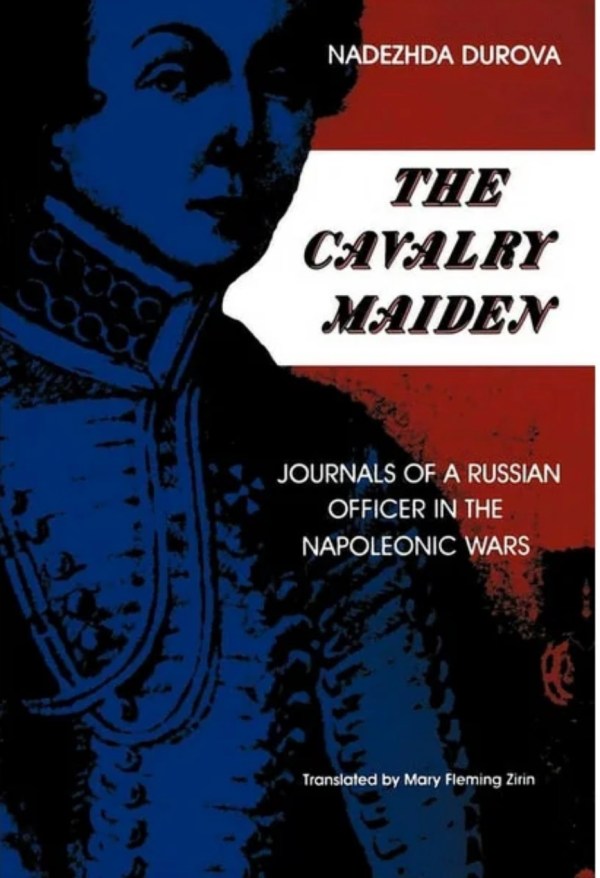
Our next female warrior is probably someone you have never heard of. I know I had never heard of her until my 19th Century Russian History course at Florida State University when I was a graduate student. My primary focus in graduate school was Russian/US relations. It was a phenomenal time to be studying this field because our relationship was in transition. The Cold War had ended, Reagan was out of office, and Boris Yeltsin was in power in Russia. It seemed like a good time to me to get a handle on where the former USSR had come from. I only had a cursory knowledge of Russian history, so this course seemed ideal.
One of the novels assigned to us to read that semester was The Calvary Maiden, the story of Nadezhda Durova. Nadezhda, like Francis Elizabeth Quinn, was a young woman who disguised herself as a man in order to fight in the Russian Army. The Calvary Maiden is her autobiography which she published under the pen name Aleksandr Aleksandrov. Unlike Francis Quinn, Durova lived her adult life as a man. She admitted to liking women’s clothes on others, but that she never felt comfortable in them. However, she did marry and have affairs with men.
So who was Nadezhda Durova? Nadezhda Adreevna Durova was born on September 17, 1783, in the Kama-Volga region of Russia. She was born into a military family and she was taught martial arts as a child. Her mother Aleksandra Aleksandrova came from a wealthy, landowning family in Ukraine. Her father was a Hussar soldier and was known to be handsome and charming. Hussars were elite, mostly European light calvary soldiers famous for their speed, daring tactics, and ornate uniforms. Renowned for scouting, raids, and shock charges, they evolved into a dashing 18th-century European staple, while Polish “Winged Hussars” functioned as elite heavy shock cavalry. (Wikipedia) Against her father’s wishes, Aleksandra and Andrei Durova eloped.
Aleksandra was excited when she discovered she was pregnant. She dreamed of a bouncing, robust baby boy; however, she gave birth to a little girl with tufts of dark brown hair. Aleksandra did not take to her daughter. She often became incensed by her crying. On one occasion, her mother would throw her out of a moving, carriage window because she would not stop crying. Andrei was horrified by his wife’s actions. He rescued his daughter and took her on horse back for the rest of their travels. After that, Andrei would not allow his wife to have any input into Nadezhda’s parenting and discipline. He called her Nadya (or Nadia) for short. So, it isn’t surprising that Nadia would find more acceptance in her father and his soldier friends than in her mother. In our country we would simply call her a tomboy. Two more daughters and, finally, a son would be born to the Durova family.
As Nadya grew up she became more and more fiercely independent. The more this happened, the more her mother attempted to break her. She was forced to spend significant hours sewing and crocheting. Nadya had little talent or interest in either. She preferred to ride her horse Alchides through the countryside. Nadya had matured into a young woman who deeply resented women like her mother and one who wasn’t especially attractive. Her face had been scarred by a harsh case of chicken pox and was overly tanned from long hours in the sun. Because of time spent in the presence of her father’s men, her manners were anything but girly. However, she was NOT without male suitors.
Because she was desperate to flee her mother’s home, she accepted a marriage proposal from a junior court clerk named Chernov. In 1803 she gave birth to a son named Ivan. However, Nadya would leave her family not long after her son’s birth and would return to her family. According to her memoirs, she was deeply unhappy. In 1806 she would again escape her family by running away and never returning. She cited a “family disappointment” as the cause for her departure. She also talks about how, at age 16, she left home and, for the first time, dressed as a man in order to join a regiment of Cossack soldiers. She writes that she fell in love with a Cossack soldier and left with him when she was 18, formally separating herself from her husband and son.
At another time when she was disguised as a man, she fought in the Polish Lancers. It was during this time that she first saw real battle. This was during the Napoleonic Wars. On May 22, 1807, she participated in direct action. The Lancers did not fight as a regiment, but instead they fought in squadrons. Because of her inexperience, Nadya did not understand this and when it was her turn, she joined in every squadron’s assault until an officer noticed what she was doing and admonished her.
It was also at this time that she noticed several French Dragoons surrounding a Russian Dragoon officer and knock him off his horse with a single pistol shot. Nadya lowered her lance and charged. Surprised by her actions, the French Dragoons fled. She gave her horse to that Russian officer to get him to the nearest field hospital for treatment.
She also fought in the Battle of Heilsberg on June 10, 1807, a bomb exploded directly under Alchides, but, miraculously neither was injured. On June 14th, her regiment would participate in the Battle of Friedland. She described the casualties to her side as being over half. All of this time, she was known as Trooper Sokolov. As the war was nearing the end in July 1807, Tsar Aleksander heard rumors about a girl in his cavalry. When asked about Trooper Sokolov, her fellow soldiers only had the best things to say. The Tsar summoned Nadya to St. Petersburg. According to her memoirs, the Tsar was impressed by her and gave her permission to stay in the cavalry. She was awarded the Cross of St. George for saving the life of the Russian officer and commissioned her as a Second Lieutenant. He gave her the privilege of choosing which regiment she wanted to join. The Tsar further provided her with money to purchase new uniforms, equipment, and a direct stipend. Nadya chose the Mariupol Hussars, which was known for the large amount of Russian aristocrats in its ranks. Interestingly, although he knew her to be a woman, Nadya would continue to dress as a man. The Tsar gave her the last name “Aleksandrov”.
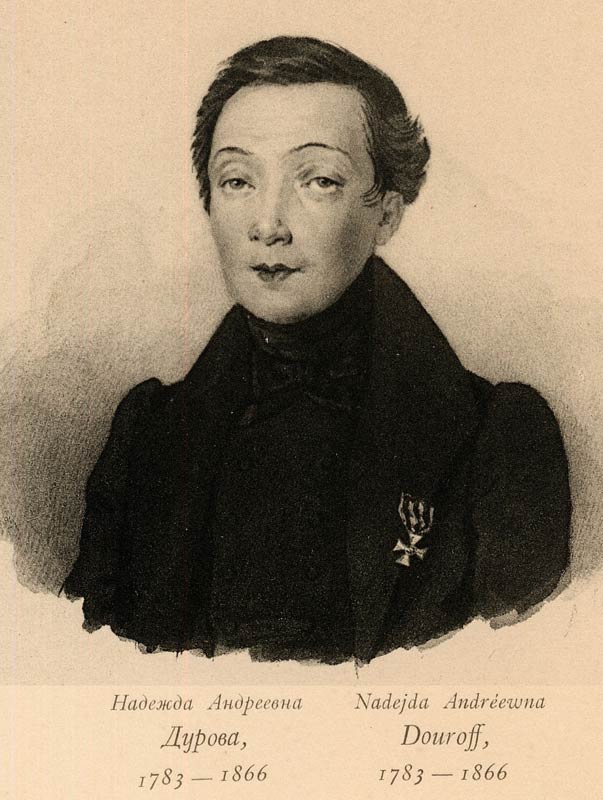
Only a few senior officers knew Nadya’s true identity. Rumors continued to circulate about the alleged female cavalrywoman. She was almost discovered during a riding accident. Her horse was thrown head over end and Nadya was knocked unconscious. She awoke just in time. Another soldier was just about to unbutton her blouse so that she could breathe.
Nadya would return to battle during Napoleon’s invasion of Russia in 1812. She was injured during the Battle of Borodino when she received a concussion and her knee was hit by a spent cannonball. Rather than lying in a hospital bed, Nadya offered her services as an orderly. She would also fight to topple Napoleon in 1813 and 1814 and she would receive additional accommodations for her service.
Early on Nadya wrote to her father and admitted to him what she was doing. She told him where she was and what had happened. Her father wanted to bring her home, but Nadya was not interested. In 1816 as the Napoleonic Wars were ending, her father wrote to her and urged her to come home and to help him run the family estate. Nadya decided to retire and to go home. She was a captain.
Bored with farm life, Nadya decided to start writing. Her brother Vasily introduced to her to famous Russian writers like Pushkin. It was Pushkin who gave her the nickname “Cavalry Maiden” in 1863. He had become an admirer of her and of her writing. While The Cavalry Maiden is her most famous work, she also wrote four novels and numerous short stories between 1836 and 1840. Nadya lived the remainder of her life in Yelabuga, a town in the Republic of Tartarstan along the right side of the Kama River in Russia. She died in March 1866 at the age of 83. A statue of her on her horse sits in Yelabuga today as a tribute to their famous citizen. She was buried in her full uniform and with military honors. In the 1940s playwright Aleksandr Gladkov wrote a play called A Long Time Ago dedicated to her. Eldar Ryazanov, a Soviet and Russian film director, screenwriter, poet, actor and pedagogue whose popular comedies, satirizing the daily life of the Soviet Union and Russia, directed the movie The Hussar Ballad which was adapted from Gladkov’s play.
I hope you have enjoyed this story of Nadya Durova. Let me know of any female soldiers/warriors you’d like me to write about!
God Bless!



You must be logged in to post a comment.