Immigration: A Historical Analysis Part 2

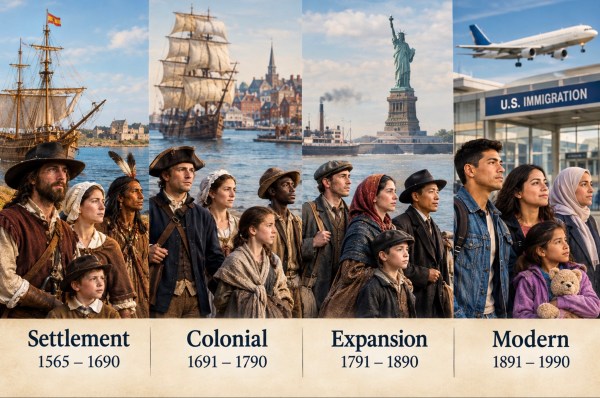
I want to now look more closely at each time period. We will look at a comparison of the nations who sent colonists first—France, Spain, and England. We will consider the various settlements and we will consider what the owners of the companies who sent settlers knew about the “New” World. This is particularly interesting because I think many have simply believed that people got on a boat and had no idea what they were heading into. That isn’t quite right. I will explain.

These were not blind expeditions into an entirely unknown wilderness. Prior to the foundations of the permanent colonies, European nations had accumulated much information about the Atlantic and Pacific coastlines. Here are the dates of the explorations:

1513 — Ponce de León → Florida
1528 — Narváez → Florida/Gulf Coast
1539 — De Soto → Southeast
1540 — Coronado → Southwest/Great Plains
1559 — Tristán de Luna → Pensacola
1562 — Ribault → Florida/South Carolina
1564 — Laudonnière → Fort Caroline
1565 — Menéndez → St. Augustine
1584–1587 — Roanoke
1607 — Jamestown
1620 — Plymouth

And there’s an especially interesting distinction here: exploration and colonization weren’t the same thing. Ponce de León, De Soto, Narváez and Coronado were primarily conducting expeditions—some for exploration, some for conquest, wealth, territorial claims, or finding settlements. St. Augustine, Roanoke, Jamestown and Plymouth represent the next step: attempting to establish communities that would remain. In fact, St. Augustine was founded in 1565—42 years before Jamestown and 55 years before Plymouth.

I think this makes for a fascinating transition: the people who eventually would become “settlers” weren’t arriving in an unexplored land. European explorers had been mapping, describing, claiming, fighting over, and attempting to colonize portions of North America for more than half a century before Jamestown.

Another important fact to remember is that often the information passed on to the monarchies involved was either flawed, wrong, or was slanted to encourage more investment from the corporations behind the settlements and/or expeditions.

Exploration Period: 1514-1620 Who Were They & Where Did They Explore

The term “immigrant” isn’t truly appropriate for this time period because the people who would ultimately arrive in North America were chosen by a monarch, colonial governor/proprietor, religious organization, etc. No one showed up at the castle and asked to be sent and there was no application process.

These monarchies or corporate leaders had a specific objective for the settlement.

  • establish a military foothold
  • claim territory for the crown
  • compete with another European power
  • establish a trading post
  • find valuable resources
  • establish an agricultural colony
  • spread Christianity
  • Create a permanent settlement
  • Provide an outlet for particular religious communities

Let’s consider the major explorations during this time period and what discoveries those produced. I don’t think most of us would remember, nor would have been able to place these on a timeline. I don’t recall being taught the explorers in a timeline, but rather by who they were and what they explored.

The earliest exploration has been highly disputed despite the fact that we named the North American Continent after him. Amerigo Vespucci’s explorations of Central and South America are more documented and, thus, considered more accurate than this travels to North America. For this reason, we won’t look at those.

The first firmly documented exploration happened in 1513 by Juan Ponce de Leon. He landed in Florida and explored the Panhandle. Eight years he returned with a colonizing expedition, but that failed because of conflict with the native population. In 1528, Pánfilo de Narváez, also from Spain landed near Tampa Bay, but the mission fell apart. Then in 1536, Álvar Núñez Cabeza de Vaca would set out again for Florida. There were three additional explorers from Spain who would follow Cabeza de Vaca and they would all spend about eight years exploring the Southern U.S. before reaching New Spain.

New Spain was the enormous Spanish colonial territory that included Mexico, California; much of the present-day southwestern United States; Florida; and other territories at various times. California was incorporated into the Spanish colonial world much later than the initial conquest of Mexico. Let’s take a look at the dates of the explorations that led to New Spain:

1521 — Spain conquers the Aztec Empire and establishes the core of New Spain in Mexico.

1530s–1540s — Spanish exploration moves north. Those include expeditions by explorers Nuño de Guzmán, Hernán Cortés, Francisco de Ulloa, and Juan Rodríguez Cabrillo who explored the Pacific coast and Gulf of California.

1542 — Juan Rodríguez Cabrillo explores the Pacific coast of present-day California for Spain.

1579 — Sir Francis Drake, an English expedition, reached the Pacific coast, probably somewhere in present-day California or Oregon, though the exact landing site remains debated.

At about the same time (1539-1543) Hernando de Soto was exploring the U.S. Southeast, including Florida, Georgia, the Carolinas, Alabama, Mississippi, Arkansas, Louisiana, and possibly Texas. It was one of the most extensive explorations into the southeastern interior. De Soto’s exploration reached the Mississippi River in 1541.

From 1540 to 1542, Francisco Vasquez de Coronado explored the Southwest and Great Plains while searching for the legendary Seven Cities of Cibola and other rumors of great fortunes. Garcia López de Cárdenas explored Arizona and discovered the Grand Canyon. Between 1540 and 1565, there were four more explorations of the Southeastern U.S. Spanish exploration essentially ended in 1565 with the establishment of a permanent settlement of St. Augustine. Founded by Pedro Menédez de Avilés in 1565, St. Augustine was the first permanent settlement.

France began exploration in 1562 with the explorer Jean Ribault. He scouted out the Atlantic Coast of Florida, Georgia, and South Carolina, establishing Charlesfort in South Carolina. Of course, this would later become Charlestown and finally Charleston. In 1564, René de Laudonnière also explored Florida and established the a settlement known as Fort Caroline in what is now Jacksonville.

It’s important to know that there was a war between Fort Caroline and St. Augustine in 1565 which began prior to the establishment of St. Augustine. Obviously, the French did not want a Spanish settlement so close to them. Fort Caroline was associated with French Huguenots (Protestants), although not everyone there was necessarily Protestant. France wanted a foothold in North America for strategic and commercial reasons, while the Huguenots also saw Florida as a place where they could establish a community outside Catholic France.

Spain already regarded Florida as part of its claimed territory. More importantly, Florida’s Atlantic coast was strategically important because Spanish ships carrying wealth from the Caribbean and Mexico passed through the Florida Straits and along the coast on their way back to Spain. A French fort nearby could potentially threaten that traffic.

The two expeditionists would face off in May 1565. Menéndez arrived in Florida in August with roughly 800 people. When the Spanish encountered the French near the St. Johns River, neither side immediately fought a decisive battle. Menéndez eventually sailed south and established St. Augustine on September 8, 1565, approximately 35–40 miles south of Fort Caroline, but this was not an end to the war.

Ribault decided that the French needed to eliminate the Spanish settlement before it could become established. On September 10, he took approximately 600 men aboard his ships and sailed south toward St. Augustine. He left a much smaller force behind to defend Fort Caroline.

Then nature changed everything. A powerful hurricane struck the Florida coast. Ribault’s fleet was scattered and many of the ships were wrecked far south of St. Augustine. The French soldiers who survived were stranded along the coast. Menéndez became aware that Fort Caroline was poorly defended. They easily captured Fort Caroline.

On September 20, 1565, Menéndez marched approximately 400–500 Spanish troops overland from the St. Augustine area toward Fort Caroline. They attacked the fort while most of its able-bodied defenders were absent with Ribault. Fort Caroline fell. Most of the French defenders were killed; some inhabitants escaped, including René de Laudonnière.

The next important explorations involved the coast of North Carolina. Three English explorers would do reconnaissance on the North Carolina coast. Philip Amadas and Arthur Barlowe began their expedition in 1584 on behalf of Sir Walter Raleigh. They reported back to Raleigh about the Outer Banks, the region, and its inhabitants. Trading with the Native Americans began right away. Amadas and Barlow would take 2 Natives back to England with them. They were Manteo and Wanchese. They would have the men speak to the Raleigh and others about the prospect of a permanent settlement. Unfortunately, they were overly optimistic which created false expectations. Amadas and Barlowe were followed by Ralph Lane who would establish a settlement called Roanoke. This settlement was to be an exploratory and military colony, but problems persisted with resources that only England could provide. The first settlement failed.

In 1587, a second attempt was made by John White. This time the settlement included families. The group that arrived on Roanoke was larger than the first. Raleigh sent seven ships with 600 people. It was still considered a military/expeditionary colony. The goals of the settlement included occupying the territory, seeking precious metals and stones, and establishing a base from which English Privateers (and pirates) could attack Spanish shipping. This is a story most of us know…The Lost Colony. There has been much investigation of Roanoke in the past few years. You can find some wonderful videos on YouTube about what they have discovered about what happened the settlers after White left for England to obtain more provisions.

Another attempt by England was not made until 1607. The Virginia Company would arrive on the James River. The Jamestown settlement was established. It was comprised of 104 men and boys. There were 40 soldiers, 35 gentlemen, artisans, and laborers. The settlement did not yet allow women because they believed it would be better to have a solidly established settlement prior to bringing women. It was also because they wanted this group of men to explore further to locate a safe harbor, find a navigable river, choose defensible ground, find fertile land, investigate resources, establish/maintain relationship with natives, and even to continue looking for a route to the Pacific Ocean. Obviously, they thought the area was much smaller than it is.

Another misconception concerns the Natives. Most, I think, probably thought that the English showed up to be surprised by the Natives, but that is not the case. They already knew that they were there. The Virginia Company had explicit instructions about the Indigenous peoples. The Roanoke Colony, as we know, had a relationship with Algonquian-speaking communities. The Jamestown colonists immediately encountered the Powhatans. What these settlers did not fully understand was the size of these groups and their political systems; their territorial boundaries; alliances between tribes; seasonal movements; agricultural methods; as well as their war fighting abilities.

After almost a large number of colonists died in the first winter, a second group was sent. This group included women. This made the Jamestown Settlement successful. HINT: men stink on their own! LOL

The last group of explorers searched out the Northeastern U.S. and parts of Canada. From 1609-1610 Samuel de Champlain, a Frenchman, explored the northeastern interior and strengthened French claims and knowledge of the area. This was followed by Dutch explorers beginning in 1614 who scouted the Hudson River and New Amsterdam (New York City). The area of settlement became known as New Netherland. Trading was a primary goal of this settlement.

In 1620 the English sent the Mayflower to the area of Massachusetts where they would establish the Plymouth Colony. This followed extensive reconnaissance of the coastline prior to the Mayflower’s departure from England. Unlike the Jamestown settlers, the Plymouth colonists did not land knowing about the area in which they would live. This was because they landed in the area of Cape Cod. The National Park Service says that there were three separate expeditions of the surrounding area prior to establishing a settlement. They knew that they needed to secure an area that had fresh water, food, a suitable settlement location that would provide security.

The families who came on the Mayflower were unlike those in St. Augustine, Roanoke, and Jamestown. These colonists were comprised of what they termed “Saints”— members of a Separatist congregation from Leiden (you know them as Pilgrims)— and “Strangers”— individuals seeking economic opportunity, English families, and people brought along because of their skills as artisans, craftsmen, and other skills needed in the colony. The total passengers were 102.

The earliest European “immigrants” were not just people moving from one place to another. They were carefully assembled populations of soldiers, farmers, craftsmen, religious groups, merchants, and adventurers chosen by governments and companies for specific purposes. These men, and later the colony’s leadership, would continue to decide who would come as they populated colonies rather than single settlements. You will see how this changes in the next post.

I realize this has been a long post, but I think it is important to consider these various periods of immigration. You will notice that I did not yet discuss the North Atlantic Slave Trade which began in 1620. I plan to address that in a separate post so that I can handle it alone from the rest of the time periods because it affects the coming time periods.

I hope that you have learned something you did not know or did not realize about the very earliest days of the U.S.A. I hope that you will subscribe to my site so that you can receive notification when the next post is posted, and that you will share it your friends.

Enjoy the rest of your week and your weekend.

God Bless!

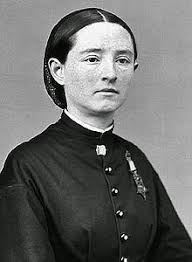
Frances Elizabeth Quinn: The Irish Girl Who Became a Union Soldier—Five Times


We all know the stories of many of the brave men who fought in the Civil War. We may even be familiar with stories of brave women who served during the war as nurses, but most of us, I would bet, aren’t familiar with a story of the story of the women who also fought. Few stories were as bold, persistent, or downright cinematic as that of Frances Elizabeth Quinn, an Irish immigrant who disguised herself as a man and enlisted in the Union Army at least five separate times. Her determination, grief, and grit made her one of the most compelling female soldiers of the era.

🇮🇪 From Ireland to Illinois: A Childhood Marked by Loss

Frances was born in Ireland and brought to the United States as a small child. Her family settled in La Moille, Illinois. Tragedy struck early—both of her parents died soon after arriving, she and her brother Thomas were separated and raised by different families, a painful fracture that shaped her future (https://en.wikipedia.org/wiki/Frances_Elizabeth_Quinn).

When Thomas ran away at fourteen to join the 52nd Illinois Infantry, Frances—only sixteen—refused to be left behind again.

🪖 A Soldier in Disguise

Frances cut her hair, donned men’s clothing, and enlisted under the name B. Frank Miller. This would be the first of many aliases.

Her enlistments included:

  • Indiana three‑month infantry unit (as B. Frank Miller)
  • 2nd Tennessee Volunteer Cavalry
  • 90th Illinois Infantry (“Irish Legion”)—twice
  • A cavalry division as a teamster
  • Later service under the name Frank Martin as an orderly to General Jeremiah Boyle(Wikipedia)(https://www.researchonline.net/ilcw/unit111.htm)

Each time she was discovered to be a woman, she was discharged—only to enlist again.

⚔️ Battlefield Service and Injury

Frances is said to have been injured twice during her service having fought in both the infantry and the calvary. She was wounded during the Battle of Stones River on December 31, 1862. There she was shot in the shoulder, and her sex was discovered yet again. Later she was wounded in the leg during an attempt to escape. (Wikipedia)

Her resilience was astonishing. Even after injury, humiliation, and repeated dismissals, she kept returning to the fight.

💔 A Sister’s Grief Becomes a Soldier’s Resolve

In April 1863, Frances learned that her beloved brother Thomas had been killed at Shiloh.
This loss devastated her—but it also fueled her determination to rejoin the Union cause.

Under the name Frank Martin, she became an orderly and scout, impressing officers with her courage and effectiveness. She even helped bring Confederate prisoners into Union lines (Wikipedia).

🎭 A Life of Aliases and Reinvention

Frances used multiple identities throughout the war:

Her ability to reinvent herself was both a survival strategy and a testament to her fierce independence.

🌟 Why Her Story Matters

Frances Elizabeth Quinn represents:

  • Women who defied gender norms long before they had legal rights to do so
  • Irish immigrant contributions to the Union cause
  • The emotional power of family bonds in wartime
  • The hidden history of female soldiers, many of whom remain unnamed

Her story is a reminder that the Civil War was not fought only by the men whose names fill the textbooks—but also by determined, courageous women who refused to stay on the sidelines.

This is the first of several posts I plan to write about females in battle.

Have a great week!


Improving Foster Care: Challenges and Solutions

In the United States today, there are approximately 400,000 children in the foster care system. The average age of a foster child is eight years old. More than half are under the age of ten, and 27% are teens. The system which relies heavily on volunteer families is often misunderstood and suffers from a bad reputation. As of 2023, there were fewer than 200,000 licensed foster homes in the US, a decline from over 220,000 in 2019, with the number continuing to drop each year. As someone who has firsthand knowledge of the system, having lived in foster care for the first 5 years and four months of my life, I can attest to the pros and cons of the system. I can also attest to my experience with some of the children who aged out of the system when I was teaching at my local university. It was the first time I had encountered anyone in that situation, and I made it my goal to mentor these young ladies.
The system, obviously, was quite different when I was in foster care. I was in the system in the late 60s and early 70s. That system was secretive and was not geared for the benefit of the child. At no time did I ever feel loved, acknowledged in my feelings, or did I understand my situation. I was treated more as a commodity than a child. In those five years and four months, I was in four homes. The last home was my longest and the one that I still somewhat recall. I cannot see faces anymore, but I can recall certain situations. Some I wish I didn’t.
There were two foster children in this home. My younger foster brother, Wesley, had some issues with his legs and wore braces. I recall going with him when his braces had to be adjusted, or he had to get new shoes. I believe he was born with curved legs and that they were being straightened out. Believe me, the braces did not slow him down any and it did not keep him from doing the things he wanted to do. Then there were three natural children—a son and two daughters. I will tell you that Wesley and I did not understand that we were not their children or that he and I were not brother and sister. DFACS did a terrible job of explaining these situations to us, if they ever tried. I don’t recall ever being told that we were not actual siblings.
Our clothes and toys (although we only had 1 or 2) came from Goodwill. We never had anything new. We had never been taken out of the home to a store to go shopping for toys or food. We were always at home, except to go to the doctor or once to go on a trip. When our adoption came, the day before we were made to pack up our things. When we asked to take a book, we were told that we could not because those things did not belong to us. We both went to our new families with the clothes on our backs and nothing else. Today, foster children are fortunate enough to have suitcases to take their belongings with them and to have foster parents who don’t confiscate their belongings at the door.
We also ate differently than the rest of the family. We were always fed at different times from everyone else. I suppose that, perhaps, they had food stamps for us and only those foods were fed to us. I recall a breakfast one morning. We had oatmeal and a small cup of Kool-Aid. Mine was cherry. Wesley accidentally knocked my Kool-Aid over into my oatmeal. I was forced to eat it anyway. There were no treats except for birthdays. We did get our favorite cake, but we had no friends and there were no parties. There was no Christmas for us. No presents. No Santa Claus.I knew nothing of these until I was adopted. You wouldn’t have known any of this if you listened to DFACs, though. According to them and their “Non-identifying Information Sheet of Lies”, I had lots of toys, and I loved to go grocery shopping. If I did, why did I weigh 31 pounds as a 5-year old?
Today, I doubt foster families would get away with this. A 5-year-old would be in kindergarten and, if the child weighed 31 pounds, someone would be answering a ton of questions as to why. However, an issue that continues from my time until now is that trauma, no matter when and how experienced, separation from birth parents, inadequacies of health care often lead to behavioral, mental, and physical health issues. In the late 1960s, some states began to pay subsidies for hard-to-place children who had these types of issues. Today, parents of children adopted or fostered with ADHD, OCD, GAD, and other mental health disorders receive monthly stipends to offset the costs of treating these disorders.
It is estimated that anywhere from 30 to 80% of foster youth have at least one chronic medical condition, and roughly 25% have three or more chronic illnesses. Obviously, these children deserve foster parents who are able and willing to provide, not only the time needed to obtain the treatment these children require, but the emotional support and the true care and concern as well. Caring for a child with a terminal illness requires an even more special type of foster situation. For these children, their chronic conditions are not only more likely to be pervasive than among their peers but also more likely to cause serious health consequences.  According to ChildrensRights.com, 77% of foster children experience more eating disorders than their peers. Bulimia occurs seven times more often among foster children than it does among the general population, and it tends to require intervention more often. (https://www.childrensrights.org/news-voices/for-children-in-foster-care-chronic-illness-takes-a-heavy-toll)
My experience when I was in care was that we were only taken to the doctor for our shots once a year. I only recall going to the doctor one other time and that was for a horrific headache, which I did not realize at the time was a migraine. I was not a particularly healthy child so it is surprising that I would not have needed to go to the doctor more often, but I know that I only went once a year. Wesley went to change his braces and to get new shoes and to get his shots. They had to do those things because he was growing. DFACS would know if the braces or shoes were too small, and they would get into trouble. They did as little for us as they could get away with. Interestingly, in Alabama where I lived, foster parents were paid $30 per month for standard foster care in 1973 (the year we were adopted). So that means that our foster parents made $60.00 for us. Today, they are paid $543; thus, they would make $1086 today for two children of similar age. That is a 27.6% increase which is quite small for the time period. That’s 52 years. You’d think they would’ve given a bigger increase given inflation over that length of time.
When we talk about mental health and trauma, we must talk about trauma that comes from anywhere. It could come from the home with the biological family that caused the separation and placement into the system, it could be abuse in the foster home, it could be simply the separation itself. Even a child placed at birth and who grows up in foster care like me will experience the trauma of separation. Ignoring this or belittling this fact only hurts the child more. Every adoptee experiences trauma, even those who are adopted at birth. No matter when a person realizes that their biological parent is not the parent who has raised them, it is going to create an identity crisis, and this crisis is traumatic. Working through the trauma takes time and therapy for everyone. How each goes about it will be different, but each will have to do it. Failing to seek healing through therapy or blocking the trauma can have dramatic results, if not deadly. “McCauley Evans describes three reasons for the disproportionately high percentage of adoptee suicides: 1) Adoption—or more precisely the separation from one’s mother—is a trauma. 2) Adoptees lack a complete, accurate, and up-to-date medical history, which may include depression or even suicide. 3) Adoptees don’t want to upset their adoptive parents with concerns about depression or anything that could be seen as ingratitude, including normal, healthy curiosity about their roots” (Riben, M. (2015). Toward Preventing Adoption-Related Suicide. Huffington Post).
When it comes to foster children, NIH found in a study of 515 foster children, that 26.4% of preadolescent children who had experienced abuse and who had entered foster care in the previous year had a history of attempting suicide and 4.1% were at imminent risk of attempting suicide. In this study, NIH further found that “children at higher risk of suicidality tended to be younger, non-Hispanic, abused, and to have experienced multiple types of maltreatment, more referrals to child welfare, more household transitions, and a longer length of time in foster care and that physical abuse and chronicity of maltreatment were the most robust predictors of suicidality.” https://pmc.ncbi.nlm.nih.gov/articles/PMC4319651/
Here's my point, if we wish for adoption and the foster care system to be our substitution for abortion, then we have to overhaul both. We have to stop treating children like a commodity. Children should never be sold! Foster and adoptive parents should be the most highly scrutinized people on the planet. There are too many pedophiles beating the system and they do it by circumventing the system and going outside the normal legal avenues. One way of doing this is rehoming. Adoptive parents who decide their adoption did not work out how they wanted; so, they go to the personal ads and list the child for sale. They find someone willing to take the child…just pay me for our expenses; they go to an attorney; and it’s all done outside of the normal channels with no vetting of the new parents. This process should be illegal, but it isn’t.
There also needs to be more regulation of private adoption agencies for these same reasons. We have to make sure that adoptive parents are being vetted properly and thoroughly, and the same for foster parents. We cannot allow ourselves to become so desperate that we take anyone. When we do this, our children get abused.
And then we need superior healthcare for our foster children, especially mental healthcare. We need to encourage them to seek counseling, group therapy, and mentors from former fosters and adoptees who have been successful. We need to turn this system around so that women can feel good about placing their children into the system and not worry that their children are going to be hurt or left. We need to encourage people to adopt. There is nothing wrong with our foster children. Bless their hearts they don’t deserve the reputation foster care gets. They are beautiful, God made children who deserve to be loved and cared for. God has a purpose for their lives, and He may just very well bless you and your family for bringing a foster child into your home. Remember Moses? He was the first foster child. God had a pretty amazing purpose for him, didn’t He?

In closing out this blog post, I would ask that you pray for our foster children. Pray for them to have safety in their homes, to have love that's true, to find good friends who they can depend on, and for permanent families. Pray that dangers like these below be taken away and that they be protected. Our children should not have to fear their homes.

1. Alarming Prevalence of Abuse – Children in foster care are significantly more likely to experience abuse, with up to 40% facing some form of maltreatment.
2. Common Types of Abuse – Neglect is the most frequent form (53%), followed by physical abuse (16%) and sexual abuse (4.4%), with residential facilities reporting higher abuse rates.
3. Declining Foster Care Population – The number of children in foster care has decreased by 6% in recent years due to preventive measures and family preservation efforts.
4. High Vulnerability Factors – Parental substance abuse, young age, and severe mental health challenges contribute to the heightened risks faced by foster children. (https://powertosoar.org/abuse-in-foster-care-statistics/)

Children are our hope for tomorrow. We cannot be selective. We must cherish them all; support them all; love them all. "The Lord watches over the foreigner and sustains the fatherless and the widow, but he frustrates the ways of the wicked." Psalms 146:9 NIV

God Bless You,

The Power of a Biblical Woman: Trust and Independence

For many people what I am going to blog about today will be considered highly controversial. There was a time in my life when I would have believed this to be so. When I was younger and before I became the mature Christian woman that I now am, I would have become angry and, perhaps, confrontational with someone of my age who spoke to me on this idea. I get it now, so I thought that I would write about now and put it into terms that the younger me would have understood better and might have considered before completely dismissing it.

I was not raised in a home to be this type of woman—a submissive woman. I was raised in the church to be a Christian, but in the churches that my family attended, I do not recall ever studying about the Biblical woman or the Biblical wife. Because of being adopted at the age of five, I already had an immense sense of independence. I did not like being told how to act or how to think by anyone other than my parents, and even with them I was skeptical.

My first five years was not a pleasant time. I did not trust people to have my interest in mind. It took me a considerable amount of time to trust my adoptive parents. I trusted my father first. He was easier because of his outgoing and loving personality. He spent time with me, reading to me, playing games, and riding bikes. My mother took more time. She was the disciplinarian and was not as affectionate. I was an adult before I realized that she was that way because she came from people who were that way, even though my grandparents were amazing people who I adored. But as is with many mothers and daughters, we butted heads a lot. My mother did not spend as much time with me doing things with me, so I did not feel a connection to her. She was always cleaning, cooking, or doing something that seemed to be more important than me (at least it seemed to me in my child mind).

My mother was fiercely independent. She did what she wanted when she wanted and how she wanted. Now that doesn’t mean that she took advantage of my dad because she didn’t really. He got upset with her when she spent too much money. Boy, when they fought over money, it was bad. They fought like a foxes in a hen house.  Where that became a problem for me was when they would bring me into their arguments. That has a way of destroying a child’s trust in their parents. Children should be able to confide in their parents and not have their words used against them or against one parent or the other. It shows immaturity in the parents. Other than this, though, my parents had a nice, respectful relationship; though, I rarely saw them be affectionate with one another.

Although it took me time to trust my mother, I came to admire her for her independence, intelligence, and tenacity. My mother went to work full time when I was in junior high school, working as the manager of a retail store. Before that time, she had always worked part-time when my father needed her in his store during inventory, moonlight madness sales and other times when he needed her and she worked for a brief period of time at our church. I watched her open that store on day one and make it successful. She knew how to design the displays and arrange the merchandise to be pleasing and fit everything in the space. She understood the mathematics and accounting, the technology, the Human Resources, the customer service needs, the shipping and receiving requirements, and then she would come home and cook dinner for us. I was astounded and awed by her. I wanted to be just like her. (But not in retail!)

My father was a staunch supporter of a college education. He graduated from the University of Virginia with a degree in economics. Both of his sisters had college degrees and were teachers. When I was about eleven, he began going to the public library and checking out books on various careers and bringing them home to me. At first I was not so keen on this. I wasn’t against it because I didn’t want to have to read the books, but because of the careers he kept bringing home—teachers, nurses, secretary. They were all careers that were generally thought of as “girl” jobs. At the time I was all about Nancy Drew. I wanted to be Nancy Drew and I was not interested in hearing about nurses and teachers. He would frequently say to me, “Deanne, no daughter of mine is going to have to depend on a man to take care of her. You need to be able to take care yourself because you never know what could happen.” I did not understand why he would say that at the time. Of course, I do now after having gone through a divorce, but also because I have had several friends who have lost husbands to unexpected deaths. He was right to prepare me for this, but he also should have prepared me to be a Biblical wife.

When I went to college, I was determined that I was going into International Business. I wanted to be a diplomat. I was going to major in Business with a minor in French and then I was going to graduate school of some kind. It was great until I took my first accounting class. I hated it. I couldn’t imagine a more boring class in my life. Then I took economics. It was worse. I had the most horrid professor. I was lucky to get out the class with a D. I had never made a D in my life. That same semester I had Calculus for business majors. I was not strong in math. At mid-term I went to my dad and told him that I was not doing great and that I was concerned about my grade. On the day of the final, I started the exam and looked it over. I couldn’t do it and I started crying. The prof came over and rubbed my back. She told me the find the first one I knew how to do. She said, “others will start to come back to you. Just keep doing the ones you know. The rest will come back to you.” She was right. I finished the course with a C. It was the worst semester of my whole college career. So, I had to sit down with myself and regroup. I changed my major from Business to Political Science. I still had the same goal, just a different way to get there.

It wasn’t long after this that I reconnected with the young man who would become my husband. I only wish that we had been better prepared for marriage. If we had, maybe we might not have done it, or maybe we might have done better and not made the mistakes we made and not have destroyed our relationship. At any rate, it did not last because neither of he was an abusive alcoholic and I made the choice to raise our child away from that environment.

When we married, we believed that the key to a good relationship was to make everything 50/50. That sounds good, right? That means both of you put in your opinion 50/50. However, this is not the way God established marriage to be. Although God took the rib from Adam’s side, God did not make Eve to at the side of Adam; he established Eve to under the protection of Adam in the same way the church is under the authority of Christ. “Wives submit yourselves to your own husbands as you do to the Lord. For the husband is the head of the wife as Christ is the head of church, his body, of which he is the Savior. Now as the church submits to Christ, so also wives should submit to their husbands in everything.” (Ephesians 5:22-24 NIV) This doesn’t mean that men can dismiss the opinions of their wives, or that they get to abuse their wives; this not what it means to submit. The word “submission” is a misunderstood word and often abused word by feminists as a means to harass men. The following verses on Ephesians men are instructed to love their wives as Christ loves his church and as he loves himself. If a man loves himself, then that means he’s not going to yell at himself; he’s not going to slap himself around; and he’s not going to bully himself. This not what it means to be a Biblical husband.

In my second marriage, I have a traditional, Biblical marriage. I submit to my husband. What does this mean? All it really means is that if he wants me to do something, I generally do it unless there is some good reason for me not to and then I am going to explain that to him and he is going to consider whether I should or shouldn’t do it. Upon that consideration of my reasoning, he decides and I proceed accordingly. Because I love and respect him, I will do as he says. Someone who might not understand submission might ask, “But what if your reasoning was sound? Why should you do as he says?” To them I would respond, “A family cannot have 2 bosses. He is our ultimate boss in the same way a business has one manager. I am the assistant manager. The manager says ‘no, I need you to do it this way, then you’re going to do it how the manager says.’ It’s no different. Ultimately, if the decision doesn’t work out, then he’s responsible. He takes that on as the head of the family. That is how God intended it to be.” For me, this second time around, I have so much less stress. I’m not constantly worried about situations and I know I can trust him. I have absolutely no reason not to trust my husband to make the right decisions for our family.

There’s also the Proverbs 31 element of being a Biblical woman which many “modern” women protest, but it is a misunderstood chapter. It was written by the mother of King Lemuel. The first 9 verses are said to be advice she gave him about how to rule as a just king.  It is the rest of the chapter that gives many women heartburn because so often it is presented as a list of qualities of Biblical womanhood. However, this part of the chapter wasn’t written for women; it was written to the king and to men. The purpose is to underscore the preeminent nature of man’s responsibility to act wisely in establishing a foundation for women of noble character to arise—man empowers woman to become the person that the Lord designed her to be. If we only see Proverbs 31 as a list of characteristics or actions, then it is a list of works by which we cannot be saved, which would be a false gospel. (See https://saltandlight.sg/devotional/hear-the-sober-truth-proverbs-31-was-not-written-to-women-it-was-written-to-a-man/)

I have to agree that when men love their wives, love the Lord, and live as the Lord has willed them to live, it makes it so much easier for everyone else around them to do the same. That does not mean that life is perfect. We still live in a fallen world and there will be times when things go wrong. There will be disagreements, but when the Lord is at the center of everything you do, you do not have to worry about the types of behaviors you see on the evening news. I would never want to go back to the kind of marriage I had the first time. You cannot have two bosses; someone has to make the final decision. There has to be trust between both partners.

There’s nothing wrong with a division of labor. Each one doing what they are good at and that does not necessarily mean girl things and boy things. If the husband likes to cook, let him cook. If the wife likes yard work, let her do the yard work. Those do not have to be areas of contention, but they have to be agreed upon. However in regard to child rearing, most often mothers are best equipped for this task because God created us for it. Everything about women was created for the purpose of birthing and raising children. There may be some exceptions, but those are rare. Some women fail to understand what this power really is. I recall a time in graduate school when I was in a course called Peace Paradigms. We were given an assignment to do a project on a life altering time in our life. Of course mine was my adoption. I remember some of the projects were really crazy, but one that stood out what a girl who talked about how women were oppressed by being forced to be wives and mothers and forced to do cook and clean for the husbands and children (and I didn’t know how that related to her and any change in her life), I just put my face in hands and rolled my eyes. In my opinion, women can potentially have more power than men if they recognize that potential and take steps to use it. Let me explain, because we have children in our care for approximately eighteen years, we have direct influence over their worldview, beliefs, and behavior for those years. Of course, you want that influence to be positive and uplifting and not that of a cult leader, but a mother, with the right tools, love, and passion can influence a child to become the next president, a surgeon, a missionary, or whatever she believes her child is capable of being and that is exceptionally powerful. I think of mothers like Sonya Carson who raised son Ben to become one of the preeminent neurosurgeons of our time. She could not read, but she made Ben write essays on books he read from the library each week. She is one of millions of mothers who worked hard to provide for her family and to make sure that her children succeeded in school so that they wouldn’t have to worry about their future like she did.

Finally, once I heard a minister say that, in a marriage, if you can prioritize each other as WE, YOU, THOU, you can head off many conflicts—first, think of how the situation affects you as a family; then, how does it affect the others; and last, how does it affect you. I have always thought those were wise words and I think of them often.

Website Built with WordPress.com.

Up ↑