
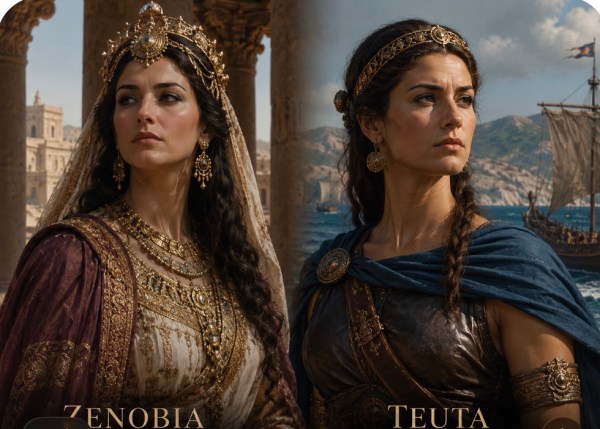
You may wonder why I chose to write about “bad girls”. I think most of us understand that we each have a dichotomous nature and that, often times, we are guided by one side more than the other. Some of us can balance the two; but, others have more difficulty. I have experienced that difficulty myself. I can sometimes be more headstrong and independent than I should be. I have learned over the years when those traits are more positive than negative. Other times it has been my greatest failure. It is my intention to relate women who are little known to us, but who made an impact on our world, whether good or bad. I will leave that interpretation and judgment to the reader.
The first woman is Teuta who lived in 3rd Century BC in the Eastern Roman Empire. Teuta was the queen regent of the Ardiaei tribe in Illyra, which includes parts of the Western Balkans including Albania, Montenegro, and the southeastern coast of the Adriatic Sea. She ruled the tribe from 231 to approximately 228-227 BCE.
Teuta assumed control of the monarchy on behalf of her young step-son, Pinnes, after the death of her husband King Agron. She is best known for her defiance against Rome which demanded she stop attacking Roman shipping and the murder of a Roman envoy. Teuta was a pirate known for intercepting Roman ships and stealing their wares for the support of her people. Her tribe along with other Illyrian tribes were known as warriors and pirates. Their economy, which struggled, was based on agriculture, mining, and commerce, primarily with Greek colonies.
Teuta utilized their navy to control the Adriatic trade routes and to capture coastal cities like Phoenice. Teuta’s fierce advocacy for her people led to conflict with the greater Roman Empire eventually leading to the First Illyrian-Roman war in 229-228 BCE. Teuta lost the war and was forced to surrender and cede territory. She is an enduring heroine in Albanian culture because they consider her a protector of their traditional ways of life.
Another such bad girl was Zenobia, a warrior during the 3rd Century AD in Syria. Like Teuta, Zenobia obtained power by becoming the regent to her oldest son, Vaballathus. She ruled from 267 to 272 AD. In 270 AD Zenobia launched an invasion of the Roman Empire that increased her kingdom. By the mid part of 271, her realm from Ancyra, central Anatolia, to Upper Egypt. She declared her son emperor and she claimed the title of empress which essentially declared the independence of Palmyra (modern day Syria).
Both of these women placed the security and well-being of their kingdoms above allegiance to the Roman Empire. They were willing to fight personally for their people when they could have passed the problems on to others. Moreover, both women had the benefit of ruling on behalf of their sons. Neither would be known had they not been widowed young and been placed in the position of needing a regent for their young children. Their personalities and characters were just what their kingdoms needed at the time they needed it. They were independent, courageous, physically and mentally strong, and faithful; though their adversaries considered them as criminal, treasonous harlots.
The historical significance of these two women should not be ignored. For the time periods in which they reigned women were considered property in most situations. Women were never consulted on their opinions much less their ideas on how to secure and improve the lives of their people. Women during antiquity were usually nothing more than objects to be admired, wives to secure the positions of their husbands, and property to be controlled. They lived among other leaders like Hannibal, Spartacus, and Julius Caesar. The courageousness of these women should be shared with our daughters so that they understand how women have been influential in their world, especially in antiquity which their history books will never include.
Have a great week!

For more information on Teuta and Zenobia:
https://www.ancient-origins.net/history-famous-people/fierce-queen-illyrians-teuta-untameable-003126
Of course there’s always Wikipedia and YouTube!



You must be logged in to post a comment.