
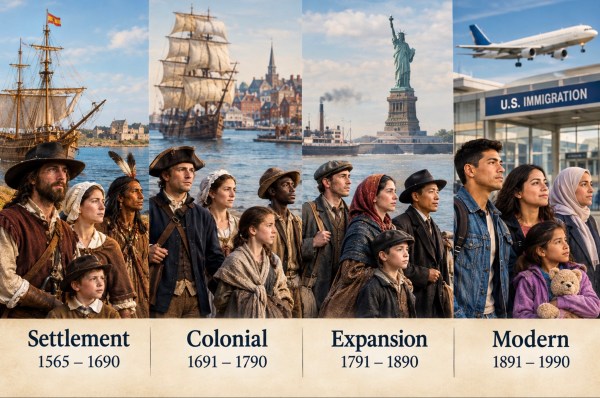
I want to now look more closely at each time period. We will look at a comparison of the nations who sent colonists first—France, Spain, and England. We will consider the various settlements and we will consider what the owners of the companies who sent settlers knew about the “New” World. This is particularly interesting because I think many have simply believed that people got on a boat and had no idea what they were heading into. That isn’t quite right. I will explain.
These were not blind expeditions into an entirely unknown wilderness. Prior to the foundations of the permanent colonies, European nations had accumulated much information about the Atlantic and Pacific coastlines. Here are the dates of the explorations:
1513 — Ponce de León → Florida
1528 — Narváez → Florida/Gulf Coast
1539 — De Soto → Southeast
1540 — Coronado → Southwest/Great Plains
1559 — Tristán de Luna → Pensacola
1562 — Ribault → Florida/South Carolina
1564 — Laudonnière → Fort Caroline
1565 — Menéndez → St. Augustine
1584–1587 — Roanoke
1607 — Jamestown
1620 — Plymouth
And there’s an especially interesting distinction here: exploration and colonization weren’t the same thing. Ponce de León, De Soto, Narváez and Coronado were primarily conducting expeditions—some for exploration, some for conquest, wealth, territorial claims, or finding settlements. St. Augustine, Roanoke, Jamestown and Plymouth represent the next step: attempting to establish communities that would remain. In fact, St. Augustine was founded in 1565—42 years before Jamestown and 55 years before Plymouth.
I think this makes for a fascinating transition: the people who eventually would become “settlers” weren’t arriving in an unexplored land. European explorers had been mapping, describing, claiming, fighting over, and attempting to colonize portions of North America for more than half a century before Jamestown.
Another important fact to remember is that often the information passed on to the monarchies involved was either flawed, wrong, or was slanted to encourage more investment from the corporations behind the settlements and/or expeditions.
Exploration Period: 1514-1620 Who Were They & Where Did They Explore
The term “immigrant” isn’t truly appropriate for this time period because the people who would ultimately arrive in North America were chosen by a monarch, colonial governor/proprietor, religious organization, etc. No one showed up at the castle and asked to be sent and there was no application process.
These monarchies or corporate leaders had a specific objective for the settlement.
- establish a military foothold
- claim territory for the crown
- compete with another European power
- establish a trading post
- find valuable resources
- establish an agricultural colony
- spread Christianity
- Create a permanent settlement
- Provide an outlet for particular religious communities
Let’s consider the major explorations during this time period and what discoveries those produced. I don’t think most of us would remember, nor would have been able to place these on a timeline. I don’t recall being taught the explorers in a timeline, but rather by who they were and what they explored.
The earliest exploration has been highly disputed despite the fact that we named the North American Continent after him. Amerigo Vespucci’s explorations of Central and South America are more documented and, thus, considered more accurate than this travels to North America. For this reason, we won’t look at those.
The first firmly documented exploration happened in 1513 by Juan Ponce de Leon. He landed in Florida and explored the Panhandle. Eight years he returned with a colonizing expedition, but that failed because of conflict with the native population. In 1528, Pánfilo de Narváez, also from Spain landed near Tampa Bay, but the mission fell apart. Then in 1536, Álvar Núñez Cabeza de Vaca would set out again for Florida. There were three additional explorers from Spain who would follow Cabeza de Vaca and they would all spend about eight years exploring the Southern U.S. before reaching New Spain.
New Spain was the enormous Spanish colonial territory that included Mexico, California; much of the present-day southwestern United States; Florida; and other territories at various times. California was incorporated into the Spanish colonial world much later than the initial conquest of Mexico. Let’s take a look at the dates of the explorations that led to New Spain:
1521 — Spain conquers the Aztec Empire and establishes the core of New Spain in Mexico.
1530s–1540s — Spanish exploration moves north. Those include expeditions by explorers Nuño de Guzmán, Hernán Cortés, Francisco de Ulloa, and Juan Rodríguez Cabrillo who explored the Pacific coast and Gulf of California.
1542 — Juan Rodríguez Cabrillo explores the Pacific coast of present-day California for Spain.
1579 — Sir Francis Drake, an English expedition, reached the Pacific coast, probably somewhere in present-day California or Oregon, though the exact landing site remains debated.
At about the same time (1539-1543) Hernando de Soto was exploring the U.S. Southeast, including Florida, Georgia, the Carolinas, Alabama, Mississippi, Arkansas, Louisiana, and possibly Texas. It was one of the most extensive explorations into the southeastern interior. De Soto’s exploration reached the Mississippi River in 1541.
From 1540 to 1542, Francisco Vasquez de Coronado explored the Southwest and Great Plains while searching for the legendary Seven Cities of Cibola and other rumors of great fortunes. Garcia López de Cárdenas explored Arizona and discovered the Grand Canyon. Between 1540 and 1565, there were four more explorations of the Southeastern U.S. Spanish exploration essentially ended in 1565 with the establishment of a permanent settlement of St. Augustine. Founded by Pedro Menédez de Avilés in 1565, St. Augustine was the first permanent settlement.
France began exploration in 1562 with the explorer Jean Ribault. He scouted out the Atlantic Coast of Florida, Georgia, and South Carolina, establishing Charlesfort in South Carolina. Of course, this would later become Charlestown and finally Charleston. In 1564, René de Laudonnière also explored Florida and established the a settlement known as Fort Caroline in what is now Jacksonville.
It’s important to know that there was a war between Fort Caroline and St. Augustine in 1565 which began prior to the establishment of St. Augustine. Obviously, the French did not want a Spanish settlement so close to them. Fort Caroline was associated with French Huguenots (Protestants), although not everyone there was necessarily Protestant. France wanted a foothold in North America for strategic and commercial reasons, while the Huguenots also saw Florida as a place where they could establish a community outside Catholic France.
Spain already regarded Florida as part of its claimed territory. More importantly, Florida’s Atlantic coast was strategically important because Spanish ships carrying wealth from the Caribbean and Mexico passed through the Florida Straits and along the coast on their way back to Spain. A French fort nearby could potentially threaten that traffic.
The two expeditionists would face off in May 1565. Menéndez arrived in Florida in August with roughly 800 people. When the Spanish encountered the French near the St. Johns River, neither side immediately fought a decisive battle. Menéndez eventually sailed south and established St. Augustine on September 8, 1565, approximately 35–40 miles south of Fort Caroline, but this was not an end to the war.
Ribault decided that the French needed to eliminate the Spanish settlement before it could become established. On September 10, he took approximately 600 men aboard his ships and sailed south toward St. Augustine. He left a much smaller force behind to defend Fort Caroline.
Then nature changed everything. A powerful hurricane struck the Florida coast. Ribault’s fleet was scattered and many of the ships were wrecked far south of St. Augustine. The French soldiers who survived were stranded along the coast. Menéndez became aware that Fort Caroline was poorly defended. They easily captured Fort Caroline.
On September 20, 1565, Menéndez marched approximately 400–500 Spanish troops overland from the St. Augustine area toward Fort Caroline. They attacked the fort while most of its able-bodied defenders were absent with Ribault. Fort Caroline fell. Most of the French defenders were killed; some inhabitants escaped, including René de Laudonnière.
The next important explorations involved the coast of North Carolina. Three English explorers would do reconnaissance on the North Carolina coast. Philip Amadas and Arthur Barlowe began their expedition in 1584 on behalf of Sir Walter Raleigh. They reported back to Raleigh about the Outer Banks, the region, and its inhabitants. Trading with the Native Americans began right away. Amadas and Barlow would take 2 Natives back to England with them. They were Manteo and Wanchese. They would have the men speak to the Raleigh and others about the prospect of a permanent settlement. Unfortunately, they were overly optimistic which created false expectations. Amadas and Barlowe were followed by Ralph Lane who would establish a settlement called Roanoke. This settlement was to be an exploratory and military colony, but problems persisted with resources that only England could provide. The first settlement failed.
In 1587, a second attempt was made by John White. This time the settlement included families. The group that arrived on Roanoke was larger than the first. Raleigh sent seven ships with 600 people. It was still considered a military/expeditionary colony. The goals of the settlement included occupying the territory, seeking precious metals and stones, and establishing a base from which English Privateers (and pirates) could attack Spanish shipping. This is a story most of us know…The Lost Colony. There has been much investigation of Roanoke in the past few years. You can find some wonderful videos on YouTube about what they have discovered about what happened the settlers after White left for England to obtain more provisions.
Another attempt by England was not made until 1607. The Virginia Company would arrive on the James River. The Jamestown settlement was established. It was comprised of 104 men and boys. There were 40 soldiers, 35 gentlemen, artisans, and laborers. The settlement did not yet allow women because they believed it would be better to have a solidly established settlement prior to bringing women. It was also because they wanted this group of men to explore further to locate a safe harbor, find a navigable river, choose defensible ground, find fertile land, investigate resources, establish/maintain relationship with natives, and even to continue looking for a route to the Pacific Ocean. Obviously, they thought the area was much smaller than it is.
Another misconception concerns the Natives. Most, I think, probably thought that the English showed up to be surprised by the Natives, but that is not the case. They already knew that they were there. The Virginia Company had explicit instructions about the Indigenous peoples. The Roanoke Colony, as we know, had a relationship with Algonquian-speaking communities. The Jamestown colonists immediately encountered the Powhatans. What these settlers did not fully understand was the size of these groups and their political systems; their territorial boundaries; alliances between tribes; seasonal movements; agricultural methods; as well as their war fighting abilities.
After almost a large number of colonists died in the first winter, a second group was sent. This group included women. This made the Jamestown Settlement successful. HINT: men stink on their own! LOL
The last group of explorers searched out the Northeastern U.S. and parts of Canada. From 1609-1610 Samuel de Champlain, a Frenchman, explored the northeastern interior and strengthened French claims and knowledge of the area. This was followed by Dutch explorers beginning in 1614 who scouted the Hudson River and New Amsterdam (New York City). The area of settlement became known as New Netherland. Trading was a primary goal of this settlement.
In 1620 the English sent the Mayflower to the area of Massachusetts where they would establish the Plymouth Colony. This followed extensive reconnaissance of the coastline prior to the Mayflower’s departure from England. Unlike the Jamestown settlers, the Plymouth colonists did not land knowing about the area in which they would live. This was because they landed in the area of Cape Cod. The National Park Service says that there were three separate expeditions of the surrounding area prior to establishing a settlement. They knew that they needed to secure an area that had fresh water, food, a suitable settlement location that would provide security.
The families who came on the Mayflower were unlike those in St. Augustine, Roanoke, and Jamestown. These colonists were comprised of what they termed “Saints”— members of a Separatist congregation from Leiden (you know them as Pilgrims)— and “Strangers”— individuals seeking economic opportunity, English families, and people brought along because of their skills as artisans, craftsmen, and other skills needed in the colony. The total passengers were 102.
The earliest European “immigrants” were not just people moving from one place to another. They were carefully assembled populations of soldiers, farmers, craftsmen, religious groups, merchants, and adventurers chosen by governments and companies for specific purposes. These men, and later the colony’s leadership, would continue to decide who would come as they populated colonies rather than single settlements. You will see how this changes in the next post.
I realize this has been a long post, but I think it is important to consider these various periods of immigration. You will notice that I did not yet discuss the North Atlantic Slave Trade which began in 1620. I plan to address that in a separate post so that I can handle it alone from the rest of the time periods because it affects the coming time periods.
I hope that you have learned something you did not know or did not realize about the very earliest days of the U.S.A. I hope that you will subscribe to my site so that you can receive notification when the next post is posted, and that you will share it your friends.
Enjoy the rest of your week and your weekend.
God Bless!


You must be logged in to post a comment.