
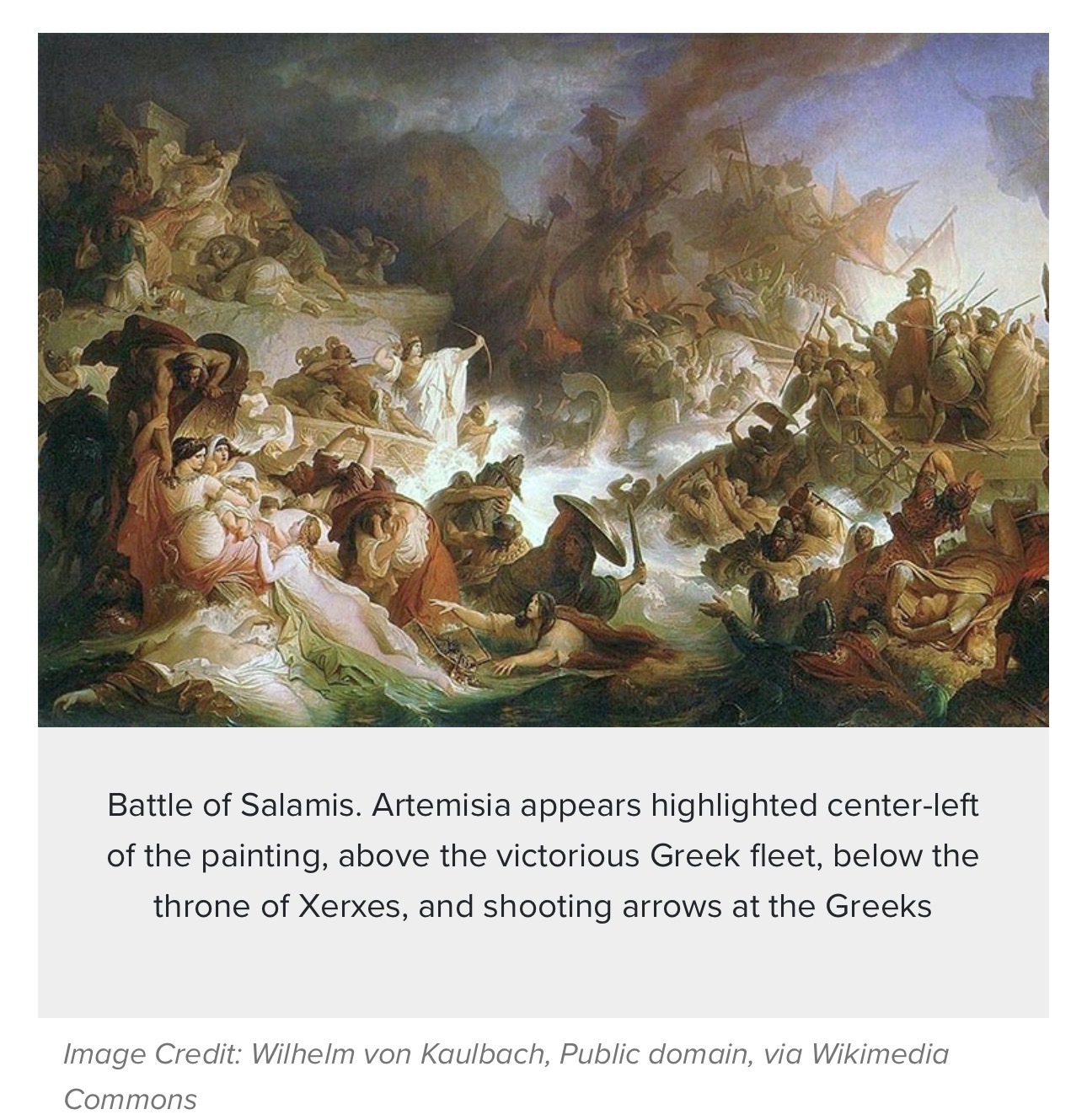
Unlike our previous warrior women, we’ll now go to the ancient world. In the annals of ancient history, few figures stand out quite like Artemisia I of Caria. A Greek queen ruling a Persian vassal state in the 5th century BCE, she personally led ships into battle against her fellow Greeks during the Second Persian Invasion of Greece. Herodotus, known as the “Father of History” and a fellow Halicarnassian, couldn’t help but marvel at her: a woman who joined Xerxes’ massive expedition not out of necessity, but driven by “high-hearted valour” and “manly courage.”
When most of us think of Ancient Greece and Rome, we would not think of a woman going into battle in our first thoughts. We know of strong ancient women like Cleopatra, but one who both ruled a region and fought isn’t what we normally think of. Most history classes aren’t going to focus on these women, choosing instead to focus on the majority…men. In fact, Alexander the Great’s sister, Cynane (358-323 BCE) was also a warrior, having fought along side her famous brother and she even masterminded an attack that would place her daughter on a throne by force.
Artemisia ruled Halicarnassus (modern-day Bodrum, Turkey) and the nearby islands of Cos, Nisyros, and Calydna. With a Halicarnassian father, Lygdamis, and Cretan mother, she was a blend of Greek and regional heritage. After her husband’s death, she assumed the tyranny (rule) herself, even though her son Pisindelis was of military age. She wasn’t forced to participate in Xerxes’ campaign—she chose to, contributing five ships to the Persian fleet. Those vessels were said to be the best in the entire navy after the elite Sidonian contingent, and her counsel to the king was considered the wisest among all his allies.
Courage Under Fire: The Battles of Artemisium and Salamis
Artemisia’s reputation as a naval commander was forged in the crucible of the Greco-Persian Wars. She took part in the Battle of Artemisium in 480 BCE, a series of naval clashes off the coast of Euboea that coincided with the famous stand at Thermopylae.
Her defining moment came later that year at the Battle of Salamis. Xerxes had captured Athens, but the Greek fleet, primarily Athenian and Spartan-led, had withdrawn to the narrow straits between the island of Salamis and the mainland. The Persian commanders overwhelmingly urged an immediate naval assault to finish the Greeks. Artemisia alone advised caution.
She urged Xerxes, via his advisors, to spare his ships and avoid battle at sea. Her reasoning was shrewd and prophetic: the Greeks were superior seafarers—“as men are to women” at sea, in her words. Xerxes had achieved his main objective by burning Athens; thus, the rest of Greece would likely submit without further risk. Fighting at this point could endanger the entire fleet. “If he succeeds [with land forces under Mardonius], the honor will be yours,” she added. “If he fails, it would be no great matter as you would be safe.”
Xerxes respected her but chose not to give weight to her opinion. The result was a decisive Greek victory that crippled the Persian navy and shifted the momentum of the war.
Even in defeat, Artemisia shone. According to Herodotus, when her ship was pursued by an Athenian vessel during the chaotic retreat, she rammed and sank a friendly Calyndian ship—either by accident or clever calculation. The Athenian pursuer, seeing her attack what he assumed was an enemy vessel (or mistaking her for a Greek defector), broke off the chase. Xerxes, according to witnesses, remarked that his men had become women and his women men, praising Artemisia’s gallantry while lamenting the performance of his other commanders. Some accounts suggest he even inquired whether she had sunk an enemy ship.
A Trusted Advisor and Strategic Mind
Artemisia wasn’t just a fighter; she was a voice of reason in Xerxes’ war council. After Salamis, she again counseled the king wisely on his next steps, reinforcing her image as one of his most reliable allies. Herodotus portrays her with genuine admiration, repeatedly highlighting her intelligence, bravery, and independence in a world dominated by male rulers and warriors.
This stands in stark contrast to typical ancient attitudes toward women in power. While many Greek sources viewed female rulers with suspicion or as aberrations, Herodotus treated Artemisia as a exemplification of courage. She was the only woman among Xerxes’ naval commanders, yet she earned his esteem through deeds rather than birthright alone.
Herodotus notes that the Athenians placed a bounty on her head because of the damage she inflicted, underscoring both the fear and respect that she inspired among her opponents.
Legacy: Beyond the Battlefield
After the Persian retreat from Greece, Artemisia largely fades from the historical record. We know she continued ruling Caria, and her lineage persisted in the region. A later Artemisia II of Caria (sister-wife of Mausolus in the 4th century BCE) would commission the Mausoleum at Halicarnassus—one of the Seven Wonders of the Ancient World—though the two should not be confused.
Artemisia I’s story survived primarily through Herodotus’ Histories, with mentions in later writers like Plutarch, Pausanias, and Polyaenus. She became a symbol of female agency and martial prowess in a male-dominated era.
In modern times, her legend has endured. She appears in historical fiction and was memorably (if dramatically) portrayed by Eva Green as a fierce antagonist in the 2014 film 300: Rise of an Empire. While Hollywood amplifies the action and romance, the core of her character—strategic brilliance, unflinching courage, and command of ships—echoes the ancient sources.
Why Artemisia Still Matters
Artemisia I of Caria challenges easy narratives about ancient gender roles, warfare, and loyalty. A Greek woman fighting for the Persian “invader” against other Greeks, she prioritized duty, strategy, and personal valor over ethnic solidarity. She proved that leadership isn’t defined by gender but by capability and resolve.
In an age when most women in power are remembered for intrigue or tragedy, Artemisia stands out for her competence on the deck of a trireme and in the war council. Herodotus marveled at her; Xerxes respected her; and history has preserved her as one of antiquity’s most remarkable warrior queens.
She reminds us that extraordinary individuals can rise above the expectations of their time, steering their own course through the storms of war and politics. In the narrow straits of Salamis, amid clashing fleets and shattered ambitions, Queen Artemisia of Halicarnassus sailed into legend—not as a footnote, but as a commander worthy of remembrance.
Further Reading:
• Herodotus, The Histories (especially Books 7–8).
• Modern accounts in Barry Strauss’ The Battle of Salamis or general histories of the Greco-Persian Wars.
Artemisia’s ships may have been outnumbered and ultimately defeated at Salamis, but her reputation sailed on, undefeated.
If you have any warrior queen bee that you’d like me to research and write about, please leave a comment. I’d be happy to consider her.
God bless!


Discover more from Author. Political Analyst. Family Historian
Subscribe to get the latest posts sent to your email.
 Author. Political Analyst. Family Historian
You must be logged in to post a comment.