
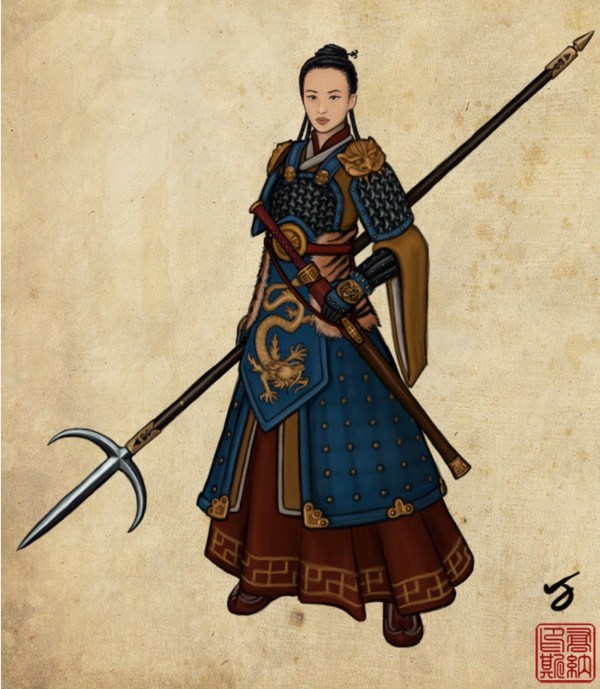
If you enjoyed the movie Mulan as much as I did, I bet you wondered if the story had any basis in fact. I wasn’t educated on the early military history of China, or Asia for that matter, in any depth. In researching female warriors for this series, I decided to research “Mulan” and find out if there were any epic warrior women. I greatly enjoyed the process. Here is what I discovered.
While Mulan is based upon the Chinese “Ballad of Mulan” which dates to the 5th or 6th Century, the character may be based upon three such warriors in Chinese history. Historians tend to agree that Mulan is a literary character, but they point to the following three women who parallel her legend as potential models for the ballad.
First is Fu Hao who was both a high priestess as a military general. She was one of the many wives of Wu Ding, king during the Shang Dynasty (cir. 13th Century). The entirety of Fu Hal’s life comes from the contents of her tomb, which was unearthed in 1976, rather than from written records. Archeologist Zheng Zhenxiang discovered more than 500 bone objects known as oracle bones. These bones are engraved with the story of the queen’s life. It might be interesting to note that King Wu Ding promoted cooperation with the neighboring tribes. To do so, he married a woman from each tribe. He had 64 wives! Although Chinese kings and emperors were strong, able men, at this time China had a semi-matriarchal society and profited from the slave trade. Fu Hao used both to her advantage.
Fu Hao owned her own land which contributed to her wealth. Oracle bones indicated that she offered the king valuable tributes during her life. The King often called upon Fu Hao to conduct rituals and to offer sacrifices to the ancestors. During this period of Chinese history two activities were of the utmost importance—religious rituals and battles. Fu Hao was engaged significantly in both.
Discovered in her tomb were many weapons and inscriptions on the oracle bones reflect Fu Hao’s role in military battles during the Shang Dynasty. In fact, Fu Hao was responsible for the defeat of the Tufang, a neighboring tribe that had been the enemy of the Shang for generations. Fu Hao defeated the Tufang in a single, decisive battle. The defeat of neighboring Yi, Qiang and Ba tribes would follow. She is described as having been responsible for conducting the largest ambush in Chinese history. She had command of over 13,000 soldiers. Generals Zhi and Hou Gao served under her. She was not the only female to serve in the military; the oracle bones revealed the records of over 600 who participated in the military during this time. The temple Mu Xin was dedicated to her posthumously.
Second is Princess Pingyang of the late 6th- early 7th Century CE. She was the only daughter of Emperor Gaozu of the Tang Dynasty and his wife Empress Taimu. The princess was instrumental in her father becoming emperor. During the fall of the Sui Dynasty while her husband and father were away fighting, Pingyang used her position and wealth to feeding the peasantry and to recruit rebel leaders. At the age of 28, she was successful in raising an army of almost 70,000 men which became known as the “Army of the Lady”. She used her army to capture key cities, to include the Sui Capital of Chang’an, in the Guanzhong region. Because of the contributions, the emperor gave her a military funeral complete with military band and named a strategic pass after her—the Niangzi Pass today was once the Lady’s Pass.
Last we have Qin Liangyu who lived from 1574 to 1648. Qin Liangyu is historically significant because she is the only woman to be officially recorded as a military commander in China’s Twenty-Four Histories. She was well educated in the classics as well as in military arts like archery and horseback riding. After the untimely death of her husband Ma Qiancheng, she took command of the elite White Cavalry. Utilizing warfare that prioritized ambushes and offensive stands in the narrow mountainous passes, she led her troops to victory over the invading forces of Manchu. She made use of her great knowledge of the rugged terrain to out maneuver the larger invading Manchu armies. Moreover, her soldiers incorporated long pikes, poisoned arrow volleys, and lightweight defensive gear to maintain speed and endurance. She also succeeded in putting out rebellions in the southwest and defending the capital of Beijing. For her achievements, Qin Liangyu earned the title “Marquis Zhongzhen”, a title given to her posthumously by the Southern Ming Dynasty. It is interesting to add that Qin Liangyu was quite tall for even women today. Her height has been estimated based upon preserved clothing to be approximately 6 foot 1 one inch. Additionally, she lived and fought into her 60s.
In closing up this series, there are other epic warrior women like Boudicca in 1st Century Britain, Joan of Arc in 15th Century France, and even a more modern Russian woman named Lyudmila Pavlichenko who fought during World War II. I wanted to focus on the lesser known of those ancient of warrior women. What I discovered during this research process was that women have always involved themselves in conflicts throughout history. While their numbers are far less dramatic than the millions of men who have fought over the centuries, these women are no less honorable, courageous, and skilled than those male counterparts, much like the women who serve in our military today. We must never diminish their contributions to our world and to history.
I am now contemplating what my next series will be. Stay tuned!





You must be logged in to post a comment.